A well-structured divorce questionnaire is one of the most important tools in a family law attorney's practice. It ensures that no critical detail is overlooked during intake and helps clients organize their thoughts before the first consultation. A comprehensive divorce intake form covers personal details, marriage history, finances, children, and settlement preferences — giving attorneys the foundation they need to build an effective case strategy.
By using a standardized questionnaire, attorneys can gather key information upfront rather than chasing details across multiple consultations. Clients also benefit: the process of completing a thorough questionnaire helps them think through finances, custody preferences, and priorities they may not have previously considered.
Below is a complete set of questions organized by category. Use this as a template for your own divorce intake form, or adapt individual sections to fit your practice.
Personal Information
Accurate personal details establish each party's identity and current circumstances. Errors here can delay filings, so this section forms the foundation of every case file.
Full Name and Contact Details
- What is your full legal name?
- Have you ever used any other names (maiden name, aliases)? If so, please list them.
- What is your current residential address?
- What is your preferred phone number?
- What is your email address?
- What is your date of birth?
- What is your place of birth?
- What is your Social Security number?
Employment and Education
- What is your current occupation?
- Who is your current employer?
- How long have you been with your current employer?
- What is your annual gross income?
- What is your highest level of education completed?
- Do you have any professional licenses or certifications?
- Have you had any significant career changes in the past five years?
Current Living Situation
- Are you currently living with your spouse?
- If not, when did you separate?
- Do you have any children living with you?
- If yes, how many and what are their ages?
- Do you own or rent your current residence?
- Are you financially supporting anyone other than yourself?
- Have you recently relocated due to the separation?
Marriage Details
Accurate information about the marriage itself is essential for establishing timelines, jurisdiction, and legal standing.
Date and Place of Marriage
- When did you get married? (Exact date)
- Where did the marriage take place? (City, state, country)
- Was this a civil or religious ceremony?
- Do you have a copy of your marriage certificate?
- Were there any issues with the legality of your marriage?
- Is this the first marriage for both parties? If not, provide details of prior marriages.
Pre-Marriage Agreements
- Did you sign a prenuptial agreement?
- If yes, do you have a copy of the prenuptial agreement?
- Were there any verbal agreements made before marriage?
- Did you discuss asset division before getting married?
- Were there any financial disclosures made before marriage?
- Did you consult a lawyer before signing any pre-marriage agreements?
Grounds for Divorce
- What are the primary reasons you are seeking a divorce?
- Have there been any incidents of domestic violence or abuse?
- Has either party been unfaithful during the marriage?
- Have you and your spouse attempted marriage counseling or reconciliation?
- Is your spouse aware that you are seeking a divorce?
Financial Information
Financial questions are often the most detailed section of a divorce questionnaire. Thorough financial disclosure helps ensure a fair division of assets and debts.
Income and Assets
- What is your current annual income (salary, bonuses, commissions)?
- What is your spouse's current annual income, to the best of your knowledge?
- Do you have any additional sources of income (rental income, side business, investments)? If so, please list them.
- What is the estimated value of your primary residence?
- Do you own any additional real estate? If yes, provide details and estimated values.
- List all bank accounts (checking, savings, money market) and their approximate balances.
- Do you have any retirement accounts (401(k), IRA, pension)? Provide account types and balances.
- List any stocks, bonds, mutual funds, or other investment accounts.
- Do you own any vehicles? Provide make, model, year, and estimated value.
- List any valuable personal property (jewelry, art, collectibles, electronics).
- Do you own or have an interest in any businesses? Provide details.
Debts and Liabilities
- What is the outstanding balance on your mortgage?
- Do you have any credit card debt? List each card and its balance.
- Are there any outstanding personal loans? Provide details.
- Do you have any student loan debt? State the remaining balance.
- List any medical debts you currently owe.
- Are there any tax liabilities or back taxes owed? Provide details.
- Do you have any business-related debts?
- Are there any outstanding legal fees or judgments against you?
Shared Financial Obligations
- Do you have joint bank accounts? List account types and balances.
- Are there any joint credit cards? Provide balances.
- List any shared investment accounts.
- Do you have a joint mortgage? State the remaining balance.
- Are there any shared business interests? Provide details.
- List any joint loans or lines of credit.
- Do you have shared insurance policies? Specify types and beneficiaries.
- Are there any joint memberships or subscriptions?
- List any shared recurring bills or expenses.
Children and Custody
When children are involved, the questionnaire must address their needs carefully. These questions help attorneys understand the current family dynamic and each parent's preferences.
Children's Information
- What are the full names, dates of birth, and ages of all children from this marriage?
- Are there any children from previous relationships who live in the household?
- Do any children have special needs, medical conditions, or disabilities?
- What schools or daycare programs do the children attend?
- Are any children involved in extracurricular activities? If so, list them.
Custody Preferences
- What type of custody arrangement do you prefer (sole, joint, shared)?
- Are you willing to consider joint legal custody?
- Do you want primary physical custody of the children?
- What specific concerns do you have about the other parent's ability to care for the children?
- Are there any safety issues that need to be addressed in the custody arrangement?
- Have you and your spouse discussed any custody preferences?
Child Support Considerations
- Who currently provides health insurance for the children?
- Do any children have extraordinary expenses (private school tuition, medical needs, therapy)?
- Are there any existing child support agreements from a prior relationship?
- Do you anticipate any changes in employment or income that could affect child support?
- Are there additional financial factors that should be considered for child support?
Parenting Time and Schedules
- What parenting time schedule would work best for you and the children?
- Are you open to a flexible parenting time arrangement?
- Do you have any work schedule constraints that affect parenting time?
- How do you want to handle holidays, school breaks, and summer vacations?
- What are your preferences for weekday vs. weekend parenting time?
- How should transportation for parenting time exchanges be handled?
- Are there any activities or commitments that need to be considered in the schedule?
Legal Representation and Proceedings
Understanding each client's legal history and prior actions helps attorneys assess where the case stands and plan next steps.
Attorney Information
- Have you previously consulted or hired a divorce attorney for this matter?
- If yes, what is your attorney's name and contact information?
- Has your spouse retained an attorney? If known, provide their name and firm.
- Do you have any concerns about your legal representation?
- What are your expectations from your legal counsel?
Previous Legal Actions
- Have you filed any legal documents related to your divorce?
- What is the current status of your divorce proceedings?
- Have you attended any court hearings or mediation sessions?
- Are there any temporary orders in place (temporary custody, support, restraining orders)?
- Have you and your spouse attempted reconciliation?
- Are there any pending motions or hearings scheduled?
- Have you been served with any legal documents by your spouse?
- Are there any restraining orders or protective orders in effect?
Expectations and Settlement Preferences
These questions help attorneys understand what each client values most and where there may be room for negotiation.
Financial Expectations
- What are your main financial concerns during and after the divorce?
- Do you expect to receive or pay spousal support (alimony)? If so, for how long?
- How do you envision dividing marital assets and debts?
- Are there any specific assets you wish to keep? Why?
- What are your expectations regarding the marital home?
- Do you anticipate any changes in your employment or income post-divorce?
- Have you considered the tax implications of property division?
Custody and Co-Parenting Concerns
- How do you envision sharing parenting responsibilities?
- What are your biggest concerns about co-parenting?
- Are there specific holidays or events you want to prioritize with the children?
- How do you plan to handle major decisions regarding the children's education, health, and religion?
- Do you have concerns about your spouse's parenting abilities?
- Are there any safety concerns that need to be addressed in the custody arrangement?
Communication and Dispute Resolution
- How do you prefer to communicate with your spouse about divorce-related matters?
- What boundaries do you want to establish in your post-divorce relationship?
- Are you open to mediation or collaborative divorce as an alternative to litigation?
- How do you plan to handle disagreements or conflicts that may arise?
- Are you open to using a co-parenting counselor or coordinator if needed?
Collecting Divorce Questionnaire Responses with File Request Pro
A thorough divorce questionnaire is essential, but managing the intake process can be time-consuming. Clients may forget to return forms, submit incomplete answers, or struggle with email attachments — all of which delay case preparation.
File Request Pro simplifies the process. Attorneys can create custom intake forms with all the question categories above, then share a single upload link with each client. Clients fill out the questionnaire at their own pace through a guided interface that reduces errors and missed questions.
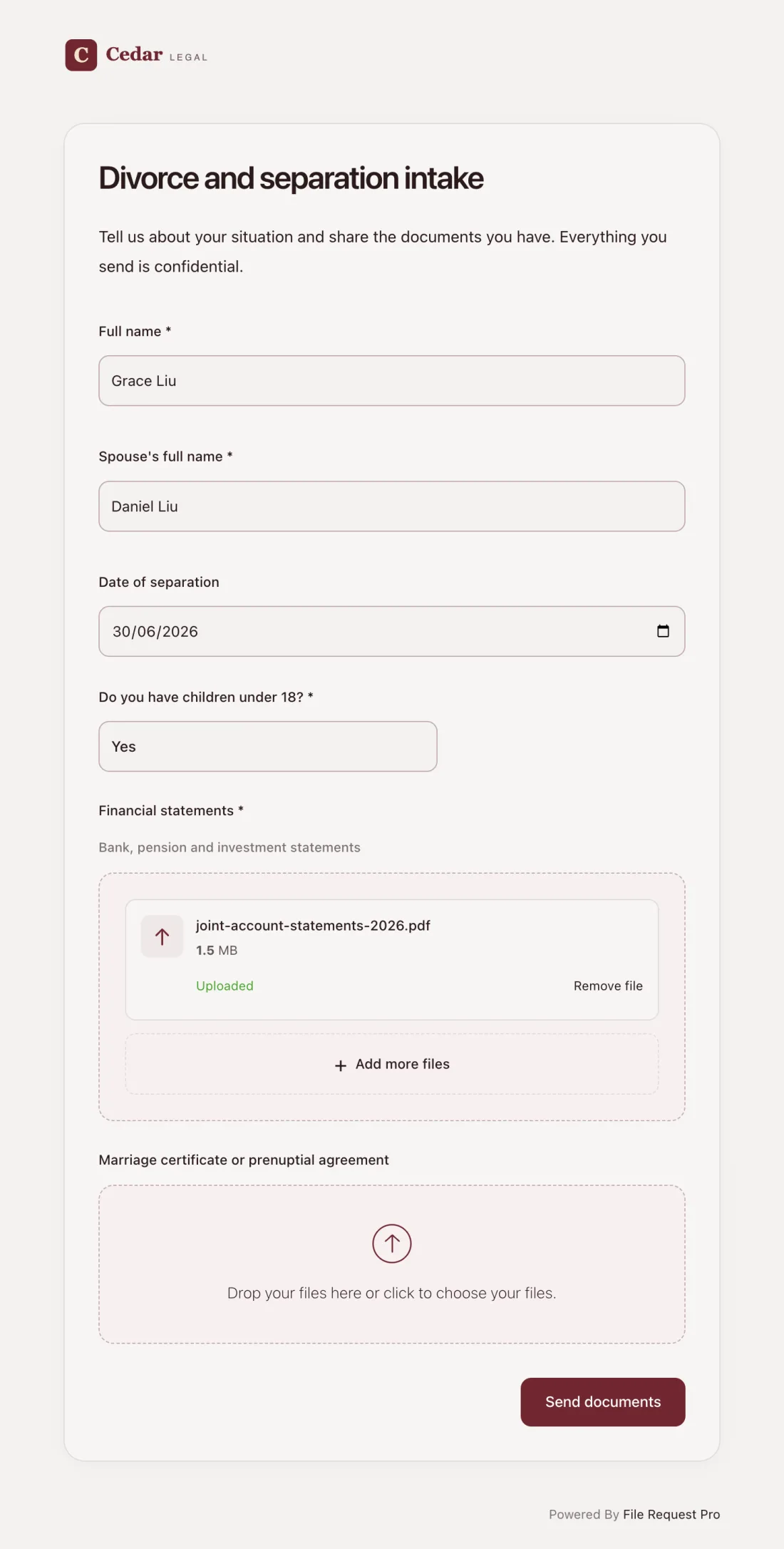
Automatic reminders reduce the need to chase clients for responses. When a client submits their completed questionnaire, File Request Pro organizes and stores all responses and uploaded documents securely in Google Drive, Dropbox, or OneDrive.
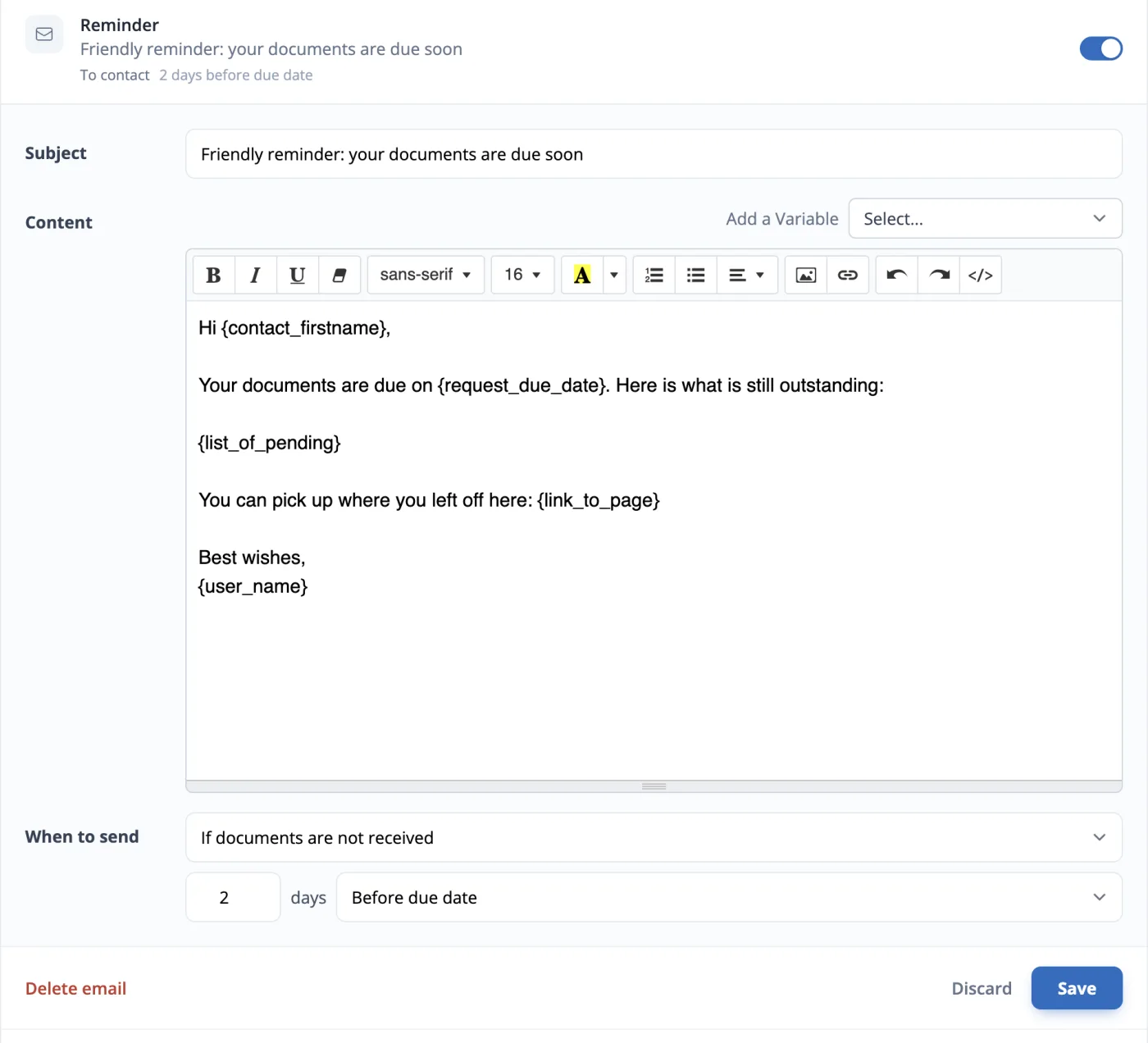
The result is a less stressful intake experience for clients and less administrative work for attorneys — freeing up time to focus on case strategy.
Frequently Asked Questions
What is a divorce questionnaire?
A divorce questionnaire is a structured intake form used by family law attorneys to collect essential information from clients at the start of a divorce case. It typically covers personal details, marriage history, financial information, children and custody preferences, and settlement expectations. The questionnaire helps attorneys assess the case quickly and ensures no important details are missed.
Why do attorneys use divorce questionnaires?
Attorneys use divorce questionnaires to streamline intake and gather comprehensive information before the first consultation. This allows them to provide more accurate legal advice, identify potential issues early, and reduce follow-up meetings needed to collect basic facts.
What information should a divorce questionnaire include?
A thorough divorce questionnaire should include sections on personal information (names, contact details, employment), marriage details (date, location, prenuptial agreements), financial information (income, assets, debts, shared accounts), children and custody preferences, legal history, and settlement expectations. The more detailed the questionnaire, the better prepared the attorney will be.
How long does it take to complete a divorce questionnaire?
A divorce questionnaire typically takes between 30 minutes and two hours to complete, depending on the complexity of the case. Clients with extensive financial holdings or multiple children may need more time to gather the necessary documents. Attorneys often recommend completing the form over several sittings rather than rushing through it.
Can a divorce questionnaire be completed online?
Yes. Many family law firms now use digital intake tools to send divorce questionnaires online. Online forms make it easier for clients to complete the questionnaire at their own pace, upload supporting documents, and submit everything securely. Digital submission also reduces incomplete answers and makes it simpler for attorneys to organize responses.
Should both spouses fill out the same divorce questionnaire?
Each spouse typically fills out their own questionnaire with their own attorney. Since each party has different perspectives, financial knowledge, and custody preferences, separate questionnaires help attorneys understand each client's individual position. In collaborative divorce or mediation, both parties may complete similar forms that are shared with a neutral mediator.
What documents should I gather before completing a divorce questionnaire?
Before starting a divorce questionnaire, gather key financial documents including recent tax returns, pay stubs, bank and investment account statements, mortgage documents, credit card statements, loan documents, insurance policies, and vehicle titles. If children are involved, collect school records, medical information, and any existing custody or support agreements.
Free Client Onboarding Checklist
Get the complete document checklist for your industry — interactive, with progress tracking.
Use the Free Checklist Tool →