If you've been searching for a "file request" feature in Google Drive, something that lets you send a link so other people can upload files directly to your Drive, you've probably already found the bad news. It's one of the most requested Google Drive features. But it doesn't exist.
Unlike Dropbox and OneDrive, Google Drive has no native file request feature. There's no built-in way to create an upload link, send it to a client or colleague, and have their files land in a specific folder on your Drive.
That leaves you with workarounds and tradeoffs. This guide covers every method for collecting files via Google Drive, explains the limitations of each, and walks through a third-party alternative that connects directly to your Google Drive account. For the complete Forms-to-Drive workflow, start with our Google Forms data collection guide.
Does Google Drive Have a File Request Feature?
No. Google Drive does not have a native file request feature. There is no way to generate an upload link that lets someone send files directly to your Google Drive without giving them access to your account.
This surprises a lot of people. Dropbox has had a File Request feature for years. You create a request, share the link, and recipients upload files without needing an account. OneDrive offers something similar. Google Drive? Nothing.
Users have asked for this feature in Google's product forums for years, but it has never shipped. There is no "Request files" button in Google Drive.
You have three realistic options, each with tradeoffs.
How to Collect Files via Google Drive
Since Google Drive doesn't have a dedicated file request tool, you'll need one of these workarounds to receive files from other people.
Method 1: Share a Google Drive Folder
The simplest approach is to create a folder in Google Drive, share it with the people you need files from, and ask them to drop their files in.
How to set it up:
- Open Google Drive and create a new folder (e.g., "Client Uploads — Project X")
- Right-click the folder and select "Share"
- Enter the email addresses of the people who need to upload files
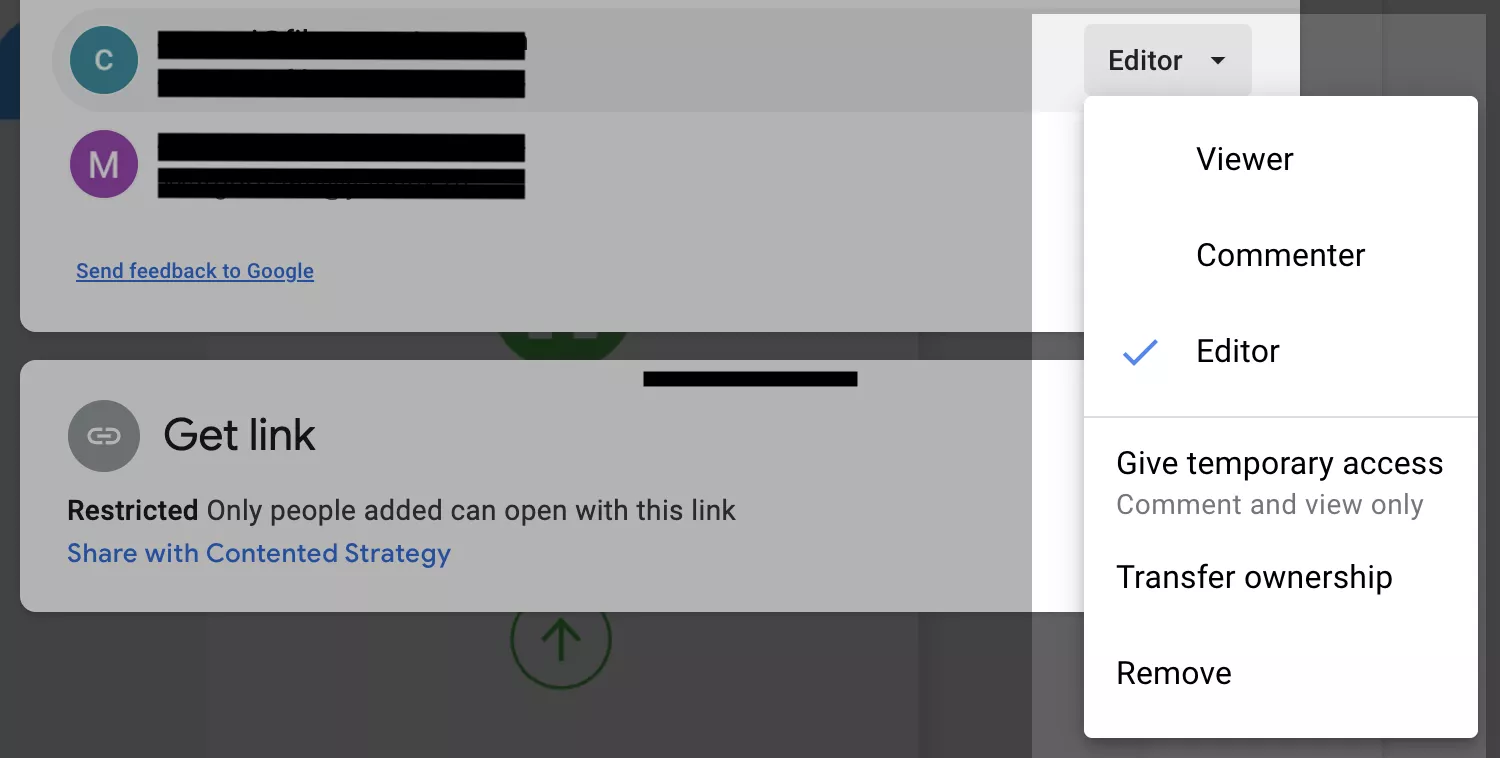
- Set their permission to "Editor" so they can add files
- Click "Send"
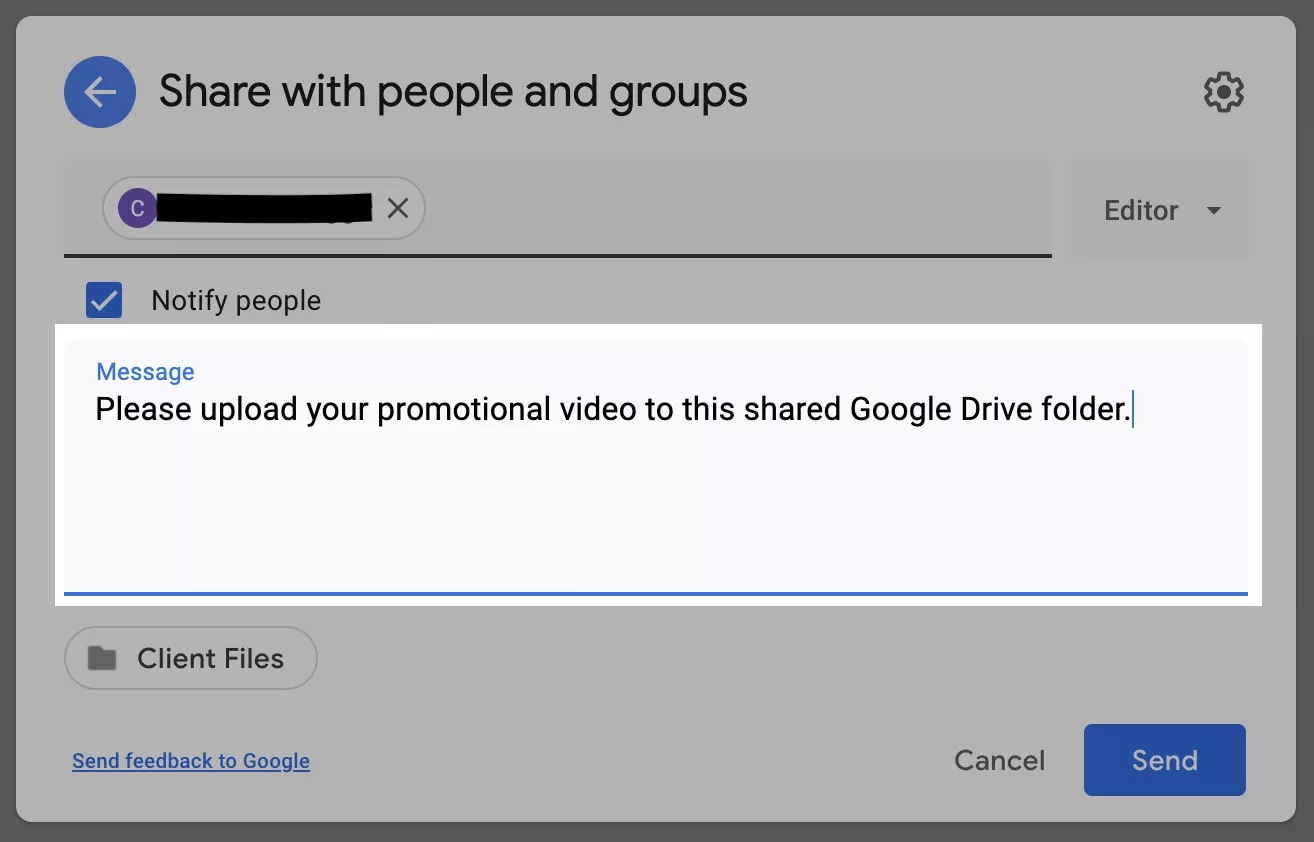
The recipients will get an email notification and can open the shared folder directly from their Google Drive.
The problems with this approach:
- Recipients need a Google account. If your client uses Outlook, Yahoo, or a non-Google email, they can't upload files. The one exception is Google Workspace visitor sharing, which on some plans lets people without a Google account upload to a shared drive (see the FAQ below).
- Everyone can see everyone else's files. Each person with folder access can see, edit, and delete every file in that folder, including files from other people. If you're collecting tax documents from 20 clients, that's a serious privacy problem.
- No upload notifications. Google Drive doesn't alert you when someone adds a file to a shared folder. You have to check manually.
- Revoking access is manual. After a project wraps up, you need to remove each person's access individually. Forget one, and a former client keeps access indefinitely.
Best for: Small internal teams where everyone already has a Google account and privacy isn't a concern.
Not ideal for: Collecting files from clients, vendors, or anyone outside your organization.
Method 2: Use Google Forms with File Upload
Google Forms supports a "File upload" question type, which lets respondents attach files to a form submission. The uploaded files go to a folder in the form creator's Google Drive.
How to set it up:
- Go to forms.google.com and create a new form
- Add a question and change the type to "File upload"
- Configure the allowed file types (documents, images, video, etc.) and maximum file size
- Add any other questions you need (name, email, project details)
- Click "Publish", then share the form link with your recipients
Uploaded files are automatically saved to a folder in your Google Drive named after the form.
The problems with this approach:
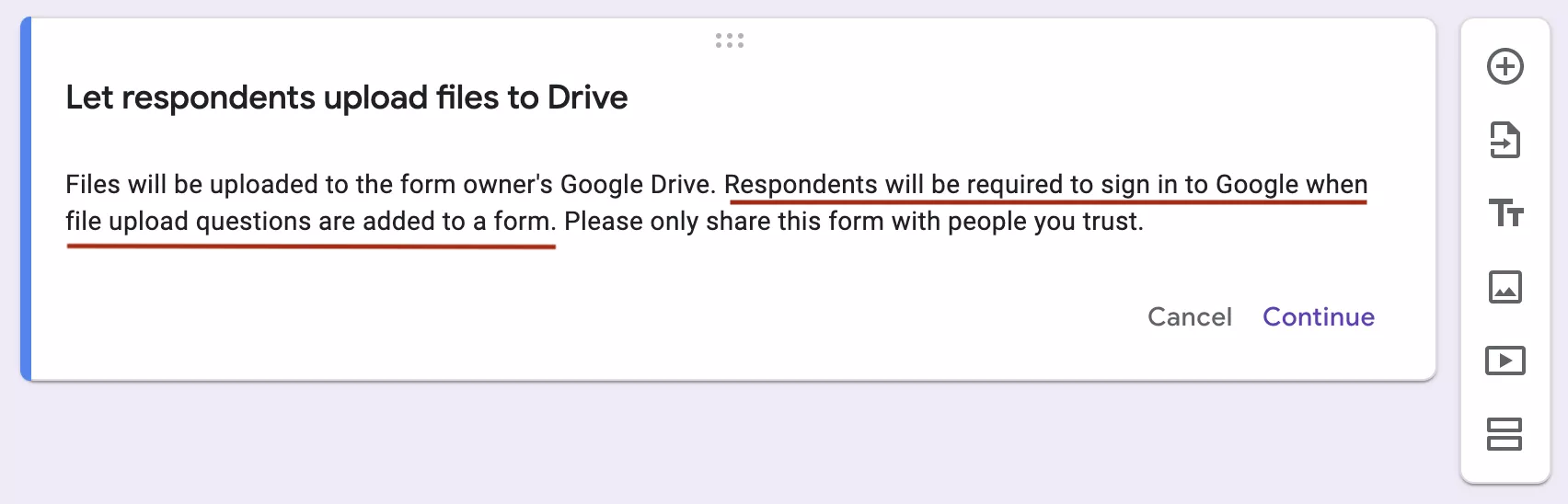
- Respondents must sign in to a Google account. This is the biggest limitation. Anyone who fills out the form must be logged into a Google account to upload files, even if you've made the Google Form public. If your client doesn't have one, they're stuck.
- Storage cap on uploads. Each file can be up to 10 GB, but the form holds only 1 GB of uploads in total by default. You can raise that limit, and every upload counts against your Drive storage.
- No branding. The form uses Google's design. You can change the header color, but you can't white-label it, use a custom domain, or remove Google's footer.
- No reminders. Google Forms has no reminder system. If someone hasn't submitted, you follow up manually.
- Flat file organization. All uploaded files go into a single folder. There's no automatic sorting by respondent name, date, or project.
- Limited file type control. You can pick broad categories such as Document, PDF, Image, or Video, but you can't limit uploads to one extension like .docx or .jpg.
Best for: Internal teams collecting files from people who already have Google accounts and don't mind the Google-branded experience.
Not ideal for: Client-facing file collection, large files, or situations where you need professional branding.
Method 3: Use a Third-Party File Request Tool
If neither shared folders nor Google Forms work for your situation (and for most client-facing use cases, they won't), a third-party file request tool fills the gap.
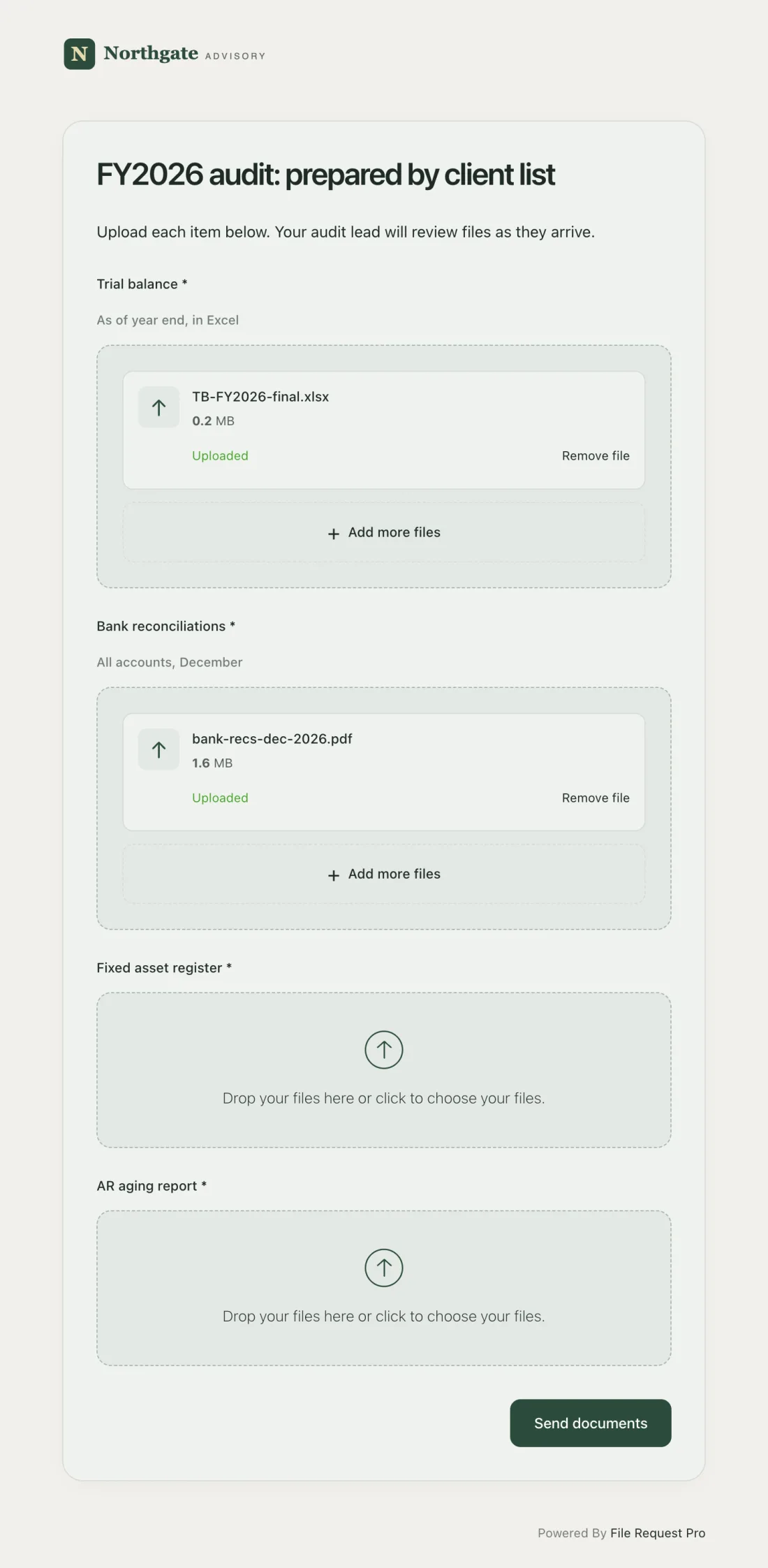
These tools connect directly to Google Drive so files still land in your Drive, but they add what Google is missing: branded upload pages, no sign-in requirement, automated reminders, and automatic file organization.
File Request Pro is built for this. You create a branded upload page, send the link, and files route to the right folder in your Google Drive. No Google account required for uploaders. No chasing. No disorganized folders.
Google Drive File Request Limitations
Whether you use shared folders or Google Forms, collecting files through Google Drive means working around limitations that were never designed for one-way file collection.
The core problem: Google Drive is a file storage and sharing tool, not a file collection tool. Sharing gives both parties access to the same space. Collection is one-way: someone sends you files, and only you see them. Google Drive doesn't support that. For a deeper look at how the permissions behave, see how Google Drive file sharing works.
What that looks like in practice:
- Google account required for almost every uploader. Google Forms always requires a Google sign-in, and shared folders do too unless your Workspace admin has turned on visitor sharing. Without it, clients on Outlook, Yahoo, or other providers are locked out.
- No privacy between uploaders. In a shared folder, every contributor can see every file, including files from other people. For tax returns or legal paperwork, this is a dealbreaker.
- No branding. Neither method lets you white-label the experience. Clients see Google's interface, not yours.
- No automated reminders. When someone hasn't submitted, you follow up manually. No built-in follow-up emails.
- No file organization. Shared folders let contributors dump files anywhere. Google Forms puts everything in one flat folder. Neither auto-sorts by submitter, date, or project.
- Revoking access is manual. After a project ends, you remove each person's access individually. Forget one, and a former client keeps access indefinitely.
For individuals collecting a few files from tech-savvy colleagues, these workarounds are fine. For businesses collecting documents from clients, especially clients who may not have Google accounts or who expect a professional experience, the limitations stack up quickly.
How File Request Pro Works with Google Drive
File Request Pro connects to your Google Drive account through a native integration. Your clients get a branded upload experience, and files end up exactly where you want them in your Drive.
Setup takes about five minutes:
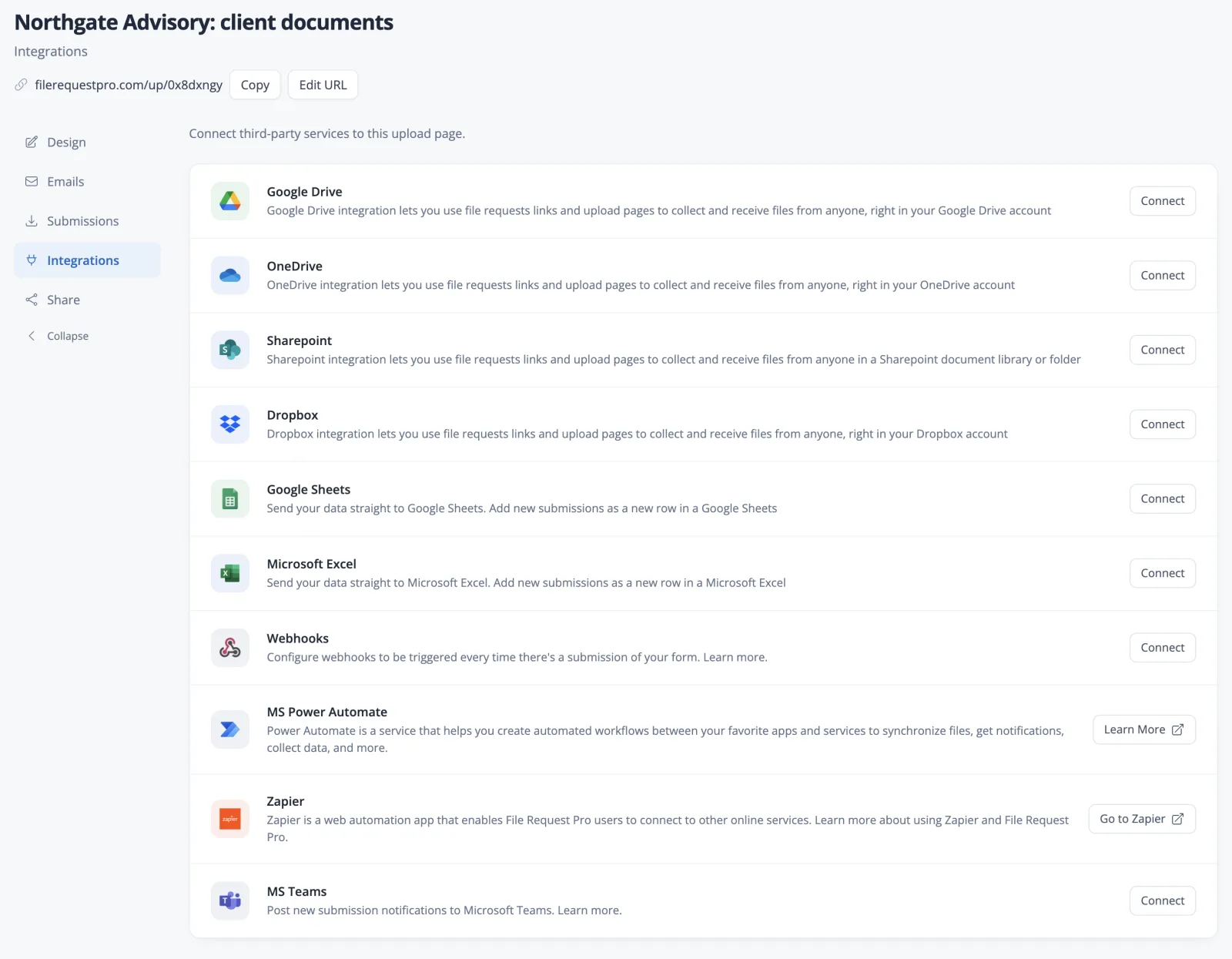
- Connect your Google Drive. Link your account with one click during setup. File Request Pro uses OAuth, so it never sees your Google password.
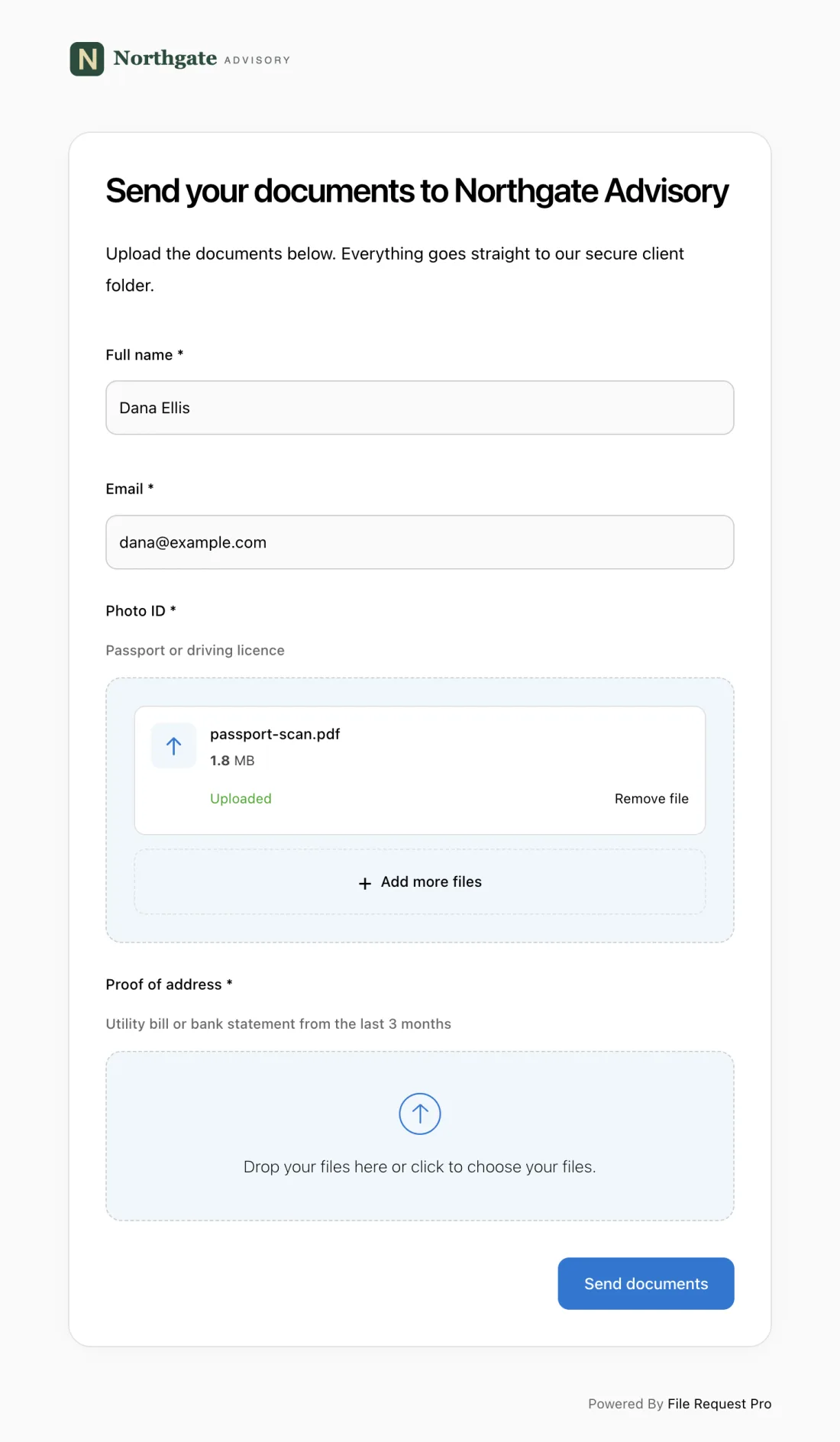
- Build your upload page. Create a branded form with your logo, colors, and custom URL. Add fields for client name, project reference, document type, or anything else you need alongside the files. Create multiple upload zones to separate different file categories.
- Send the link. Share via email, embed on your website, or add to your client portal. Clients click, upload, and submit. No account creation. No Google sign-in.
- Files arrive organized. Uploaded files go directly to your Google Drive. File Request Pro auto-creates subfolders based on client name, email, date, or any form field, so you get
Client Uploads / Acme Corp / Tax Documents 2026instead of one messy folder. - Reminders handle follow-up. Automated emails go out to anyone who hasn't submitted. You control the timing, message, and frequency.
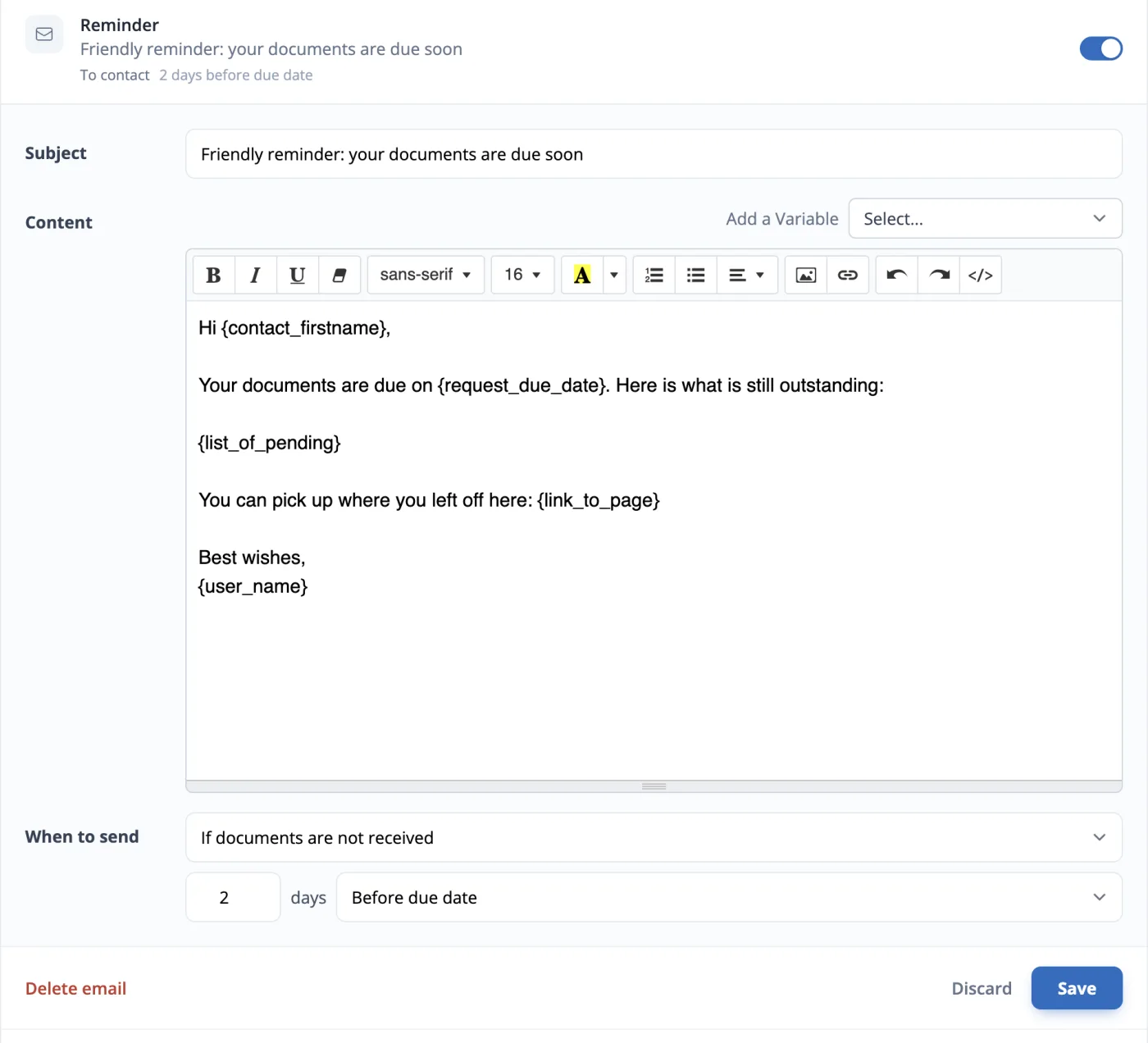
Your files stay in Google Drive. Your clients get a clean, professional upload experience. And you stop chasing people and sorting files by hand.
Google Drive File Collection: Comparison Table
A side-by-side comparison of the three approaches:
| Feature | Shared Folder | Google Forms | File Request Pro |
|---|---|---|---|
| Uploader needs Google account | Yes (except Workspace visitor sharing) | Yes | No |
| Files go to Google Drive | Yes | Yes | Yes (native integration) |
| Max file size | 5 TB (plan dependent) | 10 GB per file (1 GB form total by default) | 5 GB (configurable) |
| File privacy (per uploader) | No — everyone sees all files | Yes | Yes |
| Custom form fields | No | Yes (basic) | Yes (advanced form builder) |
| Custom branding | No | Minimal | Full white-label |
| Automated reminders | No | No | Yes (unlimited, customizable) |
| Auto-organize into folders | No | No | Yes (by name, email, project, date) |
| Embed on website | No | Yes (Google-branded) | Yes (white-labeled) |
| Cost | Free (with Google account) | Free (with Google account) | From $39/month |
Shared folders and Google Forms work for small-scale, internal file collection where everyone has a Google account. For client-facing work where you need branding, privacy, reminders, and organized folders, a dedicated tool removes the manual work that Google Drive's workarounds create.
Google Drive File Request FAQ
Does Google Drive have a file request feature?
No. Google Drive does not have a native file request feature. Unlike Dropbox (which has File Requests) and OneDrive (which has Request Files), there is no built-in way to create an upload link for receiving files. Google's product forums show requests for this feature dating back years, but it has never shipped.
How can I receive files in Google Drive without sharing my folder?
Use a third-party tool like File Request Pro that connects to Google Drive. You create an upload page, share the link, and uploaded files go directly to your Drive without giving anyone folder access or requiring a Google account. Google Forms also works, but respondents must sign in with a Google account.
Can someone upload files to my Google Drive without a Google account?
Only in one case. If your organization's Google Workspace plan supports visitor sharing and your admin has turned it on, you can invite someone without a Google account to a shared drive. They confirm their email with a PIN code and can then upload files to folders in that shared drive. Visitors can't upload to folders in My Drive, and Google Forms file uploads always require a Google sign-in. To accept uploads from anyone without that setup, you need a third-party file request tool that connects to your Drive. We cover every option in our guide on how to allow anyone to upload files to your Google Drive.
Is there a file size limit for Google Drive uploads?
For direct Google Drive uploads, individual files can be up to 5 TB (depending on your plan). For Google Forms file upload questions, you can allow up to 10 GB per file, but the form holds only 1 GB of uploads in total by default (you can raise it). Google Drive storage is shared across Gmail, Drive, and Google Photos. The free plan includes 15 GB total.
What happened to the Google Drive file request feature?
It was never released. Users have asked for it in Google's product forums for years, but Google has not launched it or announced plans to add it.
Can I use Google Forms to collect files?
Yes, with limitations. Google Forms has a "File upload" question type that saves files to your Drive. But respondents must sign in with a Google account, and the form holds only 1 GB of uploads in total by default, even though single files can be up to 10 GB. There's no branding customization or reminders, and all files land in a single unorganized folder.
How do I send a file request link for Google Drive?
Google Drive doesn't support creating a file request link natively. To send an upload link that saves files to your Google Drive, use a tool like File Request Pro. You create a branded upload page, generate a shareable link, and any files uploaded through that link go straight to your connected Google Drive account.
Is it safe to share a Google Drive folder for file collection?
It works, but it creates privacy concerns. Anyone with Editor access can see, edit, and delete all files in that folder, including files from other people. They can also reshare the folder without your permission (unless you restrict this). For sensitive documents, a shared folder is not a secure collection method.
How does File Request Pro integrate with Google Drive?
File Request Pro connects via OAuth (a secure one-click authorization). Once linked, files uploaded through your upload pages are automatically saved to your designated Drive folder. You can auto-create subfolders by client name, email, project, or date, so every file lands in the right place without manual sorting.
