A scratched bumper gets listed as "minor cosmetic wear." A missing title delays funding for two weeks. A customer swears the trade-in had new brakes, but nobody wrote it down. When your dealership runs on sticky notes and verbal handoffs, deals stall, disputes stack up, and state regulators start asking questions you do not want to answer.
This guide covers the dealership paperwork every auto dealer needs: a vehicle inspection form that documents condition before purchase or trade-in, and a car dealer sale documents checklist that tracks every piece of paperwork required to close a deal cleanly. Both are organized field by field so you can build them for your state's requirements. You'll also find a short list of documents buyers should bring, ready to send before they come in.
Why Auto Dealers Need Standardized Forms
Without a standard process, one tech records tire tread depth while another skips it. One salesperson grabs the title upfront while another forgets until the buyer is in F&I. Standardized forms mean every vehicle gets the same inspection and every deal includes the right paperwork — a paper trail that holds up when a buyer, lender, or state auditor comes knocking.
Vehicle Inspection Form Template
Use this form every time a vehicle enters your lot — trade-in, auction buy, or dealer transfer. A thorough inspection at intake prevents surprises on the sales floor and gives you documented proof if a buyer disputes condition after delivery.
Vehicle Identification
- Vehicle Identification Number (VIN) — The 17-character VIN anchors every other record. Cross-check it against the title, registration, and the physical plate on the dash and door jamb. A mismatch kills the deal at funding.
- Year, Make, Model, and Trim — Spell it out. "2019 Toyota Camry SE" is useful. "Camry" is not.
- Odometer Reading — Record exact mileage at intake. Federal law requires an odometer disclosure on most sales, and a gap between your reading and the title creates legal exposure you cannot explain away.
- Exterior Color / Interior Color — Use the manufacturer's color code when possible. Matters for title accuracy and insurance records.
- License Plate Number and State — Tracks current registration before title transfer.
Exterior Condition
- Body Panel Condition — Note dents, scratches, rust, or prior bodywork on each panel: hood, fenders, doors, quarters, roof, trunk lid. What you skip here is what a buyer finds on the lot.
- Paint Condition — Check for fading, peeling, overspray, or color mismatches. A paint thickness gauge catches collision repairs a visual check will miss.
- Glass and Mirrors — Inspect all glass for chips, cracks, or delamination. Confirm mirrors adjust and hold.
- Lights and Lenses — Test headlights (low/high), taillights, brake lights, turn signals, reverse lights. Cracked or cloudy lenses fail safety inspection and hold up the sale.
- Bumpers and Trim — Document scuffs, cracks, or missing pieces on bumpers, side moldings, and wheel well liners.
Interior Condition
- Seats and Upholstery — Note tears, stains, burns, or heavy wear. Record material type (cloth, leather, synthetic) and whether power adjustments work.
- Dashboard and Instrument Panel — Check for cracks, warping, or peeling. Verify all gauges, warning lights, and displays function at startup. A lit check-engine light kills buyer confidence on the spot.
- Carpet and Floor Mats — Look for water stains, mold, or odors suggesting flood damage. Check trunk carpet and spare tire well — this is where flood history hides.
Mechanical Systems
- Engine Condition — Record engine type and displacement. Check for leaks, belt wear, and abnormal noises at startup. Pull codes with an OBD-II scanner — hidden problems surface here before they become your problem on the lot.
- Transmission — Note auto or manual. Check fluid condition and level. Confirm smooth shifting through all gears. For manuals, check clutch engagement and synchronizer feel.
- Suspension and Steering — Bounce-test each corner for worn shocks or struts. Check for steering play, clunks, or wandering on the test drive.
Electrical Systems
- Battery and Charging System — Test voltage and cold cranking amps. Verify alternator output. Note battery age if visible — a weak battery at intake means a no-start on the lot.
- HVAC System — Run A/C and heat through all fan speeds. Confirm correct vent output and note unusual smells. A dead A/C compressor is a $1,200+ surprise you want to catch now.
- Infotainment and Electronics — Test radio, Bluetooth, backup camera, navigation, USB ports, power windows, locks, keyless entry.
Tires and Brakes
- Tire Condition and Tread Depth — Measure tread at three points per tire (inside, center, outside). Record brand, size, and DOT date code. Uneven wear flags alignment or suspension issues your recon estimate needs to cover.
- Brake Inspection — Measure pad thickness and rotor condition on all four corners. Note pulsation, noise, or pulling. Check brake fluid level and color.
Test Drive Notes
- Test Drive Observations — Drive at city and highway speeds. Note shift quality, ride, steering feel, braking, and any noises or vibrations. If something feels off at 45 mph, the buyer will feel it too.
Photos and Documentation
- Photo Documentation — Photograph every angle, the odometer, VIN plate, interior, engine bay, tire tread, and any damage. Timestamped photos are your best defense when a buyer claims damage you never caused.
Inspector Sign-off
- Inspector Name and Signature — The inspector signs and dates the form. When a dispute surfaces six months later, you need to know who inspected it and when.
- Overall Condition Rating — Assign a rating (Excellent, Good, Fair, Poor) with a summary of what needs repair or reconditioning before the vehicle hits the lot.
Car Dealer Sale Documents Checklist
Miss one document and the deal stalls — your lender holds funding, the buyer gets nervous, and your desk log backs up. Miss a required disclosure and you are looking at fines, lawsuits, or a pulled license. This checklist covers the standard documents for a retail vehicle sale. Your state may require additional forms, so verify with your DMV and dealer licensing board.
- Certificate of Title (or Manufacturer's Certificate of Origin) — Proves ownership and transfers it to the buyer. For new vehicles, the MCO serves this purpose. Verify seller name, VIN, and lien status all match before you print a single contract.
- Bill of Sale — Shows buyer, seller, vehicle description, VIN, sale price, and date. Most states require it for registration, and it is your proof of the agreed terms.
- Odometer Disclosure Statement — Federal law (49 U.S.C. 32705) requires an odometer disclosure when ownership changes. Under NHTSA's rule, model year 2011 and newer vehicles need one until they are 20 years old; model year 2010 and older vehicles are exempt. The seller certifies mileage is accurate. Some states fold this into the title; others need a separate form.
- Buyers Guide (FTC Used Car Rule) — Required on every used car or light truck a dealer offers for sale. Discloses warranty status ("as is" or covered) and lists systems that may have problems. Missing it can bring civil penalties of up to $53,088 per violation (16 CFR 1.98).
- Purchase Agreement / Retail Installment Contract — Covers price, trade-in credit, taxes, fees, financing terms, and add-ons. For financed deals, the RISC is the binding contract. Mismatched numbers across documents and your lender bounces the deal.
- Financing and Credit Application — Buyer provides employment, income, and housing info. Include signed Truth in Lending disclosures, privacy notices, and lender-specific forms.
- Insurance Verification — Confirm coverage is effective on or before delivery. Collect the insurance card or binder showing the vehicle's VIN. No insurance, no delivery.
- Trade-In Documentation — Collect the trade-in's title, registration, and odometer disclosure. Run a lien check. If a payoff exists, get the lienholder's quote in writing — verbal quotes expire fast.
- Emissions and Safety Inspection Certificate — Many states require emissions or safety inspection before registration. Schedule these before delivery and keep certificates in the deal jacket.
- Vehicle History Report — Not legally required in most states, but a Carfax or AutoCheck builds buyer confidence and cuts post-sale disputes. Some states mandate disclosure of salvage titles, flood damage, or odometer rollbacks.
- Registration and Tag Application — Completed application, fees, and supporting documents (proof of residency, ID) for DMV submission.
- Power of Attorney for Title and Registration — Authorizes your dealership to handle title transfer and registration. Standard practice that keeps the buyer out of the DMV.
- Buyer's Identification — Copy of a valid government-issued photo ID. Lenders require it for financed deals, and it confirms the buyer matches the name on every document.
- Delivery Receipt / Due Bill — Confirms the buyer took possession on a specific date. The due bill lists anything you still owe — pending repairs, second key, parts on order. Get it signed.
What documents do you need to buy a car from a dealership?
To buy a car from a dealership, you need a driver's license or other government photo ID, proof of insurance, and your payment or financing documents, plus the title and payoff details for any trade-in. Requirements vary by state and lender, but this is what to bring:
- Driver's license or other government photo ID. The dealer uses it on the title and registration application, and lenders ask for it on financed deals.
- Proof of insurance. The dealer usually needs it to register the car you're buying. In Florida, for example, the car can't be registered without it.
- Financing documents. If a bank or credit union pre-approved you, bring the letter. If you're financing through the dealer, bring proof of income, such as recent pay stubs.
- Trade-in paperwork. Bring the title (or the loan details, if a lender still holds it), the current registration, and a payoff amount from your lender. The payoff can differ from the balance on your statement.
- Down payment. Ask the dealer before your visit which payment methods it takes, such as a cashier's check or a wire transfer, and whether it sets any limits.
If you're the dealer, text or email this list to buyers when you book the appointment. A buyer who shows up without an insurance card or a payoff amount stalls the deal. Most of these items end up in the paperwork on the sale documents checklist above.
How to Collect Vehicle Documents and Inspection Photos with File Request Pro
Paper inspection forms get buried in service bays. Email attachments scatter across inboxes. Buyers show up without their title or insurance card, and your F&I manager burns 30 minutes chasing paperwork before the deal can fund. Multiply that across 80 deals a month and the lost time is staggering.
File Request Pro gives your dealership a single branded upload page where inspectors, buyers, and sales staff submit everything you need — photos, signed forms, titles, insurance cards — without creating an account or downloading an app.
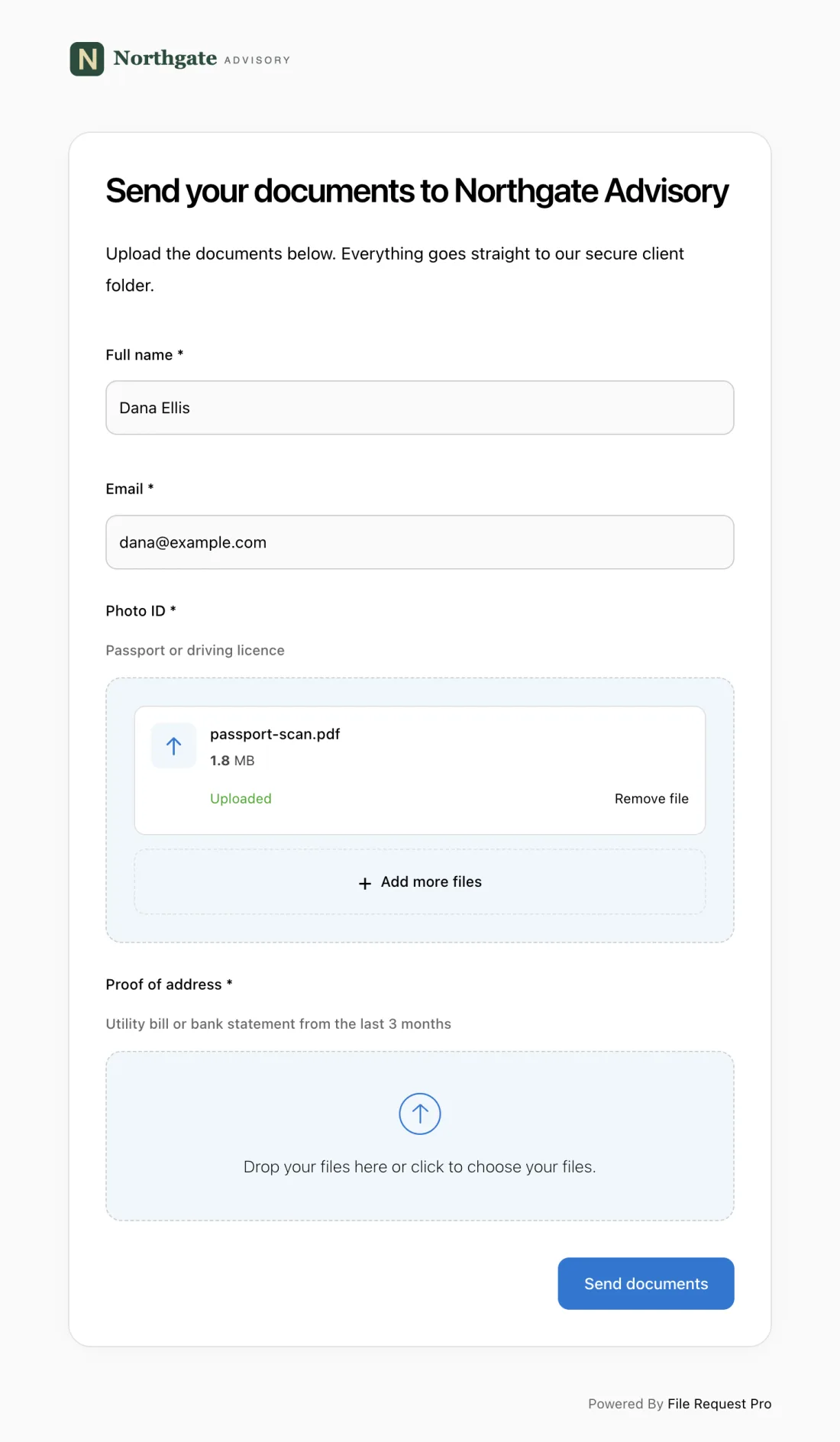
Here is what this looks like at a dealership:
- Photo uploads from the lot — Inspectors snap photos on their phone and upload to a page tagged with the VIN and stock number. Every photo lands organized and timestamped — no texting images or dumping them in an unlabeled shared folder.
- Buyer document collection before delivery — Send the buyer a link 48 hours out. They upload license, insurance, trade-in title, and payoff letter from home. When they walk in, F&I has a complete file instead of a half-empty jacket.
- Automated reminders that chase paperwork for you — Buyers who have not uploaded get automatic follow-ups on your schedule — daily, every two days, weekly. No more "did you send that title?" calls tying up your staff.
- Cloud storage sync — Files sync to Google Drive, OneDrive, SharePoint, or Dropbox, with a folder for each deal. No separate system to manage.
- No account needed for buyers — Customers click a link, drop their files, and they are done. No app, no registration, no password. Zero friction means faster turnaround on every deal.
Whether you are collecting inspection photos from a tech at auction, trade-in docs from a customer across town, or a full deal jacket for a lender, File Request Pro keeps everything in one place with a clear audit trail. Set it up in minutes.
Best Practices for Auto Dealer Document Collection
Inspect before you price
Run the full inspection before you set the lot price. Finding a leaking head gasket after you have quoted a trade-in value costs you money and credibility. The condition report should drive the appraisal, not the other way around.
Photograph everything, even what looks fine
Photos of a clean panel matter as much as photos of a scratch. When a buyer calls three weeks later claiming you sold them a car with a dented door, timestamped photos prove it left your lot clean. Capture every angle, the odometer, the VIN plate, and all damage — no matter how small.
Collect buyer documents before delivery day
The worst time to learn a buyer does not have their trade-in title is when they are sitting in F&I with their family in the showroom. Send your checklist and upload link 48 hours before delivery so your team catches gaps before anyone walks in.
Keep a deal jacket checklist for every transaction
An incomplete jacket means delayed title work, held funding, and compliance flags during audits. Build a master checklist for your state and check off each item as it arrives. Same checklist on every deal means nothing slips — whether your senior F&I manager is closing or your newest hire.
Verify documents against the vehicle
Cross-check the VIN on the title against the physical vehicle. Confirm the odometer disclosure matches your inspection. Verify the buyer's insurance name matches the purchase agreement. These 60-second checks prevent problems that take weeks to fix. A document verification process catches mismatches before they become rejected titles or returned funding.
FAQ
What documents does a car dealer need to sell a vehicle?
At minimum: certificate of title (or MCO for new vehicles), bill of sale, odometer disclosure, and FTC Buyers Guide for used vehicles. Most deals also need a purchase agreement, financing paperwork, insurance verification, registration application, and limited power of attorney. Requirements vary by state.
What should be included in a vehicle inspection form?
Cover vehicle identification (VIN, year, make, model, mileage), exterior condition (panels, paint, glass, lights), interior (seats, dashboard, carpet), mechanical systems (engine, transmission, suspension), electrical (battery, HVAC, infotainment), tires, brakes, test drive notes, photos, and inspector sign-off with condition rating.
Is a vehicle inspection required before selling a used car?
Federal law does not require a pre-sale inspection, but many states require safety or emissions testing before registration. A documented inspection protects you from post-sale disputes and builds buyer trust. Skip it and you risk chargebacks, negative reviews, and complaints that follow your license.
How do dealers handle trade-in paperwork?
Collect the trade-in's title, registration, and signed odometer disclosure. Run a lien check. If a balance remains, get a written payoff quote and satisfy it at closing. Title then transfers to your dealership for resale or wholesale.
What is the FTC Buyers Guide requirement for used car dealers?
The FTC Used Car Rule requires a Buyers Guide on every used vehicle for sale, stating warranty status ("as is" or covered) and listing systems that may have problems. Give the buyer the Buyers Guide, or an accurate copy, at the sale. Each violation can bring a civil penalty of up to $53,088 (16 CFR 1.98).
How can I collect inspection photos and sale documents digitally?
File Request Pro lets you create branded upload pages per vehicle or deal. Inspectors upload photos from their phones, buyers submit titles and insurance before delivery, and everything syncs to your cloud storage, with a folder for each deal. Automated reminders handle the follow-up.
