Your fund closing is in three weeks and half your investors still haven't returned their questionnaires. One LP's accreditation letter expired last month. Another investor's counsel is pushing back on the source-of-funds disclosure. Your compliance officer is holding the subscription agreement until every document clears — and your inbox is a graveyard of half-finished threads with subject lines like "RE: RE: FW: Missing docs." Each day that passes is another day your closing slips.
A structured investor questionnaire prevents this entirely. Send it at the start of onboarding, and you collect identity verification, accreditation status, regulatory disclosures, and supporting documents in a single submission — cutting weeks of email chasing down to a single intake step. Below: a ready-to-use template with 37 questions, variations for four fund types, and a faster way to collect everything without the back-and-forth.
What Is an Investor Questionnaire?
An investor questionnaire is a standardized form that limited partners, accredited investors, or prospective fund participants complete during onboarding. It captures the identity, financial, and regulatory information a fund manager needs to verify eligibility, satisfy compliance requirements, and finalize the subscription agreement.
Most investor questionnaires cover:
- Investor identification — legal name, entity structure, tax ID, authorized signers
- Investment profile — objectives, time horizon, risk tolerance, liquidity needs
- Accreditation verification — income, net worth, or entity qualification under SEC regulations
- Source of funds — origin of investment capital for AML compliance
- Regulatory disclosures — PEP status, sanctions screening, FATCA/CRS tax reporting
Think of it as the intake form for your fund. You would never accept a capital commitment without knowing who the investor is, whether they qualify, and where their money comes from. The investor questionnaire captures all of this upfront — before your legal and compliance teams spend hours piecing together answers from scattered email threads.
Investor Identification
These questions establish the legal identity of the investor and the entity making the commitment. Getting this right the first time prevents name mismatches on subscription documents, delayed K-1 issuance, and IRS reporting errors — problems that can take weeks to untangle after closing.
- Full legal name of the investor or investing entity — as it should appear on the subscription agreement. For entities, use the exact registered name, not a trade name.
- Entity type — individual, joint account, LLC, LP, corporation, trust, or IRA. Determines which accreditation tests apply and what formation documents to collect.
- Tax identification number (SSN or EIN) — required for K-1 preparation and IRS reporting. For non-U.S. investors, request the foreign tax ID.
- Country of citizenship or formation — drives withholding obligations, FATCA/CRS classification, and sanctions screening.
- Primary address — legal address for the individual or principal place of business for the entity.
- Name and title of authorized signer(s) — the person(s) authorized to execute the subscription agreement on behalf of the entity.
- Contact information for ongoing fund communications — email, phone, and mailing address for capital call notices and distribution statements.
Investment Profile
Understanding an investor's objectives, timeline, and risk appetite helps fund managers assess suitability — and creates a documented record that protects both parties if the investment underperforms or an investor later claims the fund was unsuitable.
- What are your primary investment objectives? — capital preservation, income generation, capital appreciation, diversification, or tax benefits.
- What is your expected investment time horizon? — critical for illiquid fund structures where capital may be locked up for 7 to 10 years.
- What is your liquidity requirement? — will you need access to this capital within the fund's lock-up period?
- How would you describe your risk tolerance? — conservative, moderate, aggressive, or speculative.
- What percentage of your total investable assets does this commitment represent? — an investor committing 40% of liquid net worth has a different risk profile than one committing 5%.
- What is the proposed commitment amount? — establishes the baseline for capital calls and determines whether the commitment meets the fund's minimum.
Accreditation Status
For private placements under Regulation D (Rule 506(b) or 506(c)), verifying accredited investor status is not optional — it is a legal requirement. Accepting a non-accredited investor into a 506(c) offering can void the entire exemption. These questions collect the information your legal team needs to confirm each investor qualifies before you accept their capital. For a broader look at the verification process, see our guide to due diligence checklists.
- Do you qualify as an accredited investor under SEC Rule 501(a)? — provide a summary of qualification criteria so investors can self-assess.
- If qualifying by income: What was your individual income in each of the past two years, and do you expect the same this year? — the test requires over $200,000 individually or $300,000 jointly.
- If qualifying by net worth: What is your net worth (excluding primary residence)? — requires exceeding $1,000,000. Include a note clarifying the residence exclusion.
- If qualifying as an entity: Does your entity have total assets exceeding $5,000,000? — the entity must not have been formed solely to acquire the offered securities.
- Do you hold a FINRA Series 7, 65, or 82 license in good standing? — professional certifications qualify an individual as accredited regardless of income or net worth.
- Please upload supporting accreditation documentation — tax returns, W-2s, brokerage statements, or CPA/attorney verification letters. For 506(c) offerings, self-certification alone is not sufficient.
Source of Funds
Anti-money laundering (AML) regulations require fund managers to understand where investment capital originates. Skipping this step does not just create compliance risk — it can result in civil penalties and personal liability for the fund's principals. These questions document the legitimate source of funds and satisfy obligations under the Bank Secrecy Act and FinCEN guidance.
- What is the source of funds for this investment? — employment income, business income, investment proceeds, inheritance, gift, or other.
- If business income, describe the nature of the business — industry, operations, and approximate annual revenue.
- If prior investment proceeds, describe those investments — fund names, asset classes, and the financial institution that held the account.
- Please upload source-of-funds documentation — bank statements, brokerage confirmations, trust distribution letters, or business financial statements.
Regulatory and Compliance Disclosures
These questions address requirements that carry serious enforcement consequences if missed — politically exposed persons (PEP) screening, sanctions compliance, and international tax reporting under FATCA and CRS. For more on securely handling sensitive compliance documents, see our secure document sharing guide.
- Are you, or any beneficial owner, a Politically Exposed Person (PEP)? — PEP status triggers enhanced due diligence requirements under AML regulations.
- Are you, or any beneficial owner, subject to sanctions imposed by OFAC, the EU, the UN, or any other authority? — a positive answer halts onboarding immediately until the compliance team completes its investigation.
- Do you confirm you are not investing on behalf of any undisclosed third party? — confirms true beneficial ownership of the committed capital.
- For U.S. tax reporting, are you a U.S. person as defined under the Internal Revenue Code? — determines FATCA obligations, withholding requirements, and the correct IRS forms (W-9 vs. W-8BEN).
- If a non-U.S. person, is your country of tax residence a CRS participating jurisdiction? — CRS requires automatic exchange of financial account information between participating countries.
- Please complete and upload the applicable IRS tax form (W-9, W-8BEN, or W-8BEN-E) — collecting this at onboarding prevents delays at year-end tax reporting.
Investment History and Documentation
These final questions assess investor sophistication, surface potential conflicts of interest, and collect the signed documents that complete the investor's onboarding file.
- Have you previously invested in private equity, venture capital, hedge funds, or other alternative investments? — prior experience signals familiarity with capital calls, lock-up periods, and LP reporting schedules.
- Do you have any relationship with the fund's GP, investment manager, or their affiliates? — related-party investments require disclosure and may trigger different regulatory treatment.
- Are you investing through a financial advisor or intermediary? — fund administrators may need to coordinate notices and distributions through the advisor's platform.
- Please upload the signed subscription agreement — ensure all pages requiring initials or signatures are completed.
- Please upload government-issued photo identification — passport or driver's license. For entities, provide ID for each authorized signer and beneficial owner holding 25%+.
- If investing as an entity, upload formation documents — certificate of formation, operating agreement, LP agreement, or corporate articles.
- If investing through a trust, upload the trust agreement and certificate of trust — confirms trustee identity and authority to commit trust assets.
- Please confirm all information is true, accurate, and complete, and that you will notify the fund of material changes — this acknowledgment creates the legal record of disclosure at the time of commitment.
Adapting the Questionnaire for Different Fund Types
The 37-question template above covers the core requirements for most fund structures. Depending on your fund type, you may need to add, remove, or adjust specific sections. Here are four common variations.
LP onboarding for private equity and hedge funds. Institutional LPs — pension funds, endowments, fund-of-funds — require deeper entity qualification and beneficial ownership questions. Add questions about the LP's own investors (look-through provisions), ERISA status for benefit plan investors, and whether the LP is subject to FOIA requests affecting fund confidentiality.
Angel investor due diligence for startups. Founders raising seed or Series A rounds can simplify significantly — a 10-question version often suffices. Prioritize accredited investor verification and a signed SAFE or subscription agreement. Drop source-of-funds unless raising internationally, and trim regulatory disclosures to accreditation and W-9 collection.
Accredited investor verification for Regulation D offerings. For 506(c) offerings using general solicitation, build around the four safe harbor methods: income verification (two years of tax returns), net worth verification (brokerage statements), professional certification (FINRA license), or third-party verification letter from a CPA, attorney, or broker-dealer.
Real estate syndication investor onboarding. Add questions about real estate investment experience, whether the investor intends to use 1031 exchange proceeds (affects closing timelines), and distribution preferences. Include brief explanations alongside each question for investors less familiar with fund structures.
Best Practices for Investor Questionnaires
Collect everything in one submission. Every separate request — questionnaire in one email, accreditation letter in another, subscription agreement in a third — creates another chance for something to get lost or stall. Fund managers who consolidate form fields and document uploads into a single intake step report closing their investor files days faster than those who collect piecemeal.
Explain why you need sensitive information. Investors are understandably cautious about sharing SSNs, net worth figures, and source-of-funds details. A brief note next to each sensitive field — "Required for K-1 preparation" or "Collected for AML/KYC compliance" — builds trust and reduces pushback from investors or their counsel.
Set a deadline tied to the closing. "Please complete by March 15 to be included in the April 1 close." Automated reminders reinforce the deadline without manual follow-up.
Secure the data from the start. Investor questionnaires contain SSNs, net worth disclosures, and government IDs — exactly the information targeted in data breaches. Use encrypted collection tools with access controls and audit logging. Email is not a secure channel for this data, and investors increasingly refuse to send sensitive documents that way.
Keep a compliance-ready audit trail. In an SEC examination, regulators want to see when each investor submitted their questionnaire, what documentation was provided, and whether accreditation was verified before capital was accepted. Timestamp every submission and store it where your compliance team can retrieve it in minutes, not hours.
Collect Investor Questionnaires and Documents in One Step
The questionnaire is only half the challenge. Most fund managers also need signed subscription agreements, accreditation documentation, government IDs, and tax forms — all from investors who are coordinating with their own lawyers, accountants, and internal approval processes.
File Request Pro is built for exactly this workflow. You create a branded intake page with form fields for the investor questionnaire and upload fields for each required document. Investors open a single link, answer the questions, attach their files, and submit — no accounts to create, no portals to navigate, no back-and-forth emails.
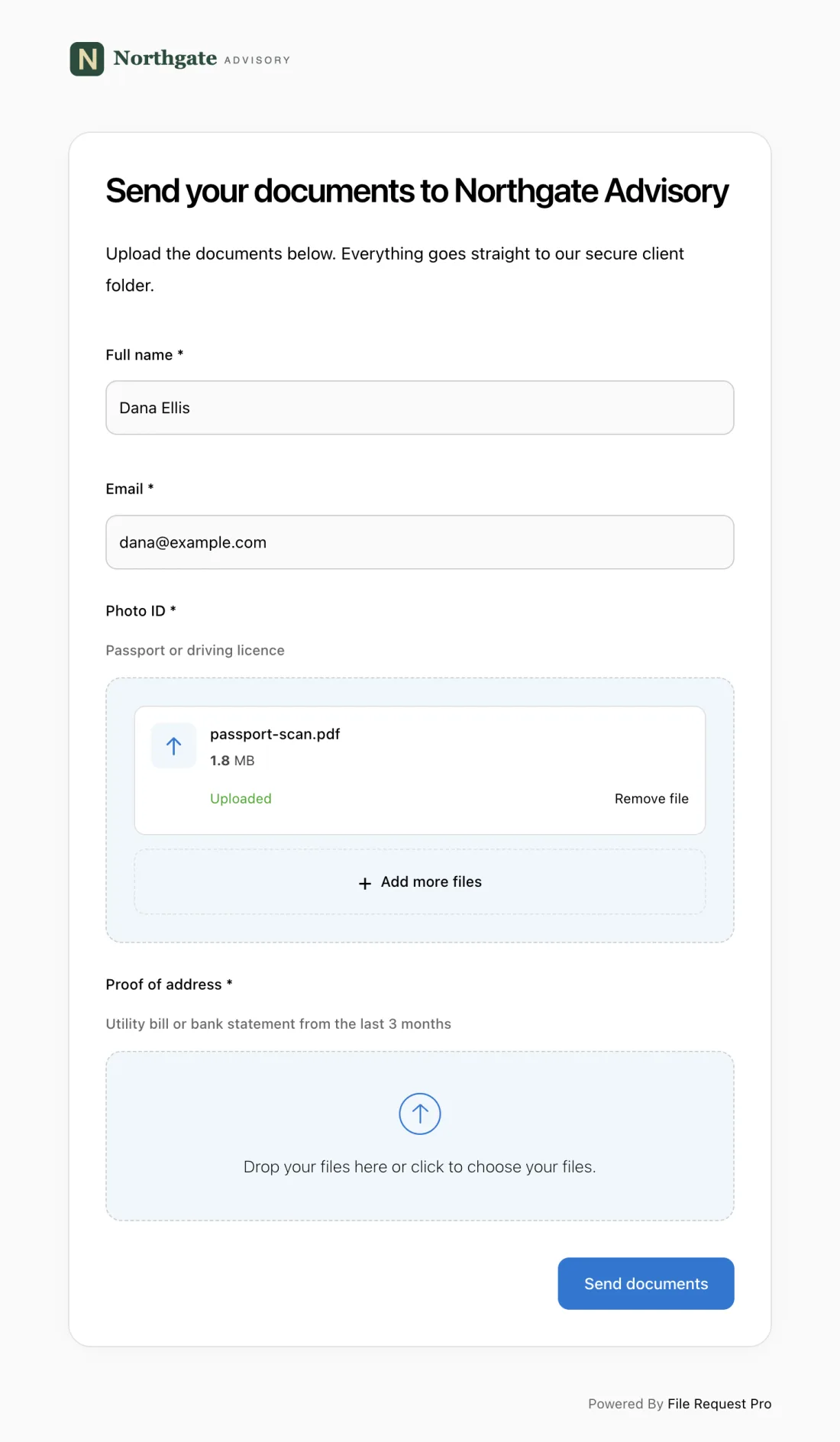
Here is what that looks like for a fund manager:
- Branded intake page — your fund's name, logo, and colors. Investors see a professional page from your fund, not a generic third-party tool.
- Form fields + file uploads combined — collect questionnaire responses and signed documents in a single submission.
- Automatic follow-up reminders — investors who haven't submitted get automatic follow-up emails on your schedule, so you stop being the person who nags.
- Cloud storage sync — submitted documents land automatically in Google Drive, OneDrive, SharePoint, or Dropbox, organized into per-investor folders. No manual downloading and renaming.
- No investor login required — investors open the link and start filling in immediately. No accounts to create, no passwords to remember, no IT support calls.
This approach works for any fund structure — private equity closings with 30 LPs, real estate syndications with 50 investors, or venture funds onboarding angels one at a time. See how it works or set up your first investor intake page in minutes.
Frequently Asked Questions
What should an investor questionnaire include?
At minimum: legal name, entity type, tax ID, accredited investor status with supporting documentation, source of funds, regulatory disclosures (PEP and sanctions screening), and signed subscription documents. Most funds also include investment profile questions — objectives, risk tolerance, and time horizon — to document suitability.
Is accredited investor verification required for all private placements?
It depends on the offering type. Rule 506(b) offerings allow self-certification — the issuer must have a "reasonable belief" that each investor is accredited. Rule 506(c) offerings, which permit general solicitation, set a higher bar: issuers must take "reasonable steps" to verify accredited status, typically through tax returns, bank statements, third-party verification letters, or FINRA professional certifications.
How do I verify source of funds for AML compliance?
Request a written declaration of the source and collect supporting documentation — bank statements, brokerage confirmations, or business financial statements. Documentation depth should match the risk: a domestic investor committing $100,000 requires less scrutiny than a foreign entity committing $5,000,000.
What is the difference between an investor questionnaire and a subscription agreement?
The questionnaire collects information your compliance team needs to verify identity, accreditation, and regulatory status. The subscription agreement is the legal contract committing capital. You verify the investor qualifies via the questionnaire before they sign the agreement. Many fund managers collect both in the same intake process.
How long should investors have to complete the questionnaire?
Give investors 7 to 14 days for individual submissions. Institutional LPs with internal legal and approval committees may need 3 to 4 weeks. Set the deadline at least two weeks before the fund's closing date to leave time for follow-ups on incomplete submissions, and send automated reminders at regular intervals to keep completion rates high.
What is the best way to collect investor documents securely?
Avoid email for tax returns, government IDs, and net worth statements — it is unencrypted, hard to track, and creates liability if data is exposed. Use a document collection tool with encryption, access controls, and an audit trail. File Request Pro lets you create secure, branded upload pages where investors submit questionnaires and documents in one step, with files syncing automatically to your cloud storage and every submission timestamped for compliance. You can set up your first intake page in under 10 minutes — no developer needed.
Free Client Onboarding Checklist
Get the complete document checklist for your industry — interactive, with progress tracking.
Use the Free Checklist Tool →