You spend 20 minutes on the phone with a promising prospect. They sound healthy, financially stable, and ready for coverage. Then halfway through underwriting, the carrier kicks the application back — the client forgot to mention a cardiac event three years ago, or they left out a second policy they already own. Now you're re-quoting, re-applying, and hoping the client hasn't gone cold.
A thorough life insurance questionnaire catches these gaps before they derail the case. It gives you a structured way to collect every detail an underwriter needs — health, lifestyle, finances, beneficiaries — so applications move forward clean the first time.
Below: a life insurance questionnaire template with 45+ questions organized by category, variations for different policy types, and a better way to collect completed questionnaires from clients without chasing emails.
What Is a Life Insurance Questionnaire?
A life insurance questionnaire is a structured set of questions you use to gather client information before recommending coverage or submitting an application. It goes beyond the standard application — helping you match the client with the right product, carrier, and coverage amount before you invest hours in a case that might not stick.
A well-built questionnaire covers six areas:
- Personal identification — name, date of birth, contact details, citizenship status
- Health and medical history — diagnoses, medications, surgeries, family health patterns
- Lifestyle and habits — tobacco use, alcohol consumption, high-risk activities, driving record
- Financial situation — income, debts, net worth, existing coverage
- Beneficiary details — who receives the death benefit and how
- Needs analysis — why they want coverage and how much they need
The questionnaire is not the application itself. It's the pre-work that makes the application accurate, reduces back-and-forth with the carrier, and cuts weeks off the underwriting timeline.
Life Insurance Questionnaire Template
Adapt this template to your practice. Add questions for niche markets you serve, remove ones that don't apply, and adjust the language to match how you talk to prospects.
Personal Information and Identity
These questions establish the basics and confirm the client's identity for the application.
- Full legal name — must match government-issued ID. Mismatches delay processing.
- Date of birth — age is the biggest factor in premium calculations.
- Gender — affects mortality tables and premium rates in most states.
- Social Security Number — required for the application and MIB (Medical Information Bureau) checks.
- Current home address — determines state regulations and available carriers.
- Phone number and email address — for follow-up and e-signature delivery.
- Citizenship or residency status — non-citizens may face different underwriting requirements.
- Government-issued photo ID type and number — driver's license, passport, or state ID.
- Marital status — affects insurable interest and beneficiary designations.
- Number and ages of dependents — directly impacts the coverage amount needed.
Health History
Health is the most scrutinized part of any life insurance application. These questions help you spot red flags early — so you can set honest expectations and place the client with a carrier that fits their profile.
- Current height and weight — carriers use build charts to assess risk. Check preferred ranges before you quote.
- Primary care physician name and contact — the carrier will order medical records (APS) from this provider.
- Date of last physical exam — a recent exam can speed up underwriting by weeks.
- Current medications — prescription and over-the-counter, with dosages. Some trigger additional underwriting questions.
- Diagnosed medical conditions — diabetes, hypertension, heart disease, cancer, asthma, depression, anxiety. Include diagnosis dates and treatment status.
- History of surgeries or hospitalizations — dates, reasons, and outcomes.
- Family medical history — parents and siblings with heart disease, cancer, stroke, or diabetes before age 60. Affects underwriting class.
- Mental health history — depression, anxiety, bipolar disorder, or other conditions. Include therapy, medication, and hospitalizations.
- History of substance abuse treatment — inpatient or outpatient. Most carriers require 2-5 years sobriety for standard rates.
Lifestyle and Habits
Lifestyle factors can bump a client from preferred to standard — or make them uninsurable with certain carriers. Honest answers here save you from quoting rates the client will never get.
- Tobacco or nicotine use — cigarettes, cigars, vaping, chewing tobacco, patches. Smoker rates run 2-3x non-smoker rates.
- Alcohol consumption — average drinks per week. Most carriers flag more than 14. Note any DUI or alcohol-related incidents.
- Recreational drug use — including marijuana. Carrier policies vary widely, even in legal states.
- High-risk hobbies — skydiving, scuba diving, rock climbing, private aviation, motor racing. Often require a flat extra.
- International travel — countries with State Department advisories can trigger exclusions or flat extras.
- Driving record — DUIs, reckless driving, suspensions, or multiple violations in the past 3-5 years.
- Criminal history — felony convictions or pending charges. Each carrier handles this differently.
- Occupation — hazardous jobs (mining, commercial fishing, logging, law enforcement) carry higher premiums.
Financial Situation
This section helps you right-size coverage and demonstrate insurable interest. Carriers flag applications where the death benefit looks disproportionate to the client's financial situation — meaning a delayed or declined case.
- Annual household income — most carriers cap death benefits at 20-30x income for applicants under 40, declining with age.
- Employer and occupation details — employer-provided group coverage factors into total coverage.
- Outstanding debts — mortgage, auto loans, student loans, credit cards, business loans. Debt replacement is a primary reason people buy coverage.
- Net worth estimate — justifies larger coverage amounts and determines whether estate planning products fit.
- Annual financial obligations — childcare, tuition, elder care, alimony, child support that would need replacement.
Beneficiary Information
Beneficiary mistakes cause delayed claims, legal disputes, and misdirected benefits. Getting this right protects the client's family and your E&O exposure.
- Primary beneficiary name, relationship, and date of birth — must match legal records. For minors, a trust or custodial arrangement is needed.
- Primary beneficiary contact information — address and phone number for claims processing.
- Contingent beneficiary — who receives the benefit if the primary predeceases the insured. Prevents probate.
- Benefit split percentages — how the death benefit divides among multiple beneficiaries. Must total 100%.
- Trust as beneficiary — is the policy payable to a trust? If so, get the trust name, date, and trustee details.
Existing Coverage and Policies
Understanding current coverage prevents over-insurance (which carriers decline) and reveals gaps you can fill.
- Current life insurance policies — carrier, type, face amount, year issued. Undisclosed policies surface during MIB checks.
- Group life insurance through employer — coverage amount and portability. Many clients don't realize employer coverage ends when they leave.
- Policies being replaced — replacement regulations vary by state and require specific disclosures.
- Previous applications declined or rated — this lives in the MIB database. The carrier will find it. Know upfront and place with a company that's lenient on that history.
Needs Analysis
These questions move the conversation from data collection to recommendation. They reveal what's driving the client's decision — and that's what turns a quote into a closed case.
- Primary reason for seeking coverage — income replacement, mortgage protection, final expenses, estate planning, business succession, key person.
- Desired coverage amount — a starting point, not the final number.
- Coverage duration preference — until kids finish college? Until the mortgage is paid? For life? Determines term length vs. permanent.
- Monthly budget for premiums — anchors your search. A policy they can't afford leads to lapses and chargebacks.
- Interest in cash value or investment component — term (pure death benefit) vs. whole life, universal life, or IUL. Narrows the product search.
Questionnaire Variations by Policy Type
The core questionnaire covers most situations. Add these product-specific questions based on what you're evaluating for the client.
Term Life Insurance
Focus on timing and conversion options:
- What specific financial obligation are you covering? (mortgage, income replacement, business loan)
- When does that obligation end? (Determines the ideal term length — 10, 15, 20, or 30 years.)
- Is a conversion option important? (Convert to permanent coverage without a new medical exam.)
- Do you anticipate your insurance needs increasing? (Consider a guaranteed insurability rider.)
Whole Life Insurance
Explore long-term financial goals and cash value expectations:
- Are you looking for guaranteed cash value growth or comfortable with market-linked returns?
- Do you plan to access cash value during your lifetime? (Policy loans, retirement income, emergency fund.)
- Is this policy part of an estate plan?
- Are you interested in participating (dividend-paying) whole life?
Universal Life Insurance
Assess comfort with premium flexibility and indexed options:
- How important is premium flexibility? (UL lets you adjust payments — helpful for variable income.)
- Are you interested in indexed universal life (IUL)?
- Risk tolerance for the cash value component?
- Do you understand that underfunding a UL policy can cause it to lapse?
Group Life Insurance
For employers offering group benefits, shift to plan design questions:
- How many employees are eligible for coverage?
- Current benefit structure? (Flat amount, salary multiple, or tiered by role?)
- Do you offer voluntary supplemental life insurance?
- Guaranteed issue amount?
- What portability or conversion options exist when employees leave the company?
How to Collect Life Insurance Questionnaires from Clients
The best questionnaire is useless if clients don't complete it. How you send and collect it affects response rates, data quality, and how many hours you spend chasing missing information.
Paper forms get filled out in a rush — handwriting gets misread, fields get skipped, and you end up calling back to clarify. Email attachments send Social Security Numbers through unencrypted channels. Generic form builders like Google Forms can't handle file uploads, and life insurance intake often requires documents alongside the questionnaire (existing policies, medical records, ID copies, financial statements).
File Request Pro lets you collect questionnaire answers and documents in one submission. Create a branded upload page with form fields for responses and file upload fields for supporting documents. Clients click a link, answer the questions, attach their files, and hit submit — no account creation, no passwords, no confused calls to your office.
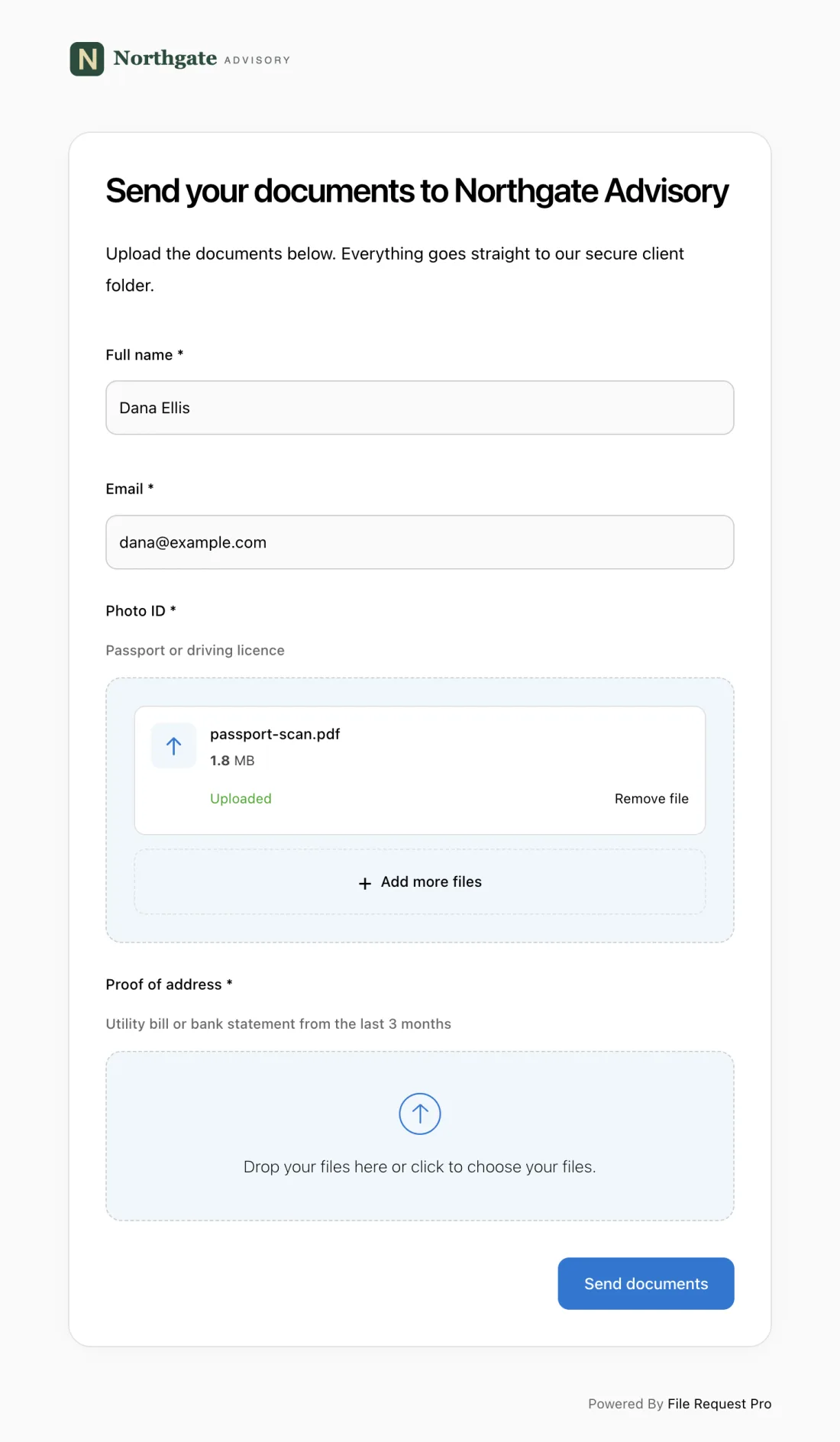
Here's what this looks like for an insurance agency:
- Branded questionnaire page — your agency's logo, colors, and messaging. Clients see a professional experience, not a generic form.
- Form fields + file uploads in one place — collect answers alongside existing policies, ID documents, medical records, and financial statements. No piecing together information from five different emails.
- Automated reminders — clients who haven't submitted get automatic follow-up emails on your schedule. Stop spending mornings writing "friendly reminder" messages.
- Cloud storage sync — submissions land in Google Drive, OneDrive, SharePoint, or Dropbox, organized into client folders. No downloading and re-uploading.
- No client account needed — click a link, fill in the form, submit. No registration, no passwords, no friction.
- Encryption — data encrypted in transit and at rest. Meets the bar for health and financial information.
- Audit trail — track when questionnaires were sent, opened, and completed. Useful for compliance and for knowing where each case stands.
Best Practices for Life Insurance Questionnaires
Explain why each question matters
Clients hesitate when asked for sensitive information without context. A brief note — "This helps us find the carrier most likely to offer preferred rates" or "Carriers check this database, so accuracy prevents delays" — builds trust and produces honest answers.
Pre-screen before the full questionnaire
Not every prospect needs 45 questions on the first interaction. Start with a 5-minute call covering deal-breakers: tobacco use, major health conditions, DUI history, hazardous occupations. Send the full questionnaire to prospects who are likely to qualify. This protects your time and avoids overwhelming someone still warming up.
Set a clear deadline
Questionnaires without deadlines sit in inboxes. Give clients a specific date and a reason: "Please complete this by Friday so I can have carrier options ready for our call on the 10th." Pair the deadline with automated reminders so you're not spending evenings writing follow-up emails.
Keep health questions specific
"Describe your health history" produces vague, unusable answers. "List all prescription medications with dosages" and "Have you been diagnosed with diabetes, heart disease, or cancer?" produce answers underwriters can work with. Specific questions mean fewer follow-up calls.
Update your questionnaire annually
Carrier underwriting guidelines change. Policies on marijuana and vaping have shifted significantly in the last two years. Review your questionnaire annually so you're not collecting outdated information or missing questions carriers now ask.
FAQ
What should a life insurance questionnaire include?
Personal identification, health and medical history (including family history), lifestyle factors (tobacco, alcohol, hobbies, driving record), financial situation (income, debts, net worth), beneficiary details, existing coverage, and needs analysis. The goal: gather enough to match the client with the right product and carrier before submitting a formal application.
How is a life insurance questionnaire different from the application?
The questionnaire is your pre-work — it helps you recommend coverage and choose the right carrier. The application is the formal document submitted to underwriting. A thorough questionnaire makes the application accurate and lowers the chance of a surprise declination or re-quote that costs you weeks.
When should agents send the life insurance questionnaire?
After the initial conversation where the client expresses interest, but before you run quotes. This gives you what you need to match the client with the best carrier for their health profile and finances.
How do I collect life insurance questionnaire responses securely?
Don't send questionnaires with sensitive health and financial data through regular email. Use a secure collection tool like File Request Pro that encrypts data in transit and at rest, requires no client login, sends automated reminders, and syncs submissions to your cloud storage.
Can I customize this life insurance questionnaire template?
Yes — and you should. If you specialize in a niche (seniors, high-net-worth, business owners), add questions for that audience. If you sell mainly term life, trim the whole life and universal life sections.
How many questions should a life insurance questionnaire have?
35-45 questions for a thorough initial assessment. Fewer and you'll miss details that matter during underwriting. More than 50 and completion rates drop. For complex cases (high-net-worth, business succession), send a supplemental questionnaire after initial screening.
Free Client Onboarding Checklist
Get the complete document checklist for your industry — interactive, with progress tracking.
Use the Free Checklist Tool →