A welder starts cutting into a pipe on a refinery platform. Thirty seconds in, he realizes nobody checked whether the line was depressurized. A scaffolder starts climbing at a construction site without noticing the overnight rain left ice on the rungs. A loader operator backs toward a trench that wasn't barricaded during the shift change.
These incidents share one thing: a 5-minute last minute risk assessment would have caught the hazard before anyone got hurt. The LMRA is the final safety gate between planning and doing — a quick, structured check that forces workers to stop, look, and think before starting a task. Below you'll find a free LMRA checklist template with 38 items organized by category, industry-specific variations, and a way to collect completed checklists from field crews digitally.
What Is an LMRA?
An LMRA — Last Minute Risk Assessment — is a short safety check performed by workers immediately before starting a task. Unlike a Job Safety Analysis (JSA) done during planning, the LMRA happens at the point of work, right before tools come out and hands start moving.
The purpose is straightforward: catch hazards that weren't visible during planning. Conditions change. Weather shifts. Equipment gets swapped. A crew member calls in sick and the replacement hasn't done this task before. The LMRA is a final checkpoint that asks: Right now, at this moment, is it safe to start?
Most LMRAs take 3 to 5 minutes. The worker or crew walks through a checklist covering the immediate environment, PPE, equipment condition, permits, and known hazards. If something fails, work stops until the issue is resolved. No exceptions.
LMRAs are standard practice across high-risk industries: construction, oil and gas, mining, manufacturing, and petrochemicals. Many companies require a completed LMRA before every task, every shift, every day. OSHA's General Duty Clause, the EU's Framework Directive 89/391/EEC, and Australia's WHS Act all support assessing risks at the point of work.
LMRA Checklist Template
Use this as a starting template. Adapt it to your site conditions, industry, and regulatory requirements.
Task & Environment Assessment
- Task understanding — Can you describe the task, its steps, and expected outcome? If not, stop and get a briefing.
- Work area inspection — Have you walked the area and checked for visible hazards (spills, debris, unstable ground, overhead loads)?
- Weather conditions — Are conditions safe for the task? Check for high winds, lightning, extreme temperatures, rain, ice, or poor visibility.
- Lighting — Is the work area adequately lit? For night work or confined spaces, is temporary lighting functioning?
- Noise levels — Are noise levels high enough to require hearing protection or interfere with communication?
- Access and egress — Are entry and exit routes clear and unobstructed? Can you evacuate quickly if needed?
- Adjacent work activities — Are other crews working nearby? Could their activities create hazards for your task?
- Housekeeping — Is the work area clean and organized? Are walking surfaces clear of tripping hazards?
Personal Protective Equipment (PPE)
- Required PPE identified — Do you know which PPE this task requires? Check the JSA, work permit, or site PPE matrix.
- PPE condition — Is all PPE in good condition? Inspect hard hats for cracks, glasses for scratches, gloves for tears, harnesses for fraying.
- PPE fit — Does your PPE fit properly? An ill-fitting harness or loose respirator gives a false sense of protection.
- Respiratory protection — If the task involves dust, fumes, or vapors, is the correct respiratory protection available and fit-tested?
- Fall protection — If working at height (above 1.8m/6ft), is fall protection in place — harness, lanyard, anchor points, guardrails?
- Specialized PPE — Does the task require specialized protection (arc flash suit, chemical-resistant clothing, fire-retardant coveralls)?
Tools & Equipment
- Tool inspection — Have you inspected all tools before use? Check for damage, wear, missing guards, and proper labeling.
- Electrical equipment — Are power tools tested, tagged, and within inspection date? Are cords intact?
- Lifting equipment — Are slings, shackles, and lifting gear inspected and rated for this load?
- Scaffolding and platforms — Is scaffolding tagged as inspected? Are platforms complete with guardrails and toe boards?
- Ladders — Are ladders in good condition, on stable ground, at the correct angle, and secured against movement?
- Vehicles and mobile equipment — Have pre-start checks been completed? Are reversing alarms and lights working?
- Right tool for the job — Are you using the correct tool? Improvised tools or equipment used beyond its design limits create unnecessary risk.
Permits & Procedures
- Work permit status — If the task requires a permit (hot work, confined space, excavation, electrical isolation), is it issued, signed, and valid?
- Isolation and lockout/tagout — If energy isolation is needed, has LOTO been completed and verified? Can you confirm zero energy state?
- Standard operating procedure — Do you have the current SOP for this task? Is it the latest revision?
- Competency and training — Are all crew members trained and competent for their assigned roles? Are certifications current?
- Communication — Does everyone know the plan, their role, and how to communicate during the task?
Hazard Identification
- Energy sources — Have you identified all energy sources (electrical, hydraulic, pneumatic, chemical, thermal, gravitational)?
- Suspended loads — Are there loads overhead or being lifted nearby? Are you outside the drop zone?
- Excavations and openings — Are trenches, pits, and floor openings barricaded or covered? Is shoring in place where required?
- Chemical hazards — Are Safety Data Sheets (SDS) available for all chemicals in use? Are spill kits nearby?
- Biological hazards — Are there risks from insects, snakes, mold, or other biological hazards at the location?
- Line of fire — Have you positioned yourself out of the line of fire? Could you be struck by moving objects or falling materials?
- Pinch points and entanglement — Have you identified where hands, clothing, or hair could be caught in moving parts?
Emergency Preparedness
- Emergency procedures — Do you know the site emergency procedure, muster point, and emergency contact numbers?
- First aid — Is a first aid kit accessible? Do you know who the trained first aiders are on your crew or nearby?
- Fire protection — If hot work or flammable materials are involved, is a fire extinguisher staged and a fire watch assigned?
- Rescue plan — For confined space entry or work at height, is a rescue plan in place with equipment and trained rescuers ready?
- Stop work authority — Does every crew member know they have the authority — and the obligation — to stop work if they see an unsafe condition?
When to Use an LMRA Checklist
The LMRA is not a once-a-day exercise. Revisit the checklist whenever conditions shift:
- Before starting any task — every task, every shift, every day. Even routine work the crew has done hundreds of times. Familiarity breeds complacency.
- After breaks and shift changes — equipment may have moved, another crew might have started nearby, or a new hazard may have appeared.
- When conditions change — weather deteriorates, equipment breaks down, scope changes mid-task, or a new chemical is introduced.
- When new personnel join — replacement workers or specialists walk through the LMRA themselves. Fresh eyes often catch what the original crew missed.
- After an incident or near-miss — stop, reassess, and complete a fresh LMRA before resuming. The conditions that caused the near-miss may still be present.
LMRA Checklist by Industry
The core LMRA structure stays the same across industries, but the hazards shift depending on the work environment. Here is what to add for each sector.
Construction Sites
Focus on fall hazards (leading edges, open floor holes, incomplete scaffolding), struck-by hazards (crane operations, material hoisting), excavation safety (shoring, soil classification, underground utilities), and multi-trade coordination. Pair the LMRA with a construction daily report form for a complete daily safety and progress record.
Oil & Gas
Focus on gas testing with calibrated detectors (LEL, O2, H2S, CO), process isolation verification, ignition source control in classified areas, H2S awareness with wind socks and escape respirators, and SIMOPS (simultaneous operations) conflict checks between production, drilling, and maintenance.
Manufacturing & Industrial
Focus on machine guarding verification, lockout/tagout at the point of work (not assumed from a tag), chemical handling with correct ventilation and spill containment, ergonomic hazards, and forklift-pedestrian interaction zones.
Mining
Focus on ground condition inspections (roof, walls, water seepage), ventilation and dust suppression checks, mobile equipment traffic management on haul roads, blast clearance and misfire inspections, and geotechnical assessment of pit walls and bench faces.
How to Collect LMRA Checklists from the Field
The hardest part of any LMRA program is not the checklist — it is getting completed forms back from the field in a way that is consistent, auditable, and does not bury the safety team in paperwork.
Paper forms work until they don't. They get lost, damaged by weather, or sit in a truck cab for weeks. Handwriting is illegible. Photos can't be attached. And when an auditor asks for records from a specific date, someone has to dig through filing cabinets. That delay can turn a routine audit into a costly citation.
File Request Pro solves this. You create a branded upload page with your LMRA checklist fields built in — workers open a link on their phone, fill in responses, attach photos of hazards or site conditions, and hit submit. No app to install. No account to create. No IT support needed.
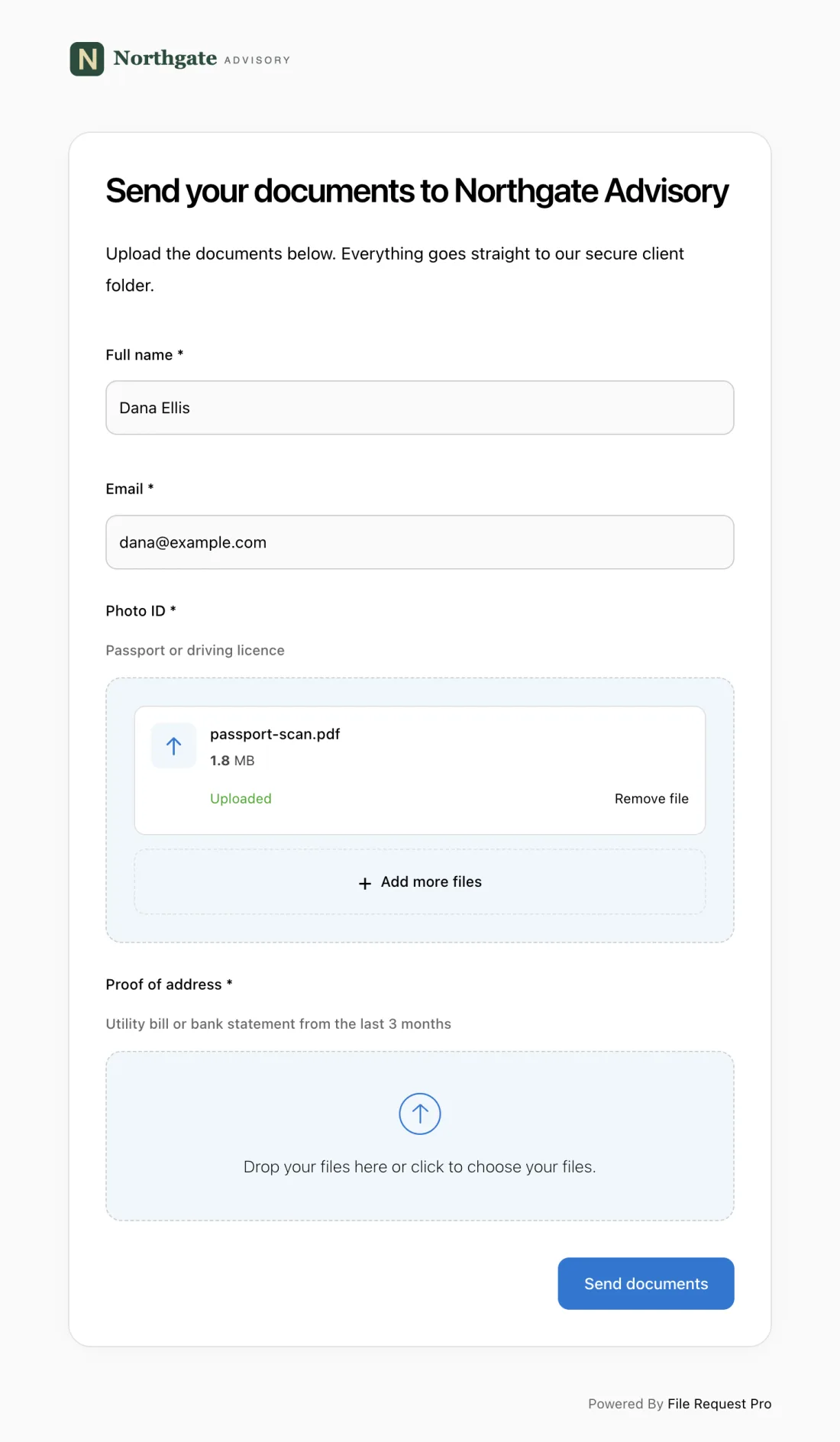
Here is how it works for safety teams:
- No worker accounts needed — field workers, subcontractors, and temp crew open a link and submit. No app downloads, no passwords, no IT setup. When your workforce rotates weekly, this removes the biggest adoption barrier.
- Photo attachments — workers photograph hazards, damaged equipment, or site conditions and attach them directly. A photo of a cracked scaffold coupler says more than a checked box.
- Automated reminders — set up automatic reminders for crews that haven't submitted their LMRA by a set time. The system follows up so your safety coordinator doesn't spend the morning chasing forms.
- Cloud storage sync — completed LMRAs flow to Google Drive, OneDrive, SharePoint, or Dropbox, organized by date, crew, or project. No manual filing, no lost paperwork.
- Audit trail — every submission is timestamped with a complete audit trail. When an auditor asks for LMRA records from last Tuesday, you pull them in seconds, not hours.
- Encryption — data is encrypted in transit and at rest. Site information, worker details, and hazard reports stay protected.
LMRA Best Practices
Keep it short and field-friendly
An LMRA that takes 20 minutes becomes one that gets pencil-whipped. Aim for a checklist a competent worker can finish in 3 to 5 minutes. If you need a longer assessment, that's a JSA — not an LMRA.
Make it a conversation, not a form
The strongest LMRAs happen when a crew talks through the checklist together. One person filling out a form in silence misses what the rest of the team already knows. Have the crew discuss each item out loud, with one person recording the outcome.
Act on the findings
Nothing kills an LMRA program faster than ignored findings. If a crew flags a missing barricade on their LMRA and nothing happens, they stop flagging hazards altogether. Respond visibly and quickly — even a same-day acknowledgment keeps workers engaged.
Review data for trends
Individual LMRAs catch individual hazards. Aggregate hundreds of them and patterns emerge — the same PPE failures week after week, the same problem areas on site. Use that data to drive systemic improvements, not one-off fixes.
Train for quality, not compliance
Workers who see the LMRA as box-ticking will produce box-ticking results. Training should focus on why the LMRA exists — real incidents where a last-minute check would have prevented an injury — not how to fill out the form.
FAQ
What does LMRA stand for?
LMRA stands for Last Minute Risk Assessment. It is a brief safety check done at the point of work, right before starting a task. The goal is to catch hazards that weren't visible during planning — changed weather, swapped equipment, or new activities nearby.
What is the difference between an LMRA and a JSA?
A Job Safety Analysis (JSA) is a detailed planning document that breaks a task into steps and identifies hazards for each. An LMRA is a shorter, field-level check done right before work begins. The LMRA complements the JSA — it does not replace it. Think of the JSA as the pre-flight plan and the LMRA as the runway check before takeoff.
How long should an LMRA take?
3 to 5 minutes for a standard task. If workers need more than 10 minutes, the checklist is too long or the task needs a deeper assessment like a JSA or HAZOP. The LMRA should be quick enough that workers complete it honestly rather than rushing through it.
Is an LMRA legally required?
The term "LMRA" does not appear in legislation, but the practice is backed by safety regulations in most jurisdictions. OSHA's General Duty Clause (Section 5(a)(1)) requires workplaces free from recognized hazards. The EU's Framework Directive 89/391/EEC requires risk assessment. Australia's WHS Act requires minimizing risks so far as reasonably practicable. A documented pre-task risk assessment is one of the clearest ways to meet these obligations.
Who is responsible for completing the LMRA?
The workers performing the task. For a crew, the foreman or crew leader typically leads the assessment with input from all members. Supervisors should review completed LMRAs periodically, but the assessment belongs to the people doing the work — they see the hazards first.
Can workers stop work based on an LMRA finding?
Yes — and they must. If an LMRA reveals a hazard that cannot be controlled, work does not start until the issue is resolved. Stop Work Authority applies to every worker on every site, regardless of schedule pressure. Organizations that punish workers for stopping work will find nobody reports hazards at all.
