A tenant screening questionnaire is one of the most effective tools landlords have for separating qualified applicants from costly mistakes. Bad tenants don't just miss rent — they cause property damage, drive away good neighbors, and trigger eviction proceedings that can cost thousands of dollars and take months to resolve.
This template gives you 50+ screening questions organized by category, along with a legal compliance guide, a scoring framework, and step-by-step advice on sending your questionnaire. Copy what you need, skip what you don't, and adapt the questions to your property.
What to Include in a Tenant Screening Questionnaire
A thorough screening questionnaire covers six areas:
- Personal information — identity verification, contact details, and who will live in the unit
- Employment and income — proof they can afford the rent
- Rental history — how they treated previous properties and landlords
- References — third-party verification of character and reliability
- Lifestyle and habits — smoking, vehicles, move-in timeline
- Pet information — type, size, breed, and vaccination status
The goal is not to collect every piece of information possible — it's to collect the right information to make a confident decision while staying within legal boundaries. Every question should have a clear purpose tied to tenancy qualifications.
Tenant pre-screening questionnaire: what to ask first
A tenant pre-screening questionnaire is a short form completed before a full rental application or screening report. It checks timing, household size, income range, pets, smoking, and the property's basic requirements. Ask every prospective renter the same lawful questions, use consistent criteria, and follow the housing laws that apply.
Keep pre-screening brief. You are looking for obvious mismatches before either side spends time on a viewing or full application. This is not the stage to collect every detail you might use for a final decision.
- When would you like the tenancy to begin?
- How long are you looking to rent?
- How many people would live in the property?
- Does the household meet the stated income requirement?
- Can you provide proof of income during the application?
- Do you have pets? If so, what type and how many?
- Does anyone in the household smoke?
- Do you need parking, accessibility features, or another advertised amenity?
- Have you reviewed the rent, deposit, location, and property rules?
- Is there anything about your timing or requirements the landlord should know before arranging a viewing?
After pre-screening, send the full renter questionnaire to everyone who moves forward. The detailed questions below cover employment, income, rental history, references, and the other information used in your screening process.
50+ Tenant Screening Questions by Category
Not every question will apply to every property. A single-family home with a yard needs pet and lawn care questions. A no-pet studio apartment doesn't. Pick the categories and questions that match your situation.
Personal Information
- What is your full legal name?
- What is your date of birth? — Needed for background and credit checks.
- What is your Social Security number? — Required for credit screening. Collect this securely, not over email.
- What is your current address?
- What is your phone number and email address?
- How many people will live in the unit? — List all adults and children by name and age.
- Will anyone not listed on the lease be staying regularly?
- Do you have a valid government-issued photo ID?
- What is your desired move-in date?
- How long do you plan to rent the property?
Employment and Income
Most landlords use a 3x rent rule — gross monthly income should be at least three times the monthly rent. These questions help verify that threshold.
- What is your current employer's name and address?
- What is your job title?
- How long have you been at your current job?
- What is your gross monthly income?
- Can you provide recent pay stubs (last two to three months)?
- Do you have additional sources of income? — Freelance work, investments, child support, etc.
- If self-employed, can you provide your last two tax returns?
- What is your supervisor's name and contact information?
- Have you ever been terminated from a job? If so, why?
- Can you provide bank statements from the last three months? — Useful for verifying savings and spending patterns, especially for self-employed applicants.
- Do you have a co-signer or guarantor? — If the applicant's income is borderline, a co-signer with strong credit can reduce your risk.
Credit and Financial History
- Do you authorize a credit check? — You must get written consent before pulling credit.
- Do you have any outstanding debts or collections?
- Have you ever filed for bankruptcy? If so, when and what chapter?
- Have you ever had a judgment entered against you?
- Do you have any current liens on your assets?
Rental History
Rental history is often the best predictor of future tenant behavior. A tenant who paid late at their last three apartments will pay late at yours.
- What is your current landlord's name and phone number?
- What is your current monthly rent?
- Why are you moving from your current residence? — Vague answers ("just want a change") deserve follow-up.
- Have you ever been evicted or asked to leave a rental?
- Have you ever broken a lease early?
- Have you ever been late on rent? If so, how often?
- Did you receive your full security deposit back from your last rental? — If not, ask why.
- Please provide contact information for your two most recent landlords.
- Have you ever had any legal disputes with a landlord?
- Can you provide a copy of your current lease? — This confirms rent amounts, lease terms, and move-out dates without relying on the applicant's memory.
- Have you ever filed a complaint against a landlord? — Note: in many states, retaliating against a tenant for filing complaints is illegal. Use this for context, not as a disqualifying factor.
References
- Can you provide two personal references (non-family)? — Include name, relationship, phone number.
- Can you provide a professional reference?
- Do you consent to us contacting your current and previous landlords?
When calling references, ask specific questions: "Did they pay rent on time?" and "Would you rent to them again?" matter more than "Were they a good tenant?"
Lifestyle and Habits
- Do you or anyone in your household smoke?
- How many vehicles do you own? — Important for properties with limited parking.
- Do you work from home? — Affects utility usage and noise considerations.
- Do you play any musical instruments? — Relevant for multi-unit buildings with noise policies.
- Have you ever had a noise complaint filed against you?
- Are you willing to carry renter's insurance?
- Do you have any large items (waterbed, hot tub, large aquarium) that could affect the property?
- Do you plan to run a home business from the rental? — A home-based business can affect insurance, zoning compliance, and foot traffic to the property.
- What is your typical daily schedule (day shifts, overnight work, etc.)? — Helps you assess noise and parking patterns, especially in multi-unit buildings.
Pet Information
If your property allows pets, these questions protect you. If it doesn't, note that service animals and emotional support animals are not classified as pets under the Fair Housing Act. You cannot refuse a tenant for having one.
- Do you have any pets?
- What type of animal, breed, and weight?
- How old is the pet?
- Is the pet spayed or neutered?
- Are vaccinations current? Can you provide documentation?
- Has the pet ever caused damage to a rental property?
- Has the pet ever bitten anyone?
- Are you willing to pay a pet deposit and/or monthly pet rent?
Emergency and Additional Information
- Who should we contact in case of emergency?
- Do you have any special needs regarding the property that we should know about?
- Is there anything else you'd like us to know about your application? — Open-ended questions often reveal details applicants wouldn't otherwise share.
Questions You Legally Cannot Ask
The Fair Housing Act prohibits discrimination based on seven protected classes. Asking certain questions, even casually during a showing, can expose you to fair housing complaints and lawsuits.
| Protected Class | Questions You Cannot Ask |
|---|---|
| Race or Color | Any question about race, ethnicity, or skin color |
| National Origin | "Where are you from?" or "What country were you born in?" |
| Religion | "What church do you attend?" or "Do you observe any religious holidays?" |
| Sex | Questions about gender, sexual orientation, or gender identity |
| Familial Status | "Are you pregnant?" or "Do you plan to have children?" or "How old are your kids?" |
| Disability | "Do you have a disability?" or "Why do you need a wheelchair ramp?" |
| Veteran/Military Status | "Were you in the military?" (protected in some states) |
State and local laws may add protections. Many jurisdictions also protect against discrimination based on source of income (such as Section 8 vouchers), marital status, age, veteran status, or criminal history. Before finalizing your questionnaire, check your state and local fair housing laws.
To stay compliant:
- Use the same questionnaire for every applicant. No exceptions.
- Tie every question to the ability to pay rent, care for the property, or comply with lease terms.
- Document your screening criteria before you start reviewing applications. This is your strongest defense if a rejected applicant files a complaint.
- Never comment on an applicant's accent, appearance, or family situation.
- If a question doesn't directly relate to tenancy qualifications, remove it.
How to Score Tenant Applications
A point-based scoring system removes emotion and bias from tenant selection. Every applicant gets measured against the same standard. Assign points for each qualification area and set a minimum threshold for approval.
Sample Scoring Framework
| Category | Criteria | Points |
|---|---|---|
| Income | Gross income is 3x+ rent | 20 |
| Income | Gross income is 2.5x–3x rent | 10 |
| Credit Score | 700+ | 20 |
| Credit Score | 650–699 | 15 |
| Credit Score | 600–649 | 5 |
| Rental History | Positive references from last two landlords | 20 |
| Rental History | One positive, one neutral reference | 10 |
| Employment | Stable employment (2+ years at current job) | 15 |
| Employment | Employed less than 2 years | 10 |
| Eviction History | No evictions | 15 |
| Background | Clean background check | 10 |
Threshold example: 70+ points = approve, 50–69 = approve with conditions (larger deposit, co-signer), below 50 = decline.
Red Flags to Watch For
Any one of these should give you pause. Two or more together should prompt serious reconsideration.
- Gaps in rental history with no explanation
- Refusal to provide landlord references
- Income that doesn't meet the 3x rent minimum
- Multiple evictions or broken leases
- Inconsistent information (for example, the employer name on the application doesn't match what the reference confirms)
- Pressure to skip the screening process or move in immediately
Signs of a Strong Tenant
- Stable, verifiable income well above the 3x threshold
- Long tenure at previous rentals (2+ years each)
- Previous landlords who say they would rent to them again
- Complete, honest application with all documentation attached
- Renter's insurance already in place, which means they understand liability and won't push claims onto your policy
State-Specific Tenant Screening Laws
Tenant screening rules vary widely from state to state. A questionnaire that's perfectly legal in Texas could violate fair housing laws in California or New York. Before you send anything to applicants, know what your state allows.
Source of Income Discrimination
A growing number of states and cities prohibit landlords from rejecting applicants based on their source of income, including Section 8 Housing Choice Vouchers.
States with source of income protections include California, New York, New Jersey, Oregon, Washington, Massachusetts, Connecticut, Vermont, and the District of Columbia. Several cities (including Chicago, Dallas, and Philadelphia) have passed local protections even where the state has not.
If you operate in one of these jurisdictions, you cannot include questions designed to screen out voucher holders or ask whether an applicant's income comes from government assistance. You can still verify that total income (including voucher amounts) meets your rent threshold.
Criminal History ("Ban the Box") Restrictions
Several states and cities restrict when and how landlords can ask about criminal history on rental applications.
California's Fair Chance Act prohibits landlords from asking about criminal history before making a conditional offer. Seattle, Minneapolis, Portland (OR), and Newark have similar rules. In these areas, you must evaluate the applicant's qualifications first and can only inquire about criminal records after a conditional approval.
Even where criminal history questions are allowed, HUD guidance warns that blanket bans on applicants with any criminal record may violate the Fair Housing Act because of their disparate impact on protected groups. If you screen for criminal history, evaluate each case individually: consider the nature of the offense, how long ago it occurred, and evidence of rehabilitation.
Security Deposit Limits
Some states cap how much you can collect as a security deposit. Others have no limit at all.
- California: Capped at one month's rent (as of July 2024)
- New York: Capped at one month's rent
- New Jersey: Capped at one and a half months' rent
- Texas and Ohio: No state-imposed cap
Your questionnaire should reflect your state's deposit rules. If you ask applicants whether they can afford a deposit, make sure the amount you quote is legal in your jurisdiction.
Application Fee Caps
Some states limit what landlords can charge for application fees. California caps fees at the actual cost of screening (roughly $55–$60 as of 2025, adjusted annually) and requires an itemized receipt. New York prohibits application fees entirely, though landlords can charge for credit checks up to $20. Wisconsin has no cap but requires fees to be "reasonable."
If your state caps fees, include the exact amount and a disclosure on your questionnaire so applicants know what they're paying for.
Bottom Line
Screening laws change frequently, and violations carry real penalties, including fines and lawsuits. Check your state attorney general's website or a local landlord-tenant attorney before finalizing your questionnaire. The National Conference of State Legislatures (NCSL) also maintains updated guides on landlord-tenant laws by state.
How to Send Your Tenant Screening Questionnaire
The best questionnaire won't help if applicants give up halfway through. How you deliver it affects whether people finish.
Skip email attachments. Emailing a Word document or PDF creates friction. Tenants have to download, fill in, save, and send back. Many will abandon the process midway. And sensitive information like Social Security numbers should never travel over plain email.
Use a secure online form. A dedicated form or file request page lets applicants fill in their answers, upload supporting documents (pay stubs, ID, pet vaccination records), and submit everything in one step. You get structured, organized responses instead of scattered email threads, which makes it much easier to compare applicants side by side.
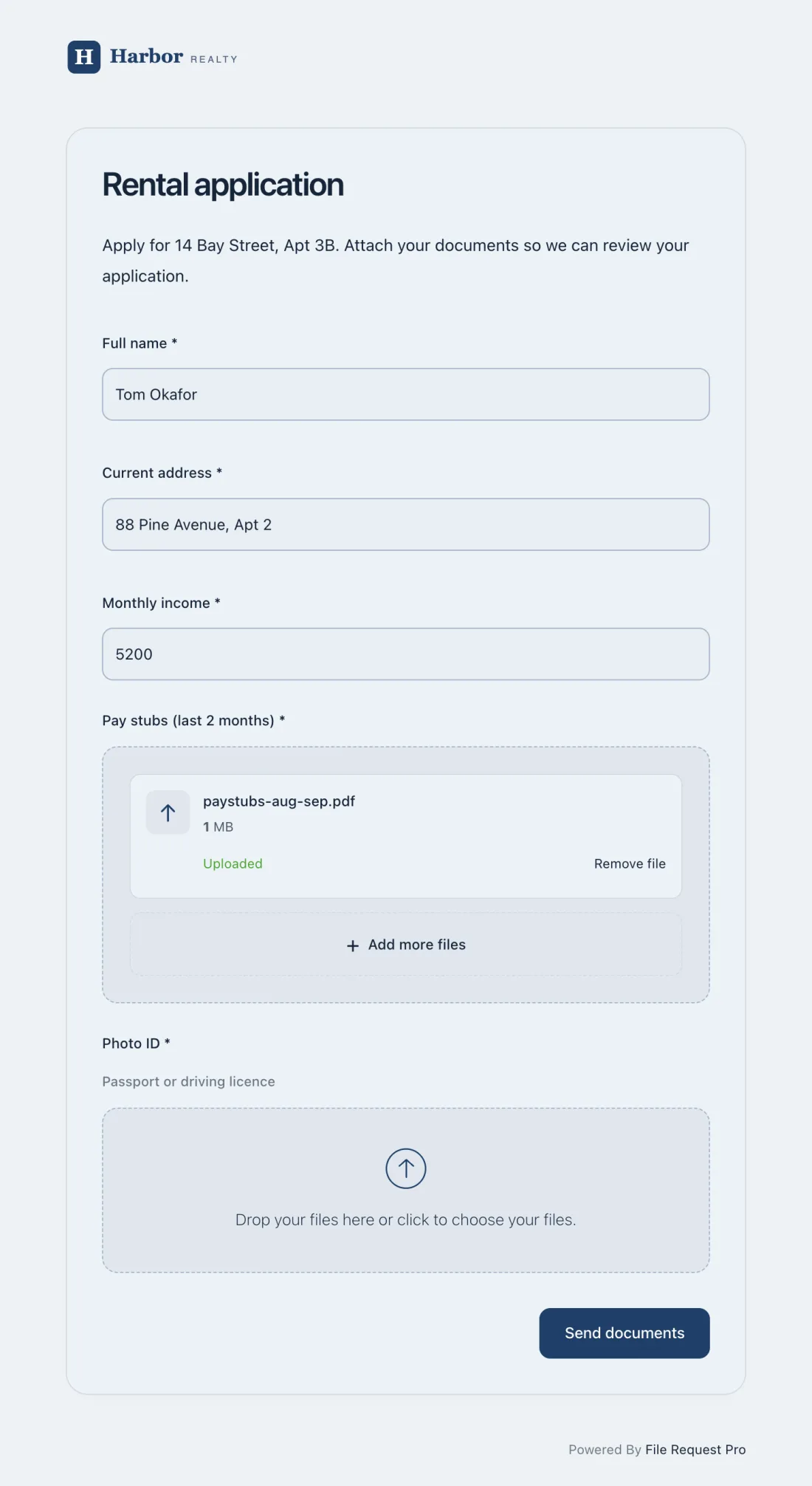
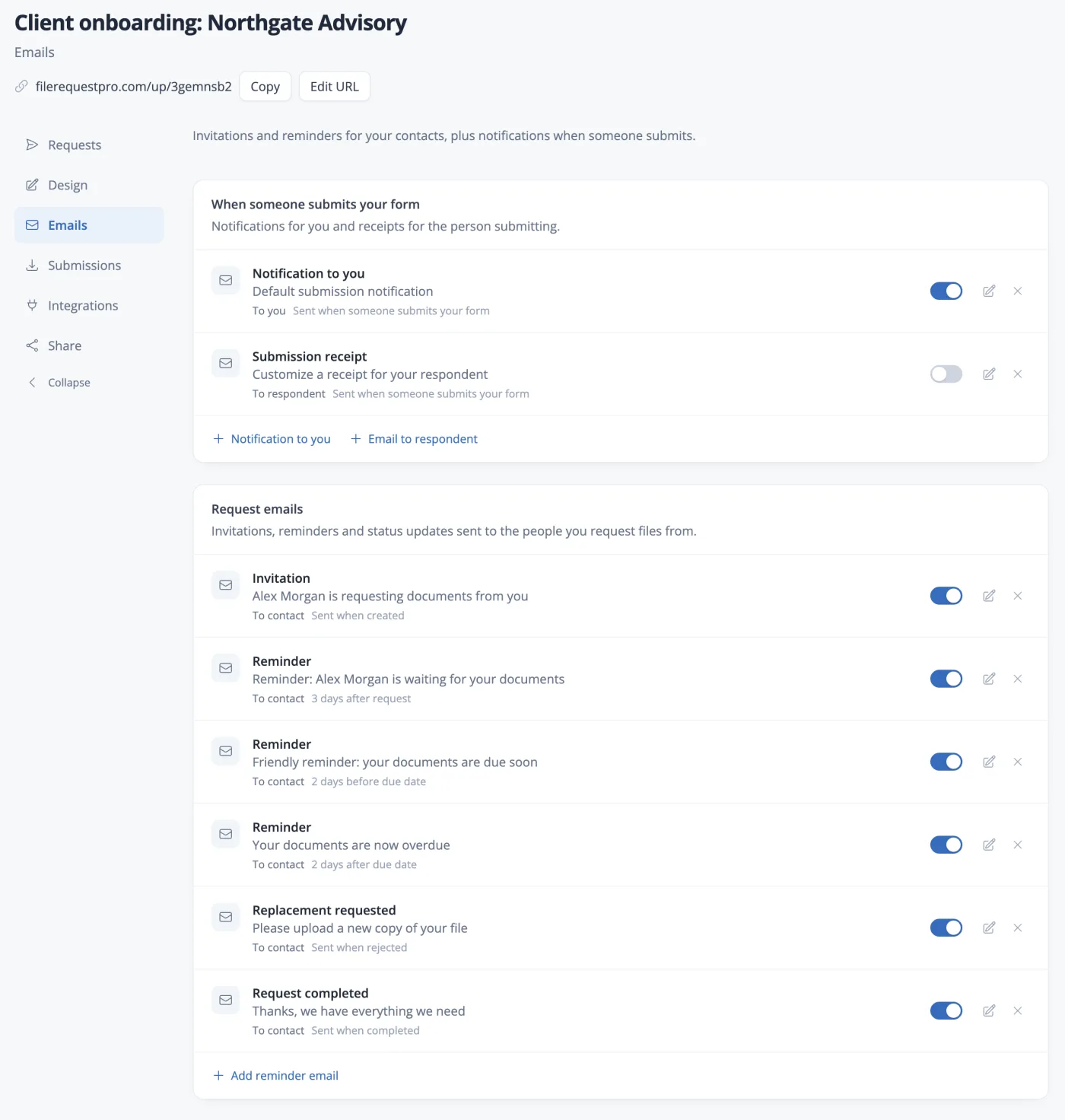
File Request Pro works well for this. You create a questionnaire page with your screening questions, applicants fill it out and upload their documents, and everything syncs to your Google Drive or OneDrive in organized folders. No manual downloading or sorting. You can also set up automated reminder emails so you're not chasing applicants who started the form but didn't finish. For requests after move-in, use a separate repair request form so maintenance issues remain actionable and easy to track.
Whatever tool you choose, look for three things: security for sensitive documents, a mobile-friendly experience so applicants can complete it from any device, and a consistent format that makes it easy to compare applications.
Frequently Asked Questions
What questions should a landlord ask a potential tenant?
Focus on questions that verify a tenant's ability to pay rent and take care of your property: employment and income details, rental history, landlord references, credit authorization, and pet information. Every question should relate directly to tenancy qualifications. Avoid questions about protected classes under the Fair Housing Act, including race, religion, national origin, familial status, disability, and sex.
How many questions should a tenant screening questionnaire have?
A solid questionnaire typically includes 30 to 50 questions across six to eight categories. Too few questions and you miss information you need. Too many and applicants abandon the form. Focus on the questions that directly affect your approval decision and cut anything that doesn't.
Can I ask a tenant about their criminal history?
In many jurisdictions, yes, but with restrictions. Several states and cities have "ban the box" laws that limit when and how landlords can ask about criminal history. HUD also advises that blanket bans on applicants with criminal records may violate the Fair Housing Act. If you screen for criminal history, evaluate each case individually based on the nature of the offense, how long ago it occurred, and evidence of rehabilitation.
Is it legal to require a minimum credit score for tenants?
Yes, as long as you apply it consistently to all applicants. A common threshold is 620 to 650, though this varies by market and property type. Document your criteria before you begin screening and apply the same standard to every application.
Can I charge an application fee for tenant screening?
Most states allow landlords to charge a reasonable application fee to cover credit checks and background screening. However, some states cap the amount. California limits the fee to actual screening costs (roughly $55–$60, adjusted annually) and requires an itemized receipt. New York prohibits application fees but allows credit check charges up to $20. Check your state's regulations before setting your fee.
What documents should I ask tenants to provide with their application?
At minimum, request government-issued photo ID, proof of income (two to three recent pay stubs or tax returns for self-employed applicants), and written authorization for credit and background checks. Depending on your screening criteria, you may also ask for bank statements, a letter of employment, and contact information for current and previous landlords.
How long should I keep tenant screening records?
Keep all screening records, both approved and denied applications, for at least three to four years. This protects you if a rejected applicant files a fair housing complaint. Store records securely and dispose of sensitive information (Social Security numbers, credit reports) according to your state's data protection requirements.
Should I use the same questionnaire for every applicant?
Yes, always. Using the same questionnaire for every applicant is a core fair housing compliance practice. It ensures consistency, makes it easier to compare applicants objectively, and protects you from discrimination claims. You can have different versions for different property types (a pet-friendly property might include pet questions that a no-pet property skips), but every applicant for the same property should receive the same form.
Free Client Onboarding Checklist
Get the complete document checklist for your industry — interactive, with progress tracking.
Use the Free Checklist Tool →