Every marketing engagement starts the same way — the client says "we need help with marketing," and you reply "great, tell me about your business." What follows is a painful cycle of half-answered emails, missing brand guidelines, and login credentials buried across Slack threads. Two weeks in, you're still chasing the basics instead of building a strategy that generates revenue.
A well-structured marketing questionnaire eliminates this chaos. It captures everything you need before the engagement kicks off — business context, audience details, current marketing efforts, brand assets, competitive landscape, goals, and account access. Below you'll find 38 ready-to-use client discovery questions organized by category, variations for different engagement types, best practices for getting complete responses, and a smarter way to send your questionnaire.
What Is a Marketing Questionnaire?
A marketing questionnaire is a structured set of questions that agencies and consultants send to new clients at the start of an engagement. It collects business background, audience insights, brand details, and technical access needed to build a strategy grounded in reality — not assumptions from a 30-minute discovery call. The client answers everything in one place, and you start with a complete picture instead of a patchwork of guesses.
Business Overview
These questions establish the foundation. You cannot write a compelling ad headline, choose the right keyword, or plan a campaign without understanding what the business does and why customers choose it.
- What is your company name and website URL? — Confirm the exact domain, including any subdomains or regional sites.
- Describe your business in two to three sentences. — How clients describe their business reveals the language customers encounter — and the messaging gaps you need to close.
- What industry or niche do you operate in? — "B2B SaaS for construction project management" is more actionable than "technology."
- How large is your company? — Employees, revenue range, and locations help you calibrate the marketing plan's scale and budget.
- What is your unique selling proposition? — This drives every downstream decision: positioning, ad copy, landing pages, and content strategy.
- What products or services generate the most revenue? — Tells you where to concentrate marketing spend first for the fastest ROI.
Target Audience
Marketing that tries to reach everyone reaches no one. These questions force specificity about who the client's most profitable customers are and how they make purchase decisions.
- Who is your ideal customer? — Describe them by demographics, job title, company size (for B2B), or lifestyle characteristics (for B2C).
- Do you have documented buyer personas? If so, please share them. — Existing personas save weeks of research and give you a head start on targeting.
- What are your customers' biggest pain points or challenges? — Pain points shape messaging, ad angles, and content topics. Without them, your copy lacks urgency.
- What objections do prospects commonly raise before buying? — Knowing objections lets you neutralize them in landing pages and ads before they stall a deal.
- How do your customers typically find you today? — Reveals which channels already produce results, so you can double down rather than start from scratch.
- What does the typical purchase journey look like, from awareness to decision? — A $29 impulse purchase demands different tactics than a six-month B2B sales cycle with five stakeholders.
Current Marketing
Before building a new strategy, you need an honest picture of what already exists. These questions prevent you from recommending tactics the client already tried and abandoned — or worse, disrupting efforts that are quietly driving revenue.
- Which marketing channels are you currently active on? — SEO, PPC, email, social media, content, events, print, partnerships. Include channels tried and stopped, with the reason.
- What's working well right now? — Protect what already produces results before changing anything. Ignoring working channels destroys value fast.
- What's not working, and why do you think that is? — The client's diagnosis reveals expectations, frustrations, and hidden assumptions you must address early.
- Have you worked with a marketing agency or consultant before? What happened? — Surfaces what the client values, what disappointed them, and landmines you need to avoid.
- What is your current monthly or annual marketing budget? — Budget determines what's feasible. A $50K strategy for a $5K budget damages credibility.
- How is your budget currently allocated across channels? — Reveals spending priorities and areas of over- or under-investment that your strategy can fix.
Brand Identity
Brand inconsistency kills trust. Your agency cannot maintain consistency without the right source materials. These questions ensure you represent the brand accurately from the first deliverable — not the third revision.
- Do you have a brand style guide or brand guidelines document? If so, please upload it. — Prevents your team from using the wrong logo version, picking off-brand colors, or writing in the wrong tone.
- Describe your brand voice and tone in a few words. — "Professional but approachable" or "bold and irreverent" — this shapes everything from social captions to landing page copy.
- Can you provide your current logo files, brand colors, and approved fonts? — Request vector files (AI, EPS, SVG), hex color codes, and font files upfront to avoid delays.
- Do you have an approved messaging framework, tagline, or elevator pitch? — Gives your copywriters a foundation instead of forcing them to guess at the brand's core promise.
- Are there any words, phrases, or topics your brand avoids? — Every brand has guardrails. Breaking them — even once — erodes client confidence fast.
Competitive Landscape
Understanding who the client competes with — and how those competitors market — reveals gaps to exploit, angles to own, and realistic performance benchmarks.
- Who are your top three to five competitors? — Include both direct competitors and indirect alternatives solving the same problem differently.
- What do your competitors do well in their marketing? — Tells you where to compete head-on and where to carve out a different angle entirely.
- Where do you believe you have a competitive advantage? — Raw material for positioning and the messaging that wins deals.
- How would you describe your market positioning relative to competitors? — Premium vs. value, niche vs. full-service — positioning shapes every marketing decision.
Goals and KPIs
Without clear goals upfront, every monthly report becomes a debate about whether the agency is delivering value — and those debates end contracts.
- What are your top three marketing objectives for the next 6-12 months? — Limiting to three forces prioritization. Agencies chasing ten goals deliver on none.
- How do you currently measure marketing success? — A client tracking vanity metrics needs education; a client with attribution models needs sophisticated reporting.
- What specific KPIs matter most to your team? — MQLs, cost per lead, ROAS, organic traffic, conversion rate — agree on the scoreboard before the game starts.
- Is there a specific revenue or lead target tied to this engagement? — "Grow leads" is useless. "200 qualified leads per month at $45 CPA" gives you a strategy to reverse-engineer.
- What is your timeline for seeing results? — A client expecting SEO results in 30 days needs expectations reset now. This prevents the misalignment that causes early churn.
- What is your budget for this engagement? — Distinct from overall marketing budget — this is the investment in your agency's services and the ad spend you manage.
Access and Assets
This is the section agencies skip most often — and the one that causes the worst onboarding delays. Getting access sorted upfront means your team starts producing work on day one.
- Can you provide access to your website analytics? — Google Analytics, Adobe Analytics, or whichever platform you use.
- Can you grant access to your advertising accounts? — Google Ads, Meta Ads Manager, LinkedIn Campaign Manager, Microsoft Advertising.
- Can you provide CMS access to your website? — WordPress, HubSpot, Webflow, Shopify — needed for SEO changes, landing pages, and content publishing.
- Can you share access to your social media profiles? — Facebook Business Manager, Instagram, LinkedIn, X (Twitter), TikTok, YouTube. Note any social media management tools in use.
- Do you have an existing content library we should review? — Blog posts, whitepapers, case studies, videos, and sales decks are a goldmine. One whitepaper can fuel months of social content.
How to Adapt This Questionnaire for Different Engagements
The 38 questions above work as a general client discovery template. For specialized engagements, add a targeted section that captures channel-specific details.
SEO engagements. Add questions about keyword rankings, Search Console access, backlink history, and previous SEO work or penalties. See our SEO client questionnaire template for the full list.
PPC and paid media. Ask about historical ad spend, CPA benchmarks, landing page assets, and conversion tracking setup.
Social media management. Add questions about posting frequency, content approval workflows, community management, and platform priorities.
Branding and identity projects. Dig deeper into brand origins, visual preferences, and intended audience perception. For design-heavy projects, use our graphic design questionnaire alongside the marketing questions.
Content marketing. Ask about editorial calendars, subject-matter expert availability, approval processes, and preferred formats (blog, video, podcast).
Web design and development. Add questions about hosting, CMS, desired features, and technical requirements. Our web design questionnaire template covers this in depth.
Best Practices for Marketing Questionnaires
Send it before the kickoff call, not after. Send immediately after the contract is signed with a firm deadline tied to the kickoff date. "Please complete this by Friday so we hit the ground running Monday" creates urgency and frames the questionnaire as essential.
Explain why each section matters. Clients who understand the access section prevents delays give more complete answers. A one-sentence intro per category ("We need this to avoid off-brand deliverables") improves response quality.
Request files alongside answers. Brand guidelines PDFs, logo files, and analytics exports belong with text answers. Collecting them separately by email guarantees half arrive late — or never.
Customize for the engagement. A social media client does not need SEO questions. A PPC engagement does not need brand voice questions. Removing irrelevant sections reduces friction and shows you respect the client's time.
Follow up within 48 hours. The longer the questionnaire sits unanswered, the less likely it gets completed. Every day without complete information is a billable day your team spends waiting instead of delivering.
Collect Client Answers and Brand Assets in One Step
Most agencies send their marketing questionnaire as a Word doc or Google Form, then chase clients separately for brand assets and campaign data. The result: a two-week onboarding bottleneck where information trickles in across email threads while your team sits idle.
File Request Pro eliminates this by combining form questions and file uploads on a single branded page. Your client answers discovery questions and uploads brand assets in one submission — no separate emails, no chasing.
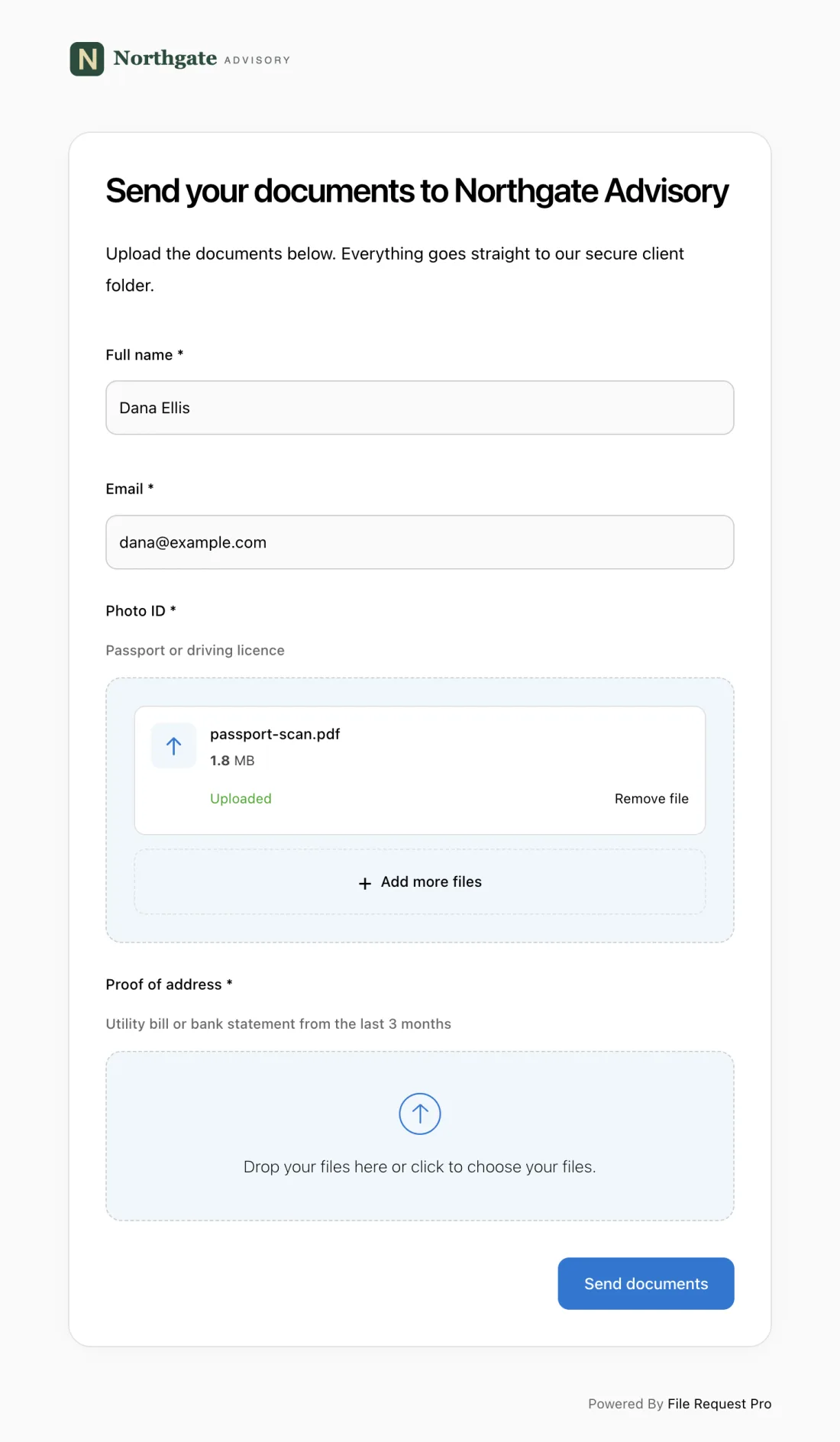
Here's what this looks like for a marketing agency:
- Branded intake page — your agency's logo, colors, and custom domain. Clients see your brand, not a generic third-party form.
- Form fields + file uploads combined — collect questionnaire answers AND brand guidelines, logo files, and content assets in one submission. No more "can you also email me your brand guide?"
- Automated reminders — clients who haven't completed the questionnaire get automatic follow-up emails on your schedule. No more awkward "just checking in" messages.
- Cloud storage sync — submitted files go straight to Google Drive, OneDrive, SharePoint, or Dropbox, organized into client folders automatically.
- No client account required — clients click a link, fill in the form, upload files, and submit. No accounts, no passwords, no friction.
The client does the work once. Your team gets everything — answers and assets — organized and ready from day one.
Frequently Asked Questions
How many questions should a marketing questionnaire include?
Aim for 25 to 40 questions depending on the engagement scope. A full-service engagement warrants the full set; a single-channel project might need just 25. The rule: every question must tie to a strategy decision. If you cannot explain how an answer shapes your work, cut it.
When should I send the marketing questionnaire to a new client?
Immediately after the contract is signed, with a firm deadline two to three business days before the kickoff call. This gives you time to review answers, identify gaps, and walk into the kickoff with a focused agenda instead of wasting it on basic fact-gathering.
What if a client gives vague or incomplete answers?
Flag incomplete answers and address them during the kickoff: "You mentioned your audience is small business owners — can you narrow that to an industry or company size?" Asking clients to share competitor campaigns they admire reveals more than written descriptions.
Should I use the same questionnaire for every client?
Keep the same core structure (business overview, audience, goals) for every client, then add or remove channel-specific sections. An SEO client needs technical access questions; a branding client needs deeper identity questions. Tailoring signals professionalism and prevents clients from abandoning the form.
How do I collect brand assets and login credentials securely?
Never collect passwords over email. Use a tool that combines file uploads with form fields so clients share assets through a secure, encrypted page. For platform access, have clients grant direct access through built-in sharing features (Google Analytics admin, Meta Business Manager partner access, Google Ads manager linking).
What's the difference between a marketing questionnaire and a creative brief?
A marketing questionnaire collects raw information from the client — business context, goals, audience, and assets. A creative brief is the strategic document your agency produces after analyzing those responses. The questionnaire is input; the brief is output. Strong agencies use questionnaire responses as the brief's foundation, then add strategic recommendations and competitive analysis.
