Without a coaching intake form, the first session becomes an awkward information-gathering exercise. You spend 45 minutes on background questions instead of coaching. The client wonders why they're paying for a conversation they could have had over email. And you walk away without a clear picture of who they are or what they need.
A structured intake form fixes this by collecting goals, background, and expectations before the first session — so you start coaching from the very first conversation. This guide gives you 45 ready-to-use coaching intake questions organized by coaching type: life coaching, executive coaching, health and wellness coaching, and business coaching, plus general intake questions that apply to every coaching practice. Copy the questions that fit your specialty, adapt them to your process, and start using them with your next client.
Why You Need a Coaching Intake Form
Most coaches already ask questions in a discovery call. The problem is relying on a conversation to capture everything you need. Clients forget details mid-call. You forget to ask about their previous coaching experience. Three sessions in, you discover a health condition or a time constraint that would have changed your entire approach.
A structured intake form solves this:
- Focused discovery calls — When clients complete an intake form before your first meeting, you skip the basic fact-gathering and spend the call on what matters: understanding their motivation, exploring their challenges, and building rapport.
- Consistent onboarding — Every client goes through the same process, so you never miss a critical question about medical history, previous coaching experience, or deal-breaking expectations.
- Better coaching plans — Written answers give you time to reflect on a client's goals and challenges before the first session. You walk in with a plan, not a blank page.
- Clear expectations — An intake form that covers session frequency, communication preferences, and commitment level prevents the "I thought we'd talk every day" conversation in week two.
- Professional first impression — Clients notice when a coach has a structured process. A polished intake form signals competence and sets you apart from coaches who wing it with a casual chat.
The key is asking the right questions without overwhelming the client. The sections below give you a targeted question set for each coaching specialty.
General Coaching Intake Questions
These questions apply to every coaching practice, regardless of specialty. They cover the basics: who the client is, what they've tried before, and how the coaching relationship will work.
Contact information
- What is your full name?
- What is your email address?
- What is your phone number?
- What is your date of birth? — Age and life stage provide context for goal-setting and the challenges a client is likely facing.
- Where are you located and what is your time zone? — Essential for scheduling, especially if you coach remotely across different regions.
- How did you hear about my coaching services? — Helps you track which referral sources are working.
Previous coaching experience
- Have you worked with a coach before? If yes, what was the experience like? — A client who had a bad experience with a previous coach may have trust concerns. A client who had a great experience has calibrated expectations.
- What prompted you to seek coaching at this point in your life? — The trigger event reveals urgency. A recent job loss, a health scare, or a milestone birthday all shape the coaching context.
- What do you expect from our coaching relationship? — Surfaces assumptions early. Some clients expect a mentor. Others want accountability. Others want someone to tell them what to do.
Goals and commitment
- What are the top three things you want to achieve through coaching? — Limiting it to three forces prioritization. Clients who list ten goals need help focusing before anything else.
- What does success look like for you at the end of our coaching engagement? — Gives you a concrete target to measure progress against.
- How much time per week can you dedicate to coaching activities outside of sessions? — Homework, journaling, and exercises only work if the client has time for them. This question sets realistic expectations.
- What is your preferred method of communication between sessions? — Email, text, voice memo, or a messaging app. Matching their preference keeps engagement high.
Life Coaching Intake Questions
Life coaching covers a wide range — career transitions, relationships, confidence, personal growth, work-life balance. These questions help you understand where a client is now and where they want to be.
- How would you rate your overall life satisfaction right now, on a scale of 1 to 10? — A simple benchmark that gives you a starting point and a number to revisit later.
- Which areas of your life feel most out of balance? — Career, relationships, health, finances, personal growth, recreation. This question highlights where to focus.
- What is your biggest challenge right now? — Open-ended on purpose. The way a client frames their biggest challenge tells you about their mindset, not just their circumstances.
- What have you already tried to address this challenge? — Prevents you from suggesting approaches the client has already tested and abandoned.
- What are your core personal values? — Values guide decision-making. A client who values freedom but works 60-hour weeks has a misalignment worth exploring.
- What does your ideal daily routine look like? — Reveals aspirations and highlights the gap between their current life and the life they want.
- What are you most afraid of when it comes to making changes? — Fear is the most common barrier to progress. Naming it upfront gives you something concrete to work with.
- Who are the most important people in your life, and how do they influence your decisions? — Coaching doesn't happen in a vacuum. Understanding a client's support system — or lack of one — shapes your approach.
Executive and Leadership Coaching Intake Questions
Executive coaching clients typically arrive with a specific professional objective: a promotion, a leadership transition, a team performance problem, or a communication gap. These questions get to the professional context quickly.
- What is your current role and how long have you been in it? — Establishes whether they're settling into a new role, hitting a ceiling in a current one, or preparing for the next step.
- What are the top three challenges you face in your leadership role? — Cuts straight to the coaching agenda. Common answers include managing difficult team members, strategic thinking, delegation, and executive presence.
- How would your direct reports describe your leadership style? — Self-awareness is the foundation of executive coaching. The gap between how a leader sees themselves and how their team sees them is where the work happens.
- Have you received any recent feedback (360 reviews, performance evaluations) you can share? — Formal feedback gives you data beyond self-reporting. It also shows whether the client is open to external input.
- What leadership skills do you want to develop? — Helps you tailor sessions. Some clients need strategic thinking skills. Others need emotional intelligence or conflict resolution.
- Describe a recent situation where you felt your leadership was tested. — Real examples reveal patterns better than abstract self-assessment.
- What does career success look like for you in the next two to three years? — Anchors the coaching engagement to a tangible professional outcome.
- Is your organization sponsoring this coaching engagement? If so, what outcomes are they expecting? — When a company pays for coaching, there are often expectations beyond the client's personal goals. Knowing this upfront prevents conflicts later.
Health and Wellness Coaching Intake Questions
Health coaching sits at the intersection of behavior change and physical well-being. These questions help you understand a client's current health status, habits, and readiness to change — without overstepping into medical territory.
- How would you rate your current physical health on a scale of 1 to 10? — A subjective baseline that's useful for tracking perceived improvement over time.
- How would you rate your current mental and emotional well-being on a scale of 1 to 10? — Physical health and mental health are connected. Low scores here may indicate the client needs support beyond what coaching provides.
- Do you have any medical conditions, injuries, or disabilities that may affect our work together? — Important for safety and for setting realistic goals. This is not a medical history — it's a flag for conditions that influence the coaching plan.
- Are you currently taking any medications? — Some medications affect energy, mood, appetite, and sleep. Knowing this helps you understand why certain changes may be harder for a client.
- Describe your current eating habits on a typical day. — Open-ended rather than prescriptive. You want to understand their reality, not make them feel judged.
- How often do you exercise, and what does that look like? — Establishes a baseline. "I walk my dog" and "I run five miles three times a week" require different coaching approaches.
- How many hours of sleep do you get on a typical night, and how would you rate its quality? — Sleep affects everything. If a client sleeps five hours a night, that's a foundational issue worth addressing before anything else.
- What health or wellness goal matters most to you right now? — Forces a single priority. Weight loss, stress reduction, better sleep, and increased energy are all valid goals — but trying to tackle all of them at once usually leads to none of them.
Business Coaching Intake Questions
Business coaching clients are typically entrepreneurs, small business owners, or professionals building something. Their challenges are concrete: revenue, growth, operations, team management. These questions ground the coaching in business reality.
- What is your business, and how long have you been running it? — Stage of business determines the coaching focus. A startup in its first year has different needs than an established business hitting a growth plateau.
- What is your current annual revenue? — A direct question, but essential. You can't coach on business growth without understanding the financial baseline.
- How many people are on your team? — Solo operators face different challenges than business owners managing a team of ten or fifty.
- What are the top three challenges in your business right now? — The most important question in the section. Common answers: not enough clients, cash flow, hiring, scaling operations, and time management.
- Where do you see your business in one year? In three years? — Aligns the coaching to a growth trajectory. Some clients want steady improvement. Others are aiming for a major scale-up or an exit.
- What have you already tried that hasn't worked? — Saves you from recommending strategies the client has tested and rejected. Also reveals what kind of advice they're skeptical of.
- What does your typical workweek look like? — Reveals whether the client is working 80 hours because they can't delegate, or 20 hours because the business isn't generating enough demand. Both are coaching problems — but different ones.
- Do you have a business mentor, advisory board, or peer group you consult regularly? — Tells you whether the client has external support or is making every decision alone. It also helps you understand what kind of guidance they're already receiving.
How to Send Your Coaching Intake Form
The best intake questions in the world are useless if clients don't complete them. And how you deliver the form affects completion rates more than most coaches realize.
Many coaches email a Word document or PDF. The client downloads it, types in answers, and emails it back. This works for a five-question form, but it breaks down when you also need signed coaching agreements, health waivers, or assessment results. You end up with answers in one email and attachments scattered across three more.
Other coaches use Google Forms or Typeform. These handle text questions well, but they look generic and offer limited options for file collection. If you want a client to upload a completed coaching agreement alongside their questionnaire answers, you'll need a separate process.
File Request Pro is built for combining questionnaires with document collection. You create a branded, multi-page form where clients answer your intake questions and upload required documents in a single session.
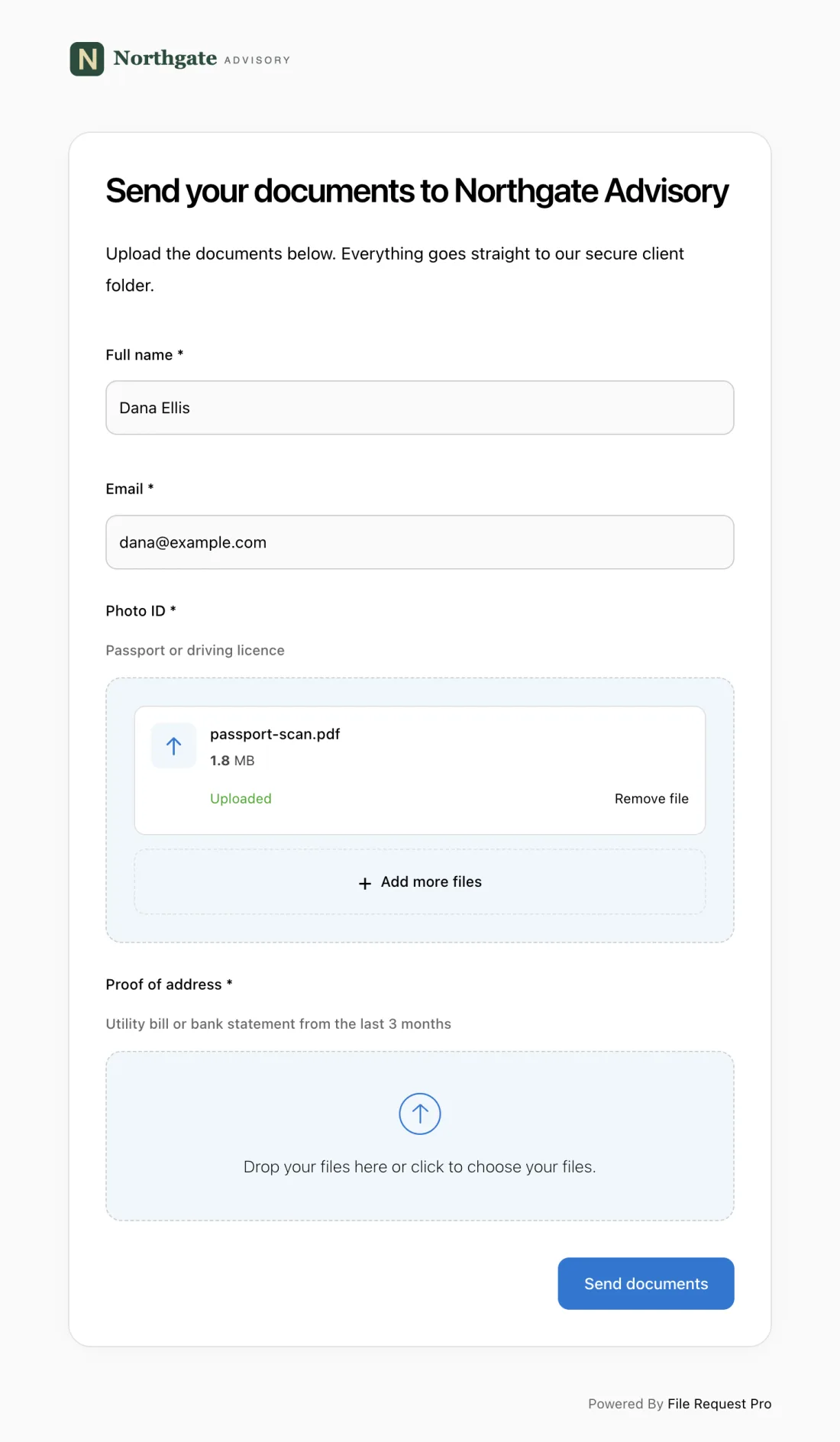
Here's how it works for coaching intake:
- Branded intake pages — Add your logo, colors (Lite and up), and a welcome message. Clients see a professional intake form that reflects your coaching brand, not a generic survey tool.
- Form fields and file uploads combined — Collect questionnaire answers and signed coaching agreements, health waivers, or assessment results on the same page. No separate emails for documents.
- No client login required — Send a link. Clients open it and start filling in. No accounts, no passwords, no friction.
- Automated reminders — Set up a follow-up sequence that nudges clients who haven't completed the form. Stop writing "just checking in" emails before every first session.
- Cloud storage integration — Completed forms and uploaded files are saved to your Google Drive, OneDrive, SharePoint, or Dropbox, organized into client folders automatically.
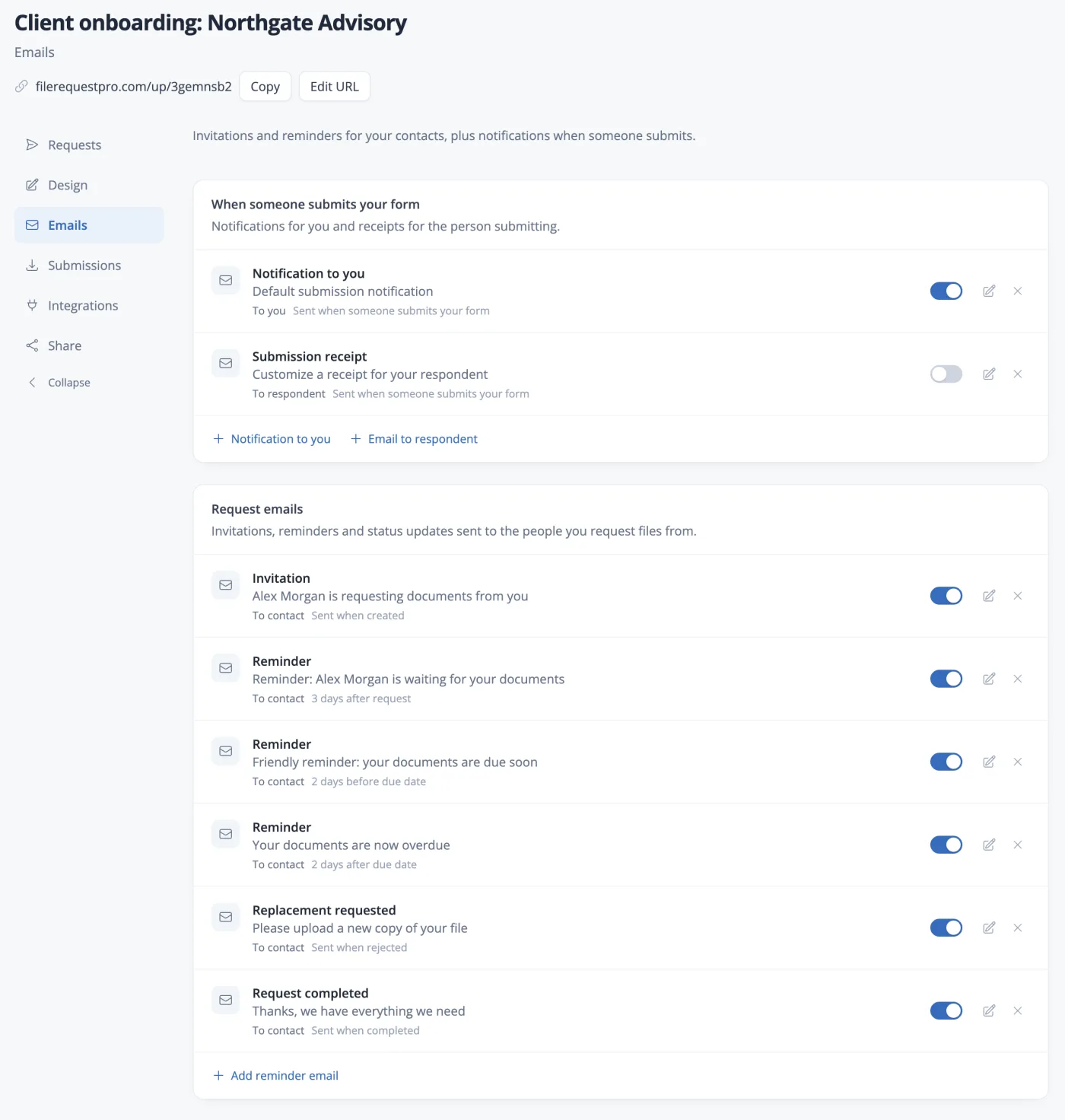
The result: clients complete the intake process in one sitting, you get everything you need before the first session, and automated reminders handle follow-up for clients who get busy.
Tips for a Better Coaching Intake Process
A few adjustments to how you design and deliver your intake form make the difference between 90% completion and a form that sits in clients' inboxes for weeks.
Don't ask everything at once. Select the general intake questions plus the section that matches your coaching specialty. A life coach doesn't need business revenue questions. A business coach doesn't need a health assessment. Keep the form focused on what you need to start coaching effectively.
Explain the purpose upfront. A brief note at the top — "Your answers help me prepare for our first session so we can focus on what matters most to you" — encourages thoughtful responses instead of rushed one-word answers.
Mix open-ended and structured questions. Scale-based questions (1-10 ratings) give you benchmarks. Open-ended questions ("What is your biggest challenge right now?") give you context and nuance. A good intake form uses both.
Send it immediately after booking. The moment a client books their first session is when motivation is highest. Send the intake form the same day. Waiting a week means competing with everything else in their inbox.
Set a deadline tied to the first session. "Please complete this by Wednesday so I can prepare for our Friday session" gives the client a concrete reason to finish the form. Open-ended deadlines lead to open-ended delays.
Frequently Asked Questions
How many questions should a coaching intake form have?
Between 15 and 25 questions is the sweet spot. That's roughly the general intake section plus one specialty section from this guide. Fewer than 15 and you'll walk into the first session with gaps. More than 25 and completion rates drop. If you need to ask more, use a multi-page form with clear section labels so clients don't feel overwhelmed.
Should I use a different intake form for each coaching specialty?
Yes. A life coaching intake form and a business coaching intake form serve different purposes and ask different questions. Use the general intake questions as your base, then add the specialty-specific section that matches the engagement. This keeps each form focused and relevant.
When should I send the intake form — before or after the discovery call?
Before. When clients complete the intake form ahead of your first meeting, you skip the basic fact-gathering and spend the session on deeper conversation. You also have time to review their answers and prepare targeted questions, which makes the first session more productive.
What if a client gives vague answers on the intake form?
Use the first session to dig deeper. If a client writes "I want to improve my life" as their goal, that's a starting point, not a finished answer. Your job in the first session is to help them translate vague aspirations into specific, actionable goals.
Do I need to include a confidentiality agreement in the intake form?
It depends on your practice and local requirements. Many coaches include a brief confidentiality statement or attach a coaching agreement as part of the intake process. If you use a tool that supports file uploads, you can have clients sign and upload a separate coaching agreement alongside the intake form.
Can I reuse the same intake form for every client?
Absolutely. That's the point of having a structured form — consistent onboarding for every client. If you use a tool like File Request Pro, you can set up a template once and send it to each new client with a unique link. The form stays the same; the responses are collected and organized separately.
How do I handle clients who don't complete the intake form?
Send one manual follow-up, or set up automated reminders that nudge the client at set intervals. If a client still hasn't completed the form by the first session, address it directly — explain that the form helps you make the most of their time and investment. Most clients respond well when the request is framed as a benefit to them.
