Google Drive is the default cloud storage for millions of people and teams. But the moment you need someone else to upload files to your Drive -- a client sending contracts, a vendor submitting invoices, a student turning in an assignment -- you hit a wall. Google Drive was built for storage and collaboration, not one-way file collection.
The good news: you have four ways to let anyone upload files to your Google Drive, each with different tradeoffs around cost, ease of use, and whether uploaders need a Google account. This guide covers all four, from the simplest to the most capable, so you can pick the one that fits.
Method 1: Share a Google Drive Folder
The simplest approach: create a folder in Google Drive, share it with specific people, and ask them to drop their files in. No extra tools, no setup -- just Google Drive's built-in sharing. (Our guide to Google Drive file sharing explains how the permissions work in this setup.)
How to set it up:
- Open Google Drive and create a new folder (right-click in your Drive and select New folder). Give it a clear name like "Client Uploads -- Project X."
- Right-click the folder and select Share.
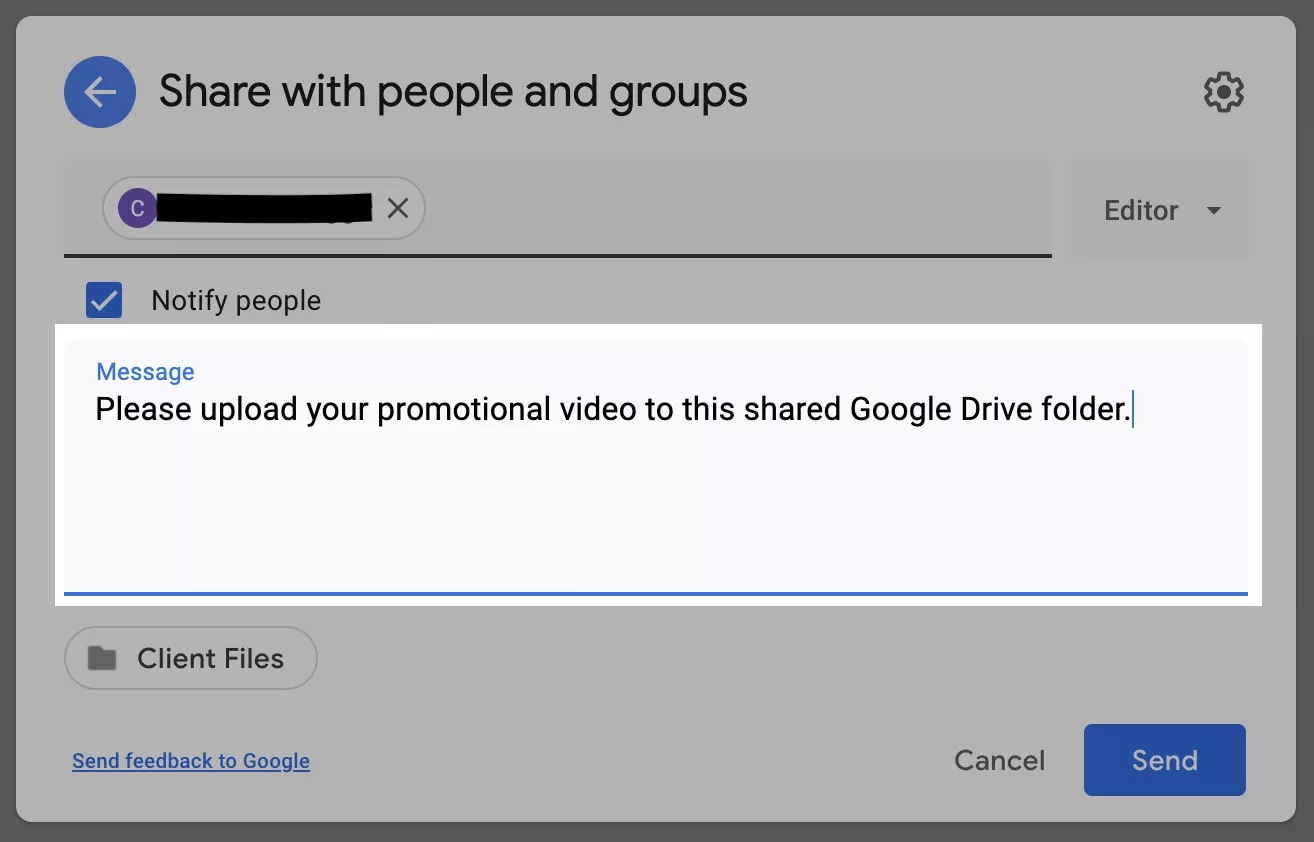
- In the sharing dialog, enter the email addresses of the people who need to upload files.
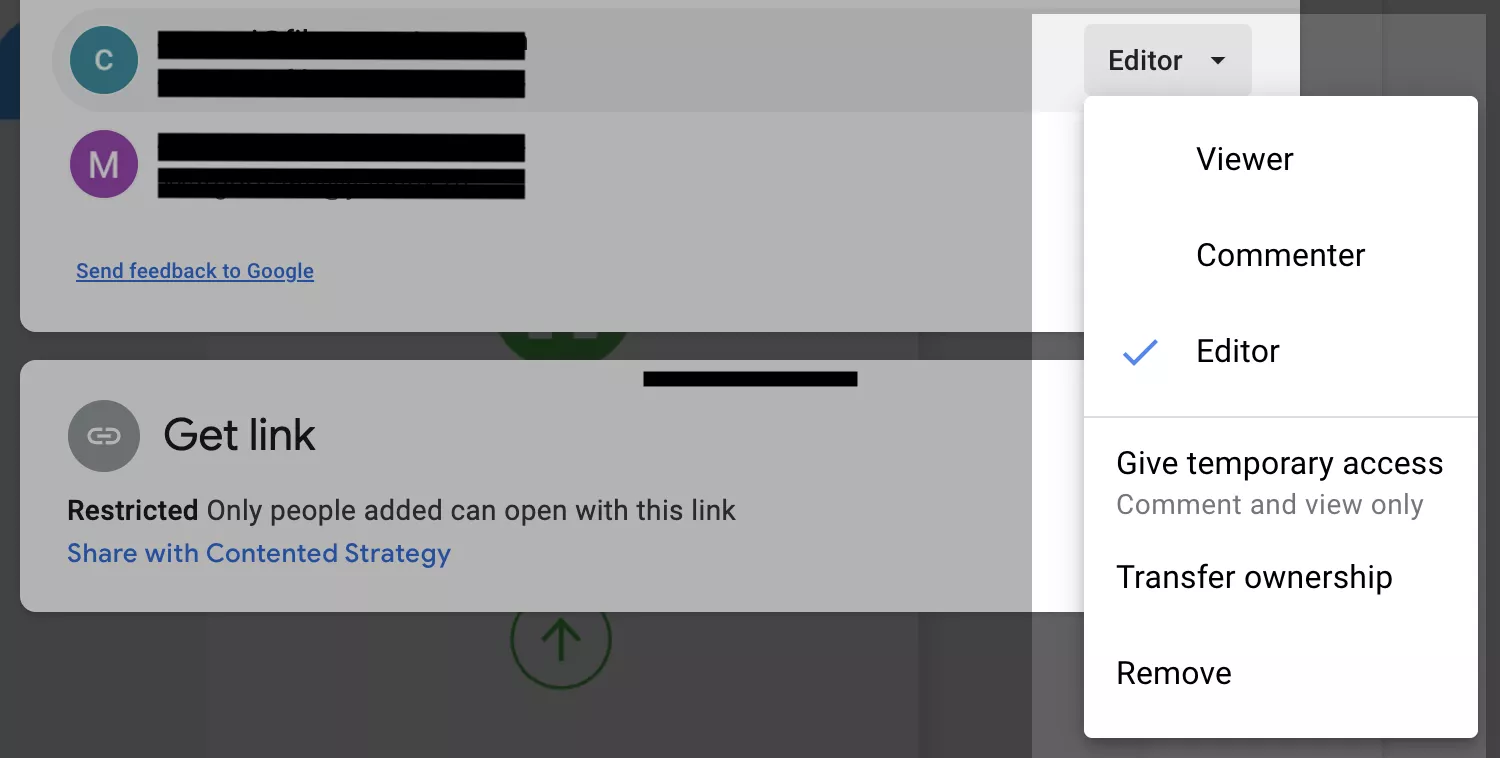
- Set their permission level to Editor. This is important -- "Viewer" and "Commenter" roles cannot upload files. Only Editors can add content to a folder.
- Click Send. Each person receives an email notification with a link to the shared folder.
Recipients can now open the folder and drag files into it, or use the "New" button to upload from their device.
When this works well:
- Small internal teams where everyone already has a Google account
- Collaborative projects where everyone needs access to the same files anyway
- Quick, one-off file exchanges between people who trust each other
Limitations of sharing a Google Drive folder:
- Every uploader needs a Google account. If your client uses Outlook, Yahoo, or a company email that isn't connected to Google, they cannot upload files. There is no workaround for this within Google Drive itself.
- No privacy between uploaders. Every person with Editor access can see, edit, rename, and delete every file in the folder -- including files uploaded by other people. If you're collecting tax documents from 20 clients using the same folder, each client can see the others' files. That's a privacy problem you don't want to explain to a client.
- No upload notifications. Google Drive does not send you an alert when someone adds a file to a shared folder. You have to check manually or set up a workaround with Google Apps Script.
- Editors can do more than upload. The Editor role also lets people move files, delete files, and reshare the folder with others. You cannot give someone "upload-only" access through Google Drive's native permissions.
- Revoking access is manual. When the project wraps up, you need to remove each person's access one by one. Miss someone, and they keep access indefinitely.
Bottom line: Sharing a folder works for quick, internal file swaps. It breaks down when you need privacy between uploaders, when recipients don't have Google accounts, or when you're collecting files from more than a handful of people.
Can Viewers Upload? How to Ask for Upload Permission
No. In a regular Google Drive folder, Viewers and Commenters can't add files. Only Editors can. Shared drives have their own roles: Contributors, Content managers and Managers can all upload. So if a folder shows no upload option, or Drive says you don't have permission to upload, your role on that folder is usually Viewer or Commenter.
If you need to upload to someone else's folder:
- If the link opens a "You need access" page, click Request access. Add a note saying you need Editor access to upload files, then click Send request. The owner gets an email and chooses which role to give you.
- If you can open the folder but can't add files, you're a Viewer or Commenter. Send the owner the folder link and ask them to make you an Editor.
If you own the folder: right-click it and select Share. If the person is listed, change their role next to their name to Editor and click Save. If they opened the folder through a link and aren't listed, add their email, choose Editor and click Send. The Editor role also lets them delete files and reshare the folder, so give it only to people you trust.
None of this works for someone without a Google account. For them, see Method 3 (Workspace only) or Method 4 below.
Method 2: Use Google Forms with File Upload
Google Forms includes a "File upload" question type that lets respondents attach files to a form submission. Uploaded files land automatically in a folder in the form creator's Google Drive. This gives you more structure than a shared folder -- you can add form fields for names, descriptions, and project details alongside the file upload.
For a detailed walkthrough of this method, see our complete guide to Google Forms file upload.
How to set it up:
- Go to forms.google.com and create a new form.
- Click the + button to add a new question.
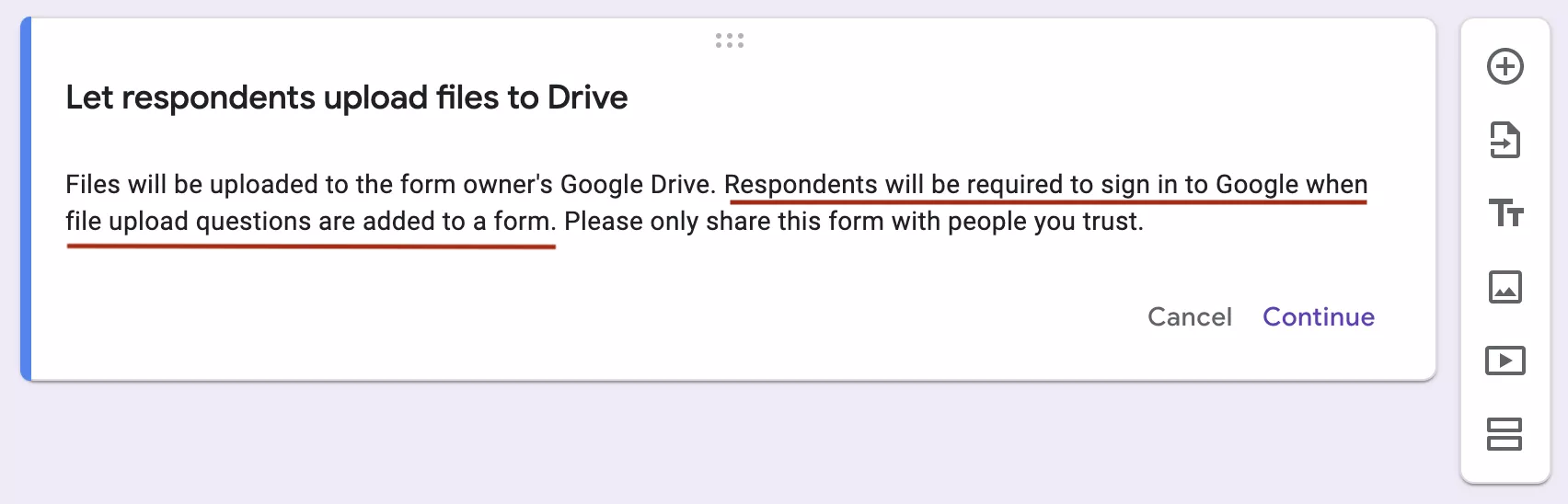
- Change the question type from "Multiple choice" to File upload. Google will display a notice that respondents must sign in with a Google account.
- Configure the allowed file types (documents, images, video, etc.) and set the maximum file size per upload (up to 10 GB per file).
- Add any other questions you need -- name, email, project reference, document category.
- Click Send and share the form link with your recipients.
All uploaded files go to an auto-created folder in your Google Drive, named after the form.
When this works well:
- Collecting files from people who already have Google accounts (internal teams, university students, Google Workspace organizations)
- Situations where you need structured data alongside the file (project name, category, description)
- Zero-budget situations where branding and automation aren't priorities
Limitations of Google Forms file upload:
- Respondents must sign in to a Google account. This is the biggest limitation. Anyone filling out the form must log into Google to upload a file. If your client or vendor doesn't have a Google account, they're locked out. You can learn more about making Google Forms accessible, but you cannot remove the sign-in requirement for file uploads.
- Individual file size capped at 10 GB. That sounds generous, but the total storage for the entire form defaults to 1 GB across all responses. You can increase this to 1 TB, but everything counts against your Drive storage quota.
- No branding. The form wears Google's design. You can change the header color and add an image, but you cannot white-label the form, use your own domain, or strip out Google's branding.
- No automated reminders. Google Forms has no built-in reminder system. If someone hasn't submitted their files, you need to follow up manually.
- Flat file organization. All uploaded files land in a single folder. There is no automatic sorting by respondent name, date, or project. If you collect 50 submissions, you get 50 files in one folder with Google's auto-generated filenames.
- Limited file type control. You can restrict uploads to broad categories (Document, Spreadsheet, PDF, Image, Video, Audio). PDF is its own category, but you can't pick exact formats like "JPEG only" or "DOCX only."
Bottom line: Google Forms is a decent free option when every respondent has a Google account and you don't need branding, reminders, or organized file storage. For client-facing file collection, the sign-in requirement is almost always a dealbreaker. See our guide on collecting data with Google Forms for more on what Forms can and can't do.
Method 3: Use Google Workspace Shared Drives (Workspace Only)
If your organization uses Google Workspace (the paid version of Google's productivity suite), you get access to shared drives -- team-level storage spaces that aren't tied to any individual's account. Shared drives include a feature called visitor sharing that lets you share files and folders with people outside your organization, even if they don't have a Google account.
How it works:
- Create a shared drive in your Google Workspace account (or use an existing one).
- Create a folder within the shared drive for collecting uploads.
- Right-click the folder and select Share.
- Enter the email address of the person you want to share with -- this can be any email address, not just Gmail.
- Set their permission to Contributor (the highest level available for external visitors).
- The recipient receives an email invitation with a PIN-based verification process to access the folder.
Visitors verify their identity through a PIN sent to their email, then get 7 days of access to upload, edit, or view files in the shared folder.
When this works well:
- Organizations already paying for Google Workspace that occasionally need files from external contacts
- Cases where non-Google users need to upload files and you already have Workspace
- Teams that want to keep file collection inside Google's ecosystem
Limitations of shared drives for file collection:
- Requires Google Workspace. Free Google accounts don't get shared drives. Your organization needs a paid Workspace plan.
- Admin must enable visitor sharing. The Workspace administrator needs to turn on external sharing and visitor sharing in the admin console. Many organizations disable this for security reasons.
- Access expires after 7 days. Visitors need to re-verify with a new PIN after 7 days. If your file collection process runs longer, this creates friction.
- No upload-only access. Contributors can see other files in the shared folder, edit existing files, and move content around -- not just upload.
- No notifications, reminders, or tracking. You don't get notified when files are uploaded, can't send automated reminders, and have no dashboard showing who has and hasn't submitted.
- No branding or custom forms. Uploaders see Google Drive's standard interface. You cannot add your logo, custom instructions, or form fields alongside the upload.
- Visitors cannot access the root folder. You must share a specific subfolder, not the shared drive itself.
Bottom line: Shared drive visitor sharing removes the Google account requirement -- a real advantage. But it's locked behind a Workspace subscription, requires admin configuration, and still lacks the branding, reminders, and organization that client-facing file collection demands.
Method 4: Use a Third-Party File Upload Tool
If the native Google options fall short -- and for most client-facing or external file collection, they will -- a third-party upload tool fills the gaps. These tools connect to Google Drive so files still land in your Drive, but they add what Google is missing: branded upload pages, no sign-in requirement, automated reminders, and automatic file organization.
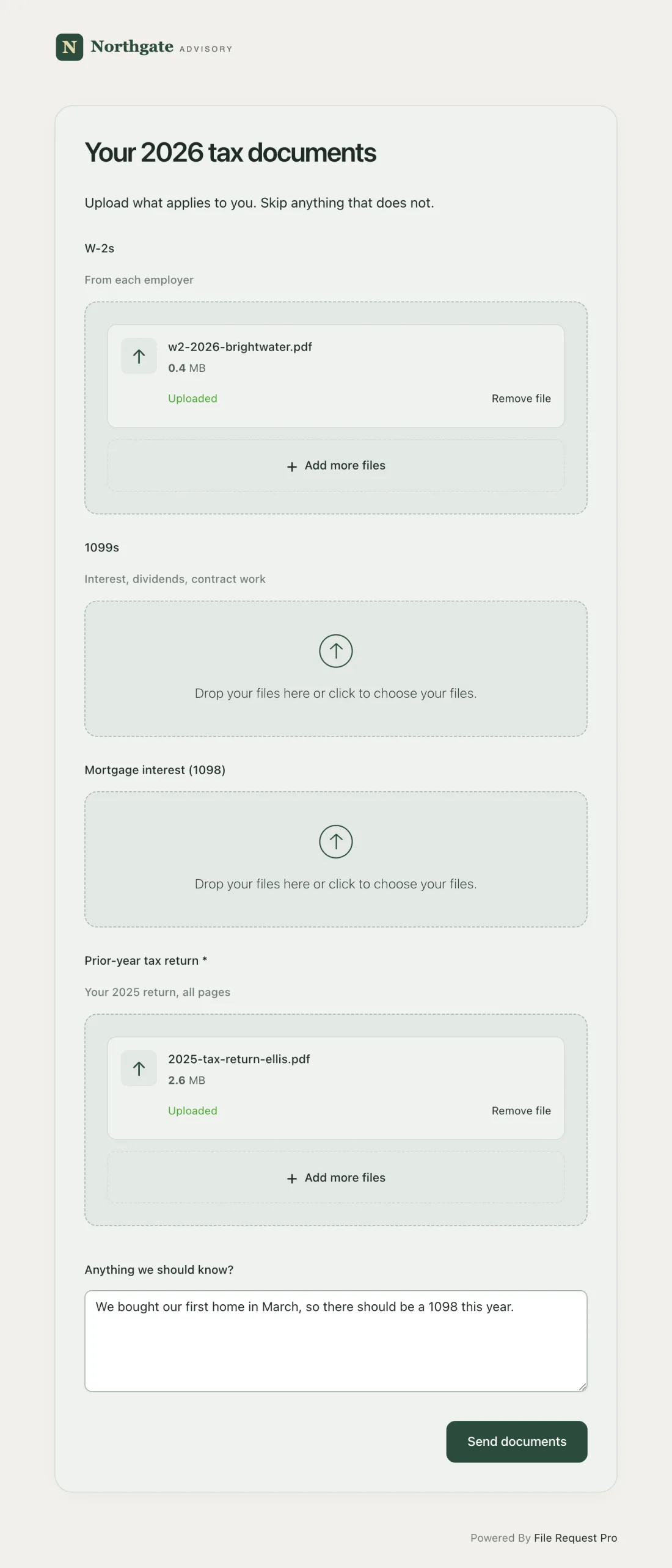
File Request Pro is purpose-built for this. You create a branded upload page, send the link, and files are saved to the right folder in your Google Drive. No Google account required for uploaders. No chasing people. No messy folders.
How to Set Up Google Drive File Collection with File Request Pro
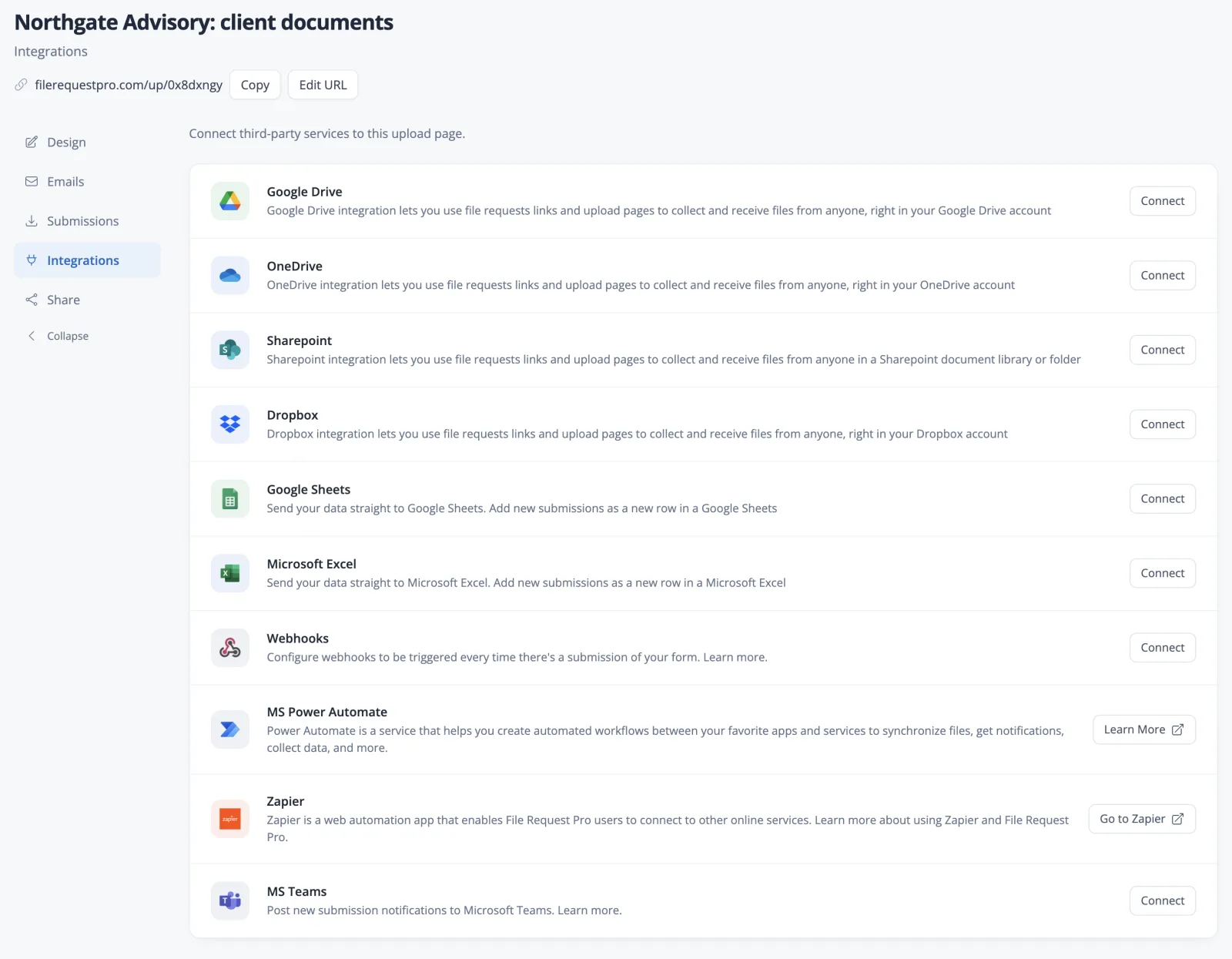
Step 1: Connect your Google Drive. After signing up for a free trial, link your Google Drive account in one click. File Request Pro uses OAuth -- a secure authorization standard -- and never sees your Google password.
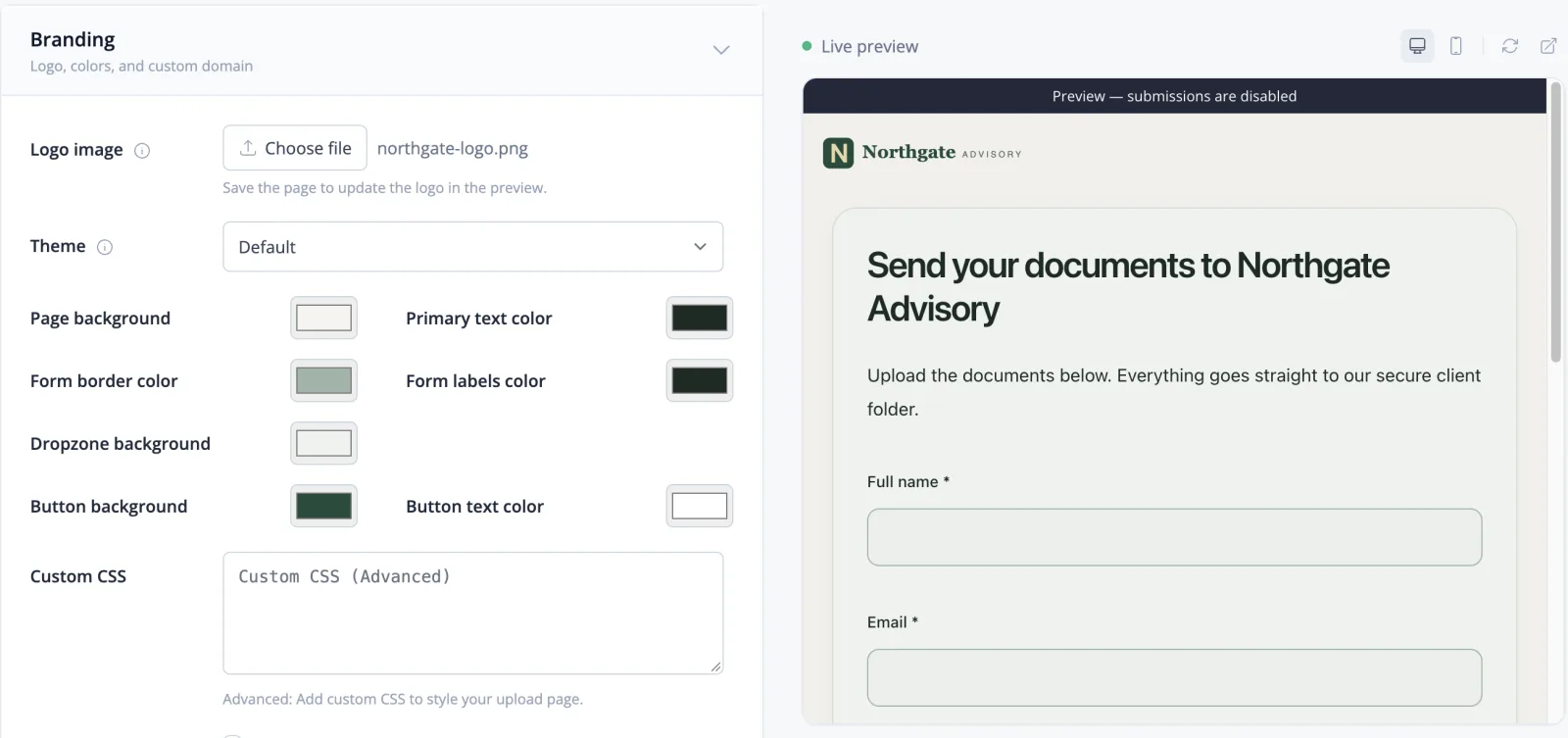
Step 2: Build your upload page. Create a branded file upload form with your logo, colors, and custom URL. Add fields for client name, project reference, document type -- whatever context you need alongside the files. You can set up multiple upload zones to separate file categories (e.g., "ID Documents" and "Financial Statements" on the same page).
Step 3: Configure access and sharing. Choose whether to make the page public, restrict it to invite-only, or protect it with a password. Customize the URL so it's easy to remember and looks professional.
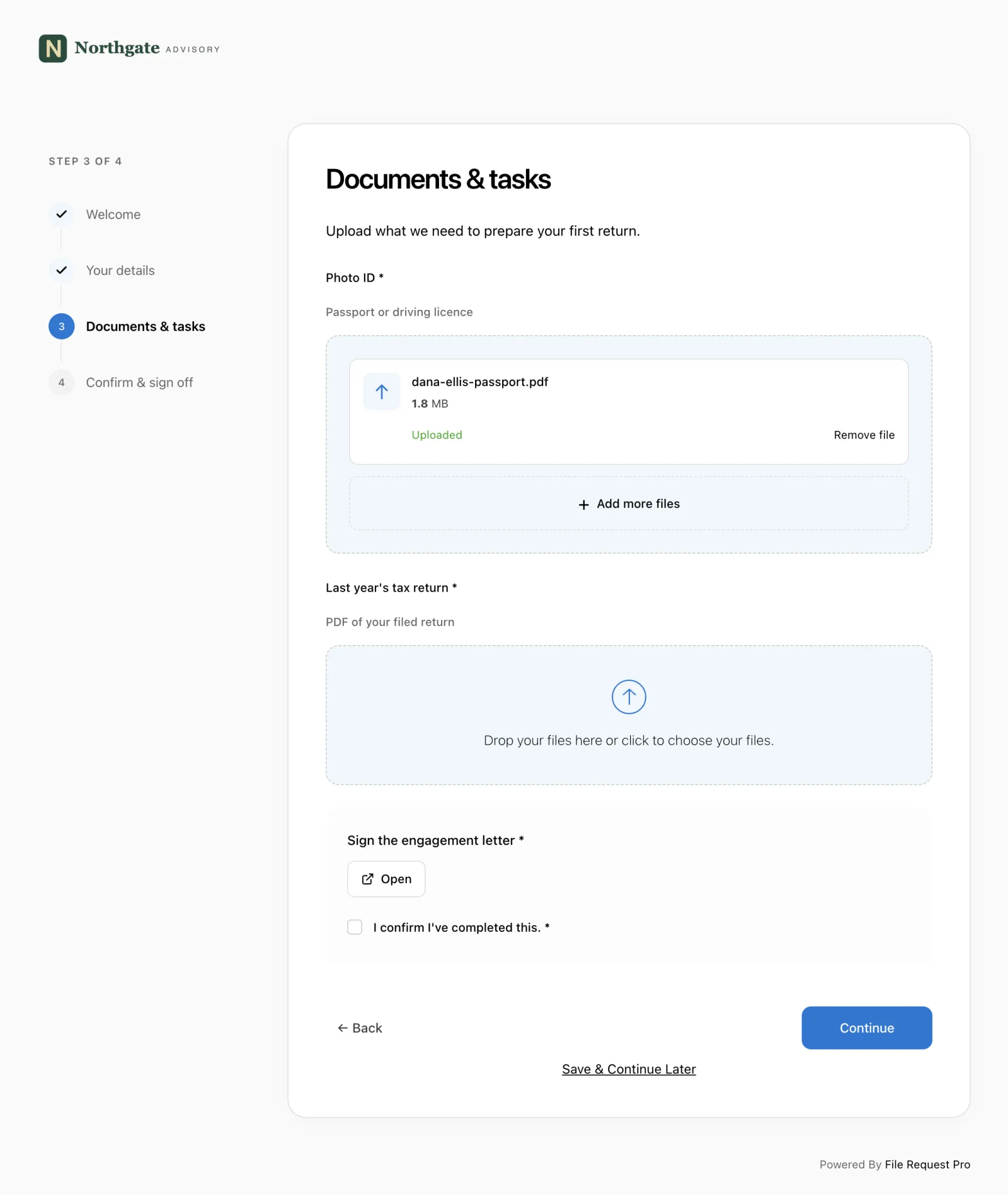
Step 4: Send the link. Share via email, embed on your website, or add to your client portal. Clients click, upload, and submit. No account creation. No Google sign-in. No app to download.
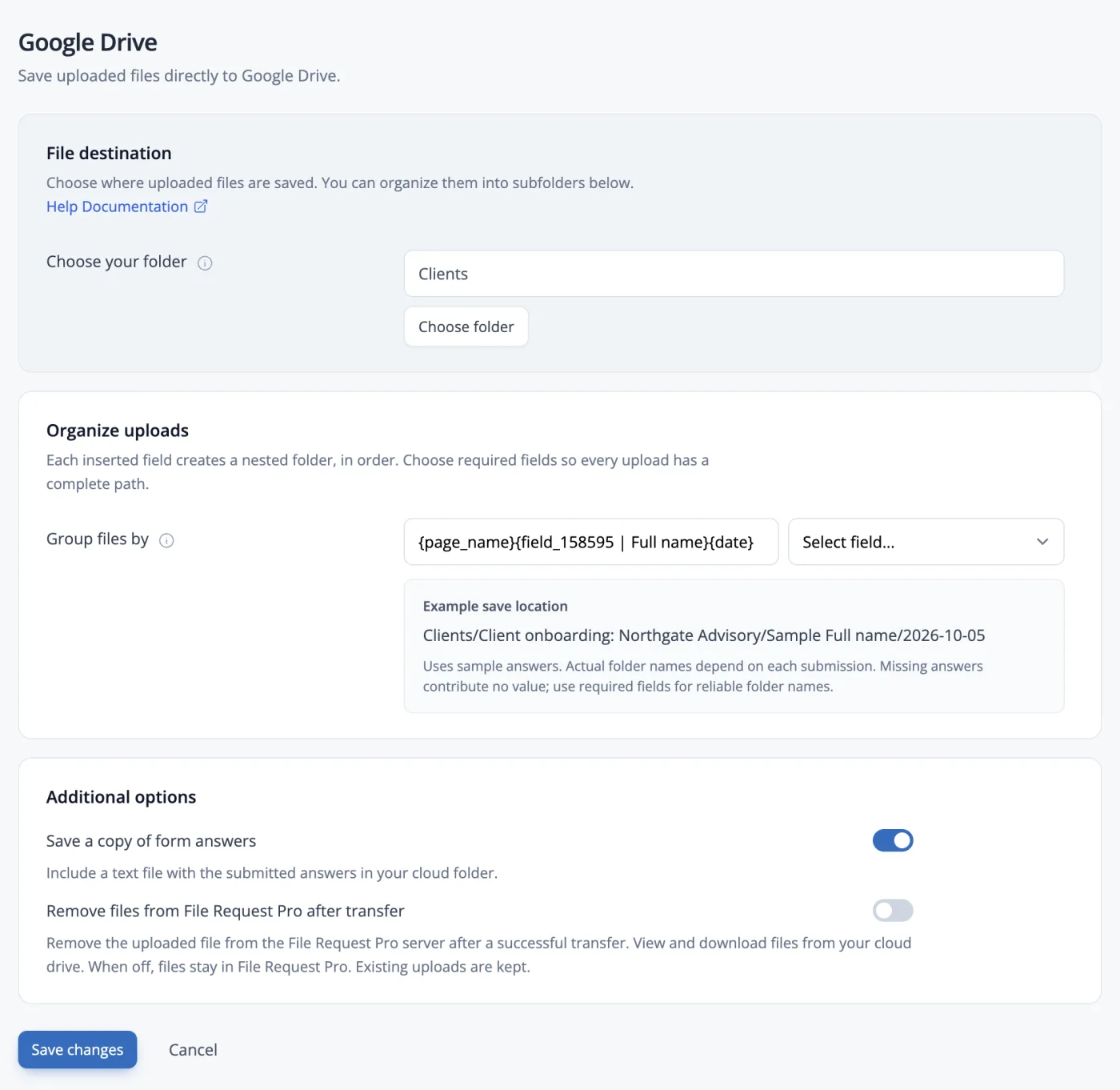
Step 5: Files arrive organized. Uploaded files are saved to your Google Drive. File Request Pro auto-creates subfolders based on client name, email, date, or any form field you choose. Instead of dumping 50 files into one folder, you get a clean structure like Client Uploads / Acme Corp / Tax Documents.
Step 6: Automated reminders handle follow-up. Set up reminder emails that go out automatically to anyone who hasn't submitted their files. You control the timing, message, and frequency -- no more manual chasing.
Why Teams Choose a Dedicated Upload Tool
File Request Pro pairs file collection with a form builder, so you gather structured data and documents in one step. Here are the features that matter most for professional file collection:
- No Google account required. Anyone with the link can upload files -- whether they use Gmail, Outlook, Yahoo, or a corporate email system.
- Custom branding. Your logo, colors, and messaging -- not Google's. Clients see your brand throughout the upload experience.
- Forms with conditional logic. Show different questions based on previous answers, so clients only see what's relevant to them. Team and Enterprise plans can also split a form into several pages.
- Large file support. Accept files up to 1 GB each on Lite, 5 GB on Pro and Team, and 10 GB on Enterprise, far beyond what most email attachments allow.
- Automated reminders and notifications. Get notified when files arrive. Send automated follow-ups to people who haven't submitted yet.
- Dynamic file organization. Files are automatically sorted into subfolders by client name, date, project, or any form field -- no manual organizing needed.
- Encryption in transit and at rest. Uploads travel over an encrypted connection, and stored files are encrypted with AES 256-bit encryption.
- Embeddable upload pages. Paste a snippet of code into your website to embed the upload form on any page.
Bottom line: A dedicated upload tool like File Request Pro fills every gap in Google Drive's native options -- no sign-in requirement, your own branding, automated reminders, and organized folders -- while keeping all your files in Google Drive where they belong.
Comparison: 4 Methods to Let Anyone Upload to Your Google Drive
Here's how the four approaches stack up:
| Feature | Shared Folder | Google Forms | Workspace Shared Drives | File Request Pro |
|---|---|---|---|---|
| Uploader needs Google account | Yes | Yes | No (PIN verification) | No |
| Files go to Google Drive | Yes | Yes | Yes | Yes (native integration) |
| Max file size | 5 TB (plan dependent) | 10 GB per file | 5 TB (plan dependent) | 1 to 10 GB per file (plan dependent) |
| Privacy between uploaders | No | Yes | No | Yes |
| Custom form fields | No | Yes (basic) | No | Yes (advanced form builder) |
| Custom branding | No | Minimal | No | Your logo and colors |
| Automated reminders | No | No | No | Yes |
| Auto-organize into folders | No | No | No | Yes (by name, email, project, date) |
| Upload notifications | No | Yes (form response) | No | Yes (instant email alerts) |
| Embed on website | No | Yes (Google-branded) | No | Yes (your branding) |
| Requires paid plan | No | No | Yes (Google Workspace) | Yes (from $39/month) |
Which Method Should You Use?
Your pick depends on who's uploading and what you need from the process.
Choose a shared folder if you're exchanging files with a small internal team where everyone has Google accounts and privacy between uploaders isn't a concern.
Choose Google Forms if you need a free solution with form fields, your respondents all have Google accounts, and you don't mind the Google-branded experience or manual file organization.
Choose Workspace shared drives if your organization already pays for Google Workspace, you need occasional file uploads from non-Google users, and you can live with temporary access windows and no automation.
Choose a third-party tool like File Request Pro if you collect files from clients, vendors, or external contacts on a regular basis -- especially if uploaders may not have Google accounts, you need professional branding, you want automated reminders to stop chasing people, or you need files organized automatically in your Drive.
Frequently Asked Questions
Can non-Google users upload files to Google Drive?
Not with Google's free tools. Both shared folders and Google Forms file uploads require the uploader to sign in with a Google account. Google Workspace's visitor sharing lets non-Google users upload to shared drives via PIN verification, but your organization needs a paid Workspace plan. The most flexible option is a third-party tool like File Request Pro, which lets anyone upload to your Google Drive without creating an account or signing in.
How do I allow someone to upload files to my Google Drive without giving them access to my other files?
Create a specific folder for uploads and share only that folder -- not your entire Drive. Set the permission to "Editor" so they can add files. The person will only see the contents of that shared folder, not the rest of your Drive. For true one-way uploads where the uploader can't see other files in the folder, use Google Forms or a third-party upload tool instead of a shared folder.
Is there a Google Drive file request feature like Dropbox?
No. Unlike Dropbox (which has had File Requests for years) and OneDrive (which offers Request Files), Google Drive has no native file request feature. Google's product forums are full of user requests for this going back years, but Google has never shipped it. For a full breakdown, see our guide to Google Drive file requests.
What is the file size limit for Google Drive uploads?
For direct uploads to Google Drive, individual files can reach up to 5 TB (depending on your storage plan). For Google Forms file uploads, the per-file limit is 10 GB, but total form storage defaults to 1 GB across all responses (you can raise it to 1 TB). Keep in mind that Google Drive storage is shared across Gmail, Drive, and Google Photos -- the free plan gives you 15 GB total.
Can I collect files through Google Drive without sharing a folder?
Yes, but not with Google Drive alone. Google Forms collects file uploads without sharing a folder -- files go to an auto-created folder in your Drive, and respondents never see your Drive contents. But respondents still need a Google account. For folder-free collection from anyone, use a third-party tool that integrates with Google Drive.
How do I get notified when someone uploads files to my Google Drive?
Google Drive does not notify you when files are added to shared folders. Google Forms can send a notification for each form response (enable it in the form settings). For reliable upload notifications, a third-party tool like File Request Pro sends an instant email alert every time someone submits files, including what was uploaded and who uploaded it.
Is it safe to let someone upload files to my Google Drive?
Sharing a Google Drive folder with Editor access lets the other person see, edit, and delete every file in that folder. They can also reshare the folder with others. For sensitive documents, that's a liability. Safer alternatives include Google Forms (uploaders can't see other submissions) or a dedicated file upload tool with encryption and per-submission privacy.
