Google Forms gives you a fast, free way to build an intake form — no coding, no software purchases, no learning curve. For solo practitioners and small teams who need a basic form to collect client details, it works. But the moment your intake process involves file uploads, conditional logic, or professional branding, Google Forms falls short.
This guide walks you through building a client intake form in Google Forms step by step, with specific field recommendations for different industries. We also cover the limitations you should know about before committing — and what to use instead when you outgrow it.
What Is an Intake Form?
An intake form is a structured document that collects key information from a new client, patient, or project at the start of a working relationship. It replaces the back-and-forth emails, phone calls, and scattered messages that slow down onboarding.
Depending on your industry, an intake form might collect:
- Contact details — name, email, phone, address
- Background information — company size, industry, current situation
- Project scope — goals, timelines, budget, specific requirements
- Supporting documents — contracts, identification, financial records, insurance cards
The goal: get everything you need in one request, so you can start working instead of chasing details. A well-designed intake form also sets expectations. Clients know what's required, and you skip the awkward follow-up cycle of "just one more thing I need from you."
Most professional service firms use intake forms for one of two purposes: post-sale onboarding (gathering what your team needs to deliver) or lead qualification (screening potential clients before a discovery call). For a full walkthrough, see our client intake form checklist.
How to Build a Client Intake Form in Google Forms
All you need is a free Google account. Here's how to set up an intake form from scratch.
Step 1: Create a new form
Go to docs.google.com/forms and click the + (blank) icon to start a new form. You can also browse Google's template gallery for a starting point, though none of the templates are specifically designed for client intake.
If you're already in Google Drive, click New > Google Forms to create the form inside a specific folder — useful for keeping intake responses organized alongside project files.
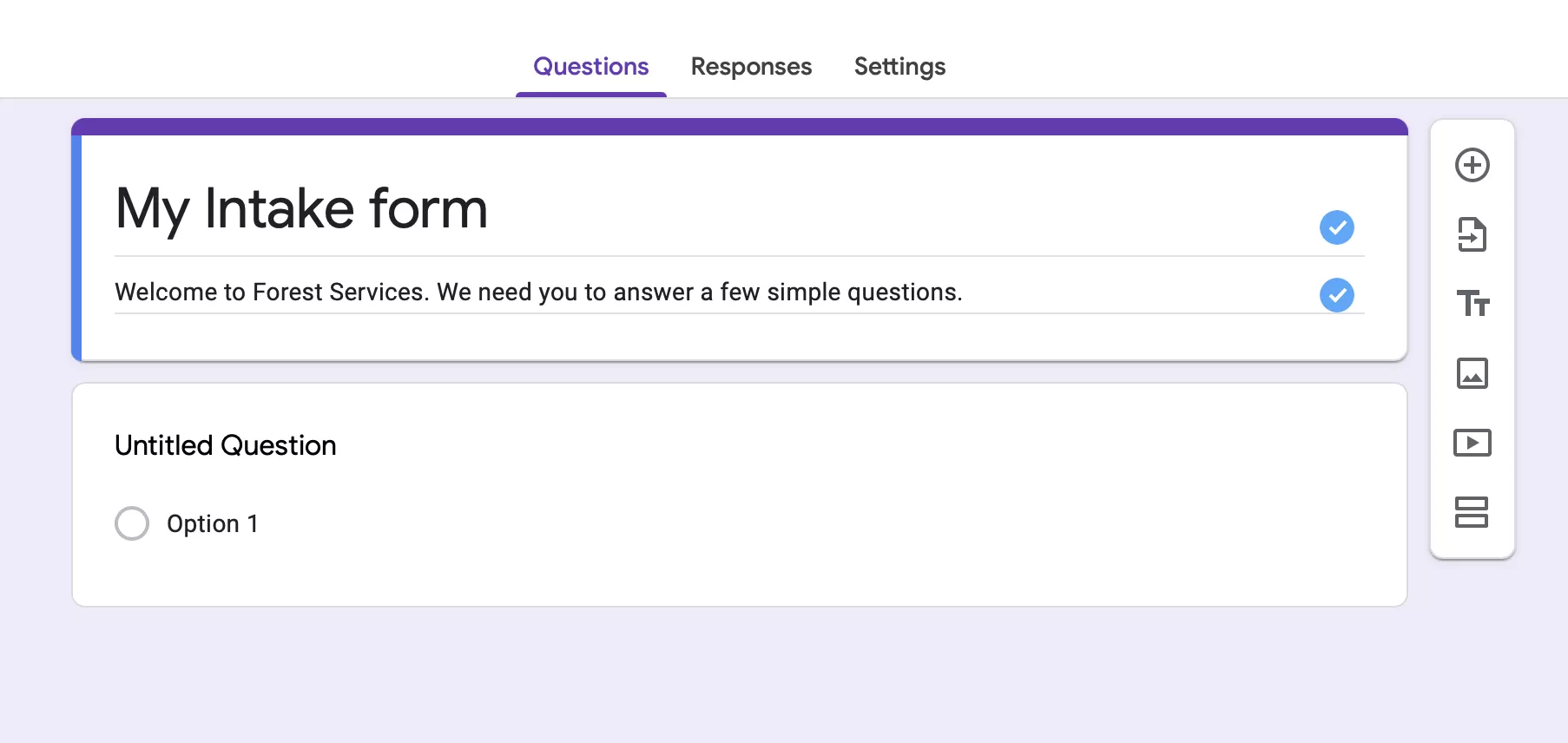
Step 2: Name your form and add a description
Click "Untitled form" in the top-left corner and give your form a clear title, like "New Client Intake Form" or "Project Onboarding Questionnaire." Use the description field to set expectations: what the form is for, how long it takes, and any documents the client should have ready.
For example: "Please complete this form to help us prepare for your engagement. It takes about 5 minutes. If you have your business registration or project brief available, those will be helpful."
Step 3: Customize the theme
Click Customize Theme (the palette icon) to change the header image, theme color, background color, and font style. Your options are limited — you cannot add your company logo to the form itself, use custom fonts, or apply CSS styling — but choosing brand-aligned colors helps the form feel less generic.
Step 4: Add your intake questions
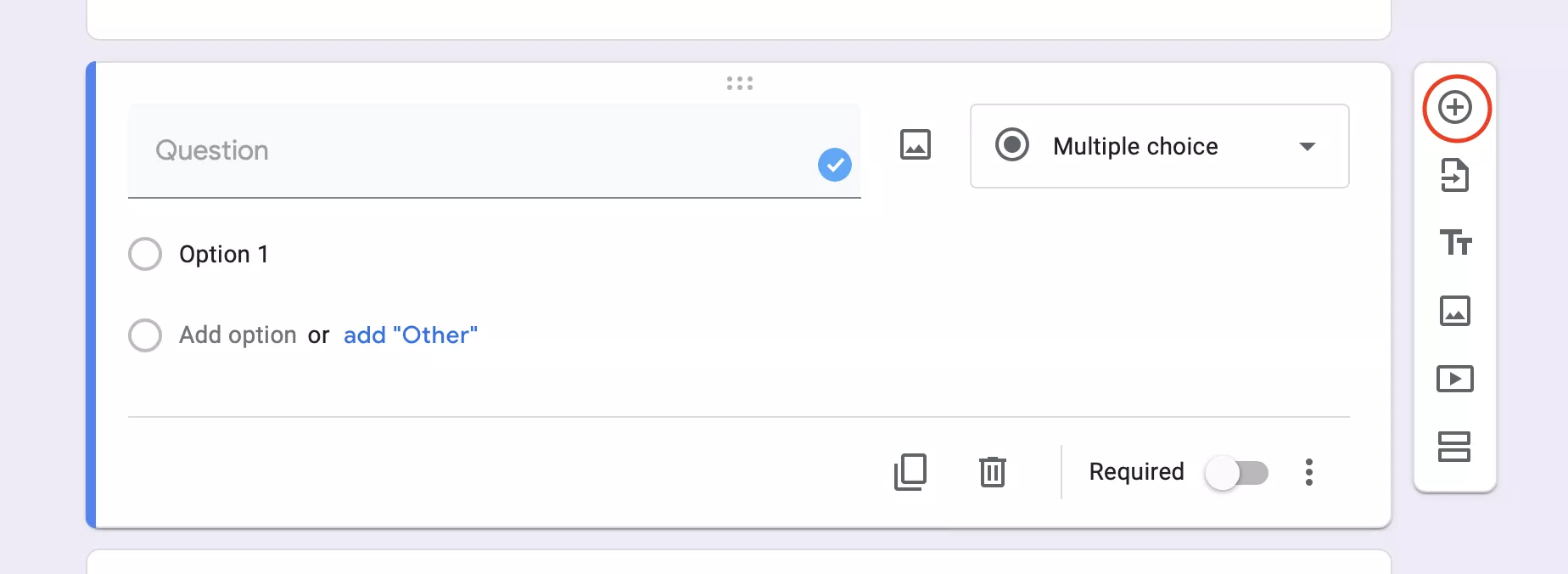
Click the + button in the floating toolbar to add questions. For each one, select the question type from the dropdown. Here are the most useful types for intake forms:
- Short answer — for names, email addresses, phone numbers, company names. Add response validation to enforce email format where needed.
- Paragraph — for open-ended responses like project descriptions, case summaries, or "tell us about your situation" fields.
- Multiple choice — for single-select options like "How did you hear about us?" or "What type of service do you need?"
- Checkboxes — for multi-select questions like "Which of these services are you interested in?"
- Dropdown — works like multiple choice but saves space when you have many options (e.g., state/province selection).
- Date — for preferred start dates, deadlines, or date-of-birth fields.
- File upload — for collecting documents. Note: respondents must sign in with a Google account to use this field.
Mark essential fields as Required so clients cannot submit without completing them. But be selective — marking every field as required frustrates respondents and drives up form abandonment.
Step 5: Organize with sections
For longer intake forms, break questions into sections using the section divider in the floating toolbar. Sections create separate pages, so the form feels less overwhelming. A typical intake form uses three sections:
- Contact Information — name, email, phone, company
- Project or Case Details — scope, goals, timeline, budget
- Supporting Documents — file uploads, additional notes
You can also use sections to create basic conditional routing — sending respondents to different pages based on their answers. Click the three-dot menu on a multiple choice question and select "Go to section based on answer."
Step 6: Configure settings and share
Click the gear icon (Settings) to adjust form behavior. For intake forms, pay attention to these settings:
- Collect email addresses — useful for follow-up, but adds friction since respondents must sign in
- Limit to one response — prevents duplicate submissions
- Confirmation message — customize the text clients see after submitting (e.g., "Thanks! We'll review your information and contact you within 2 business days.")
When ready, click Publish and share your form via email, a shareable link, or HTML embed code. For intake forms, a direct link is usually the simplest — you can include it in a welcome email or on your website's contact page. See our guide on embedding a Google Form on your website if you want to integrate it directly into a page.
Step 7: View and manage responses
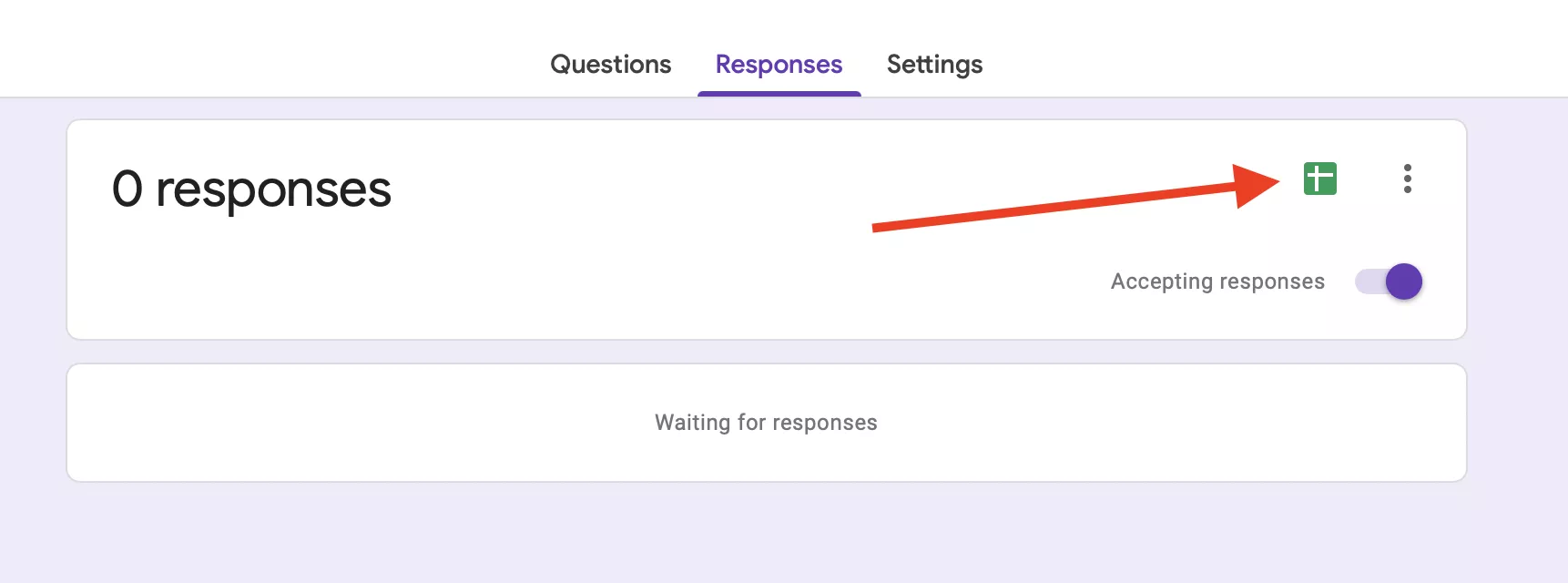
Click the Responses tab in your form to see a summary of all submissions or review individual responses one by one. Click the green Sheets icon to link responses to a Google Sheet, where each submission becomes a new row — far easier for tracking and sorting client data.
Recommended Intake Form Fields by Question Type
The fields you include depend on your industry and how much information you need to get started. Here's a general framework that works across most professional services:
Contact information (essential for every intake form)
| Field | Google Forms Question Type |
|---|---|
| Full name | Short answer |
| Email address | Short answer (with email validation) |
| Phone number | Short answer |
| Company / organization name | Short answer |
| Preferred contact method | Multiple choice (Email / Phone / Text) |
Project or service details
| Field | Google Forms Question Type |
|---|---|
| Type of service needed | Dropdown or multiple choice |
| Project description / case summary | Paragraph |
| Goals or desired outcome | Paragraph |
| Budget range | Multiple choice or dropdown |
| Preferred start date | Date |
| Deadline or urgency | Multiple choice (Flexible / Within 30 days / Urgent) |
Background and referral
| Field | Google Forms Question Type |
|---|---|
| How did you hear about us? | Multiple choice with "Other" option |
| Have you worked with a similar provider before? | Multiple choice (Yes / No) |
| Anything else we should know? | Paragraph |
Google Forms Intake Form by Industry
Every industry has its own intake requirements. Below are the key fields to add beyond the standard contact and project details above. Use these as a starting point and adapt to your practice.
Legal intake form
Law firms need to capture case details and conflict-check information during intake. If you handle law firm intake at volume, ask whether Google Forms can handle the document collection side — most legal intake requires identification, existing contracts, or court documents.
- Type of legal matter (dropdown) — Family law, Business dispute, Estate planning, Immigration, Personal injury, Criminal defense, Real estate, Other
- Brief description of your legal situation (paragraph) — what happened, when, who's involved
- Opposing party name(s) (short answer) — for conflict checking
- Have you spoken with another attorney about this matter? (multiple choice) — Yes / No
- Are there any deadlines or court dates? (short answer) — statute of limitations, upcoming hearings
- Relevant documents (file upload) — contracts, police reports, court notices
Accounting intake form
Accounting firms need to understand the client's entity structure, filing obligations, and current financial situation. For a complete accounting client onboarding checklist, see our separate guide.
- Business entity type (dropdown) — Sole proprietorship, LLC, S-Corp, C-Corp, Partnership, Non-profit
- Services needed (checkboxes) — Tax preparation, Bookkeeping, Payroll, Advisory, Audit support
- Fiscal year end (date or short answer)
- Current accounting software (dropdown) — QuickBooks, Xero, FreshBooks, Wave, None, Other
- Number of employees (short answer or dropdown range)
- Prior year tax returns (file upload) — needed for continuity and planning
Healthcare intake form
Patient intake covers medical history and insurance information. One critical caveat: Google Forms does not offer a BAA (Business Associate Agreement), which means it is not suitable for collecting protected health information under HIPAA. Healthcare providers should verify compliance with their legal team before using any form builder for patient intake.
- Date of birth (date)
- Insurance provider and policy number (short answer)
- Primary care physician (short answer)
- Current medications (paragraph)
- Allergies (paragraph)
- Reason for visit (paragraph or multiple choice, depending on specialty)
Consulting and coaching intake form
Consultants and coaches need to understand where the client is now and where they want to go. The intake form doubles as a scoping tool. For a full question set by coaching niche, see our coaching intake form template.
- What is your biggest challenge right now? (paragraph)
- What does success look like for this engagement? (paragraph)
- Have you tried other solutions? (paragraph) — what worked, what didn't
- Decision-making process (multiple choice) — I'm the sole decision-maker / Need to consult a partner / Committee decision
- Preferred meeting cadence (multiple choice) — Weekly / Biweekly / Monthly
Design and creative intake form
Creative agencies and freelancers need project specs, brand assets, and reference material — which is where Google Forms' file upload limitations hit hardest.
- Type of project (checkboxes) — Logo design, Website, Brand identity, Marketing collateral, Social media, Video, Other
- Brand guidelines or style guide (file upload) — existing logos, color codes, fonts
- Reference examples (paragraph) — links to designs, competitors, or styles they like
- Target audience (paragraph) — who is this for?
- Deliverable format (checkboxes) — Print / Web / Social media / Video
Google Forms Intake Form Limitations
Google Forms works for simple intake. But the moment you try to run a professional intake workflow, you hit its walls. Here are the ones that trip people up most often.
File uploads require a Google sign-in
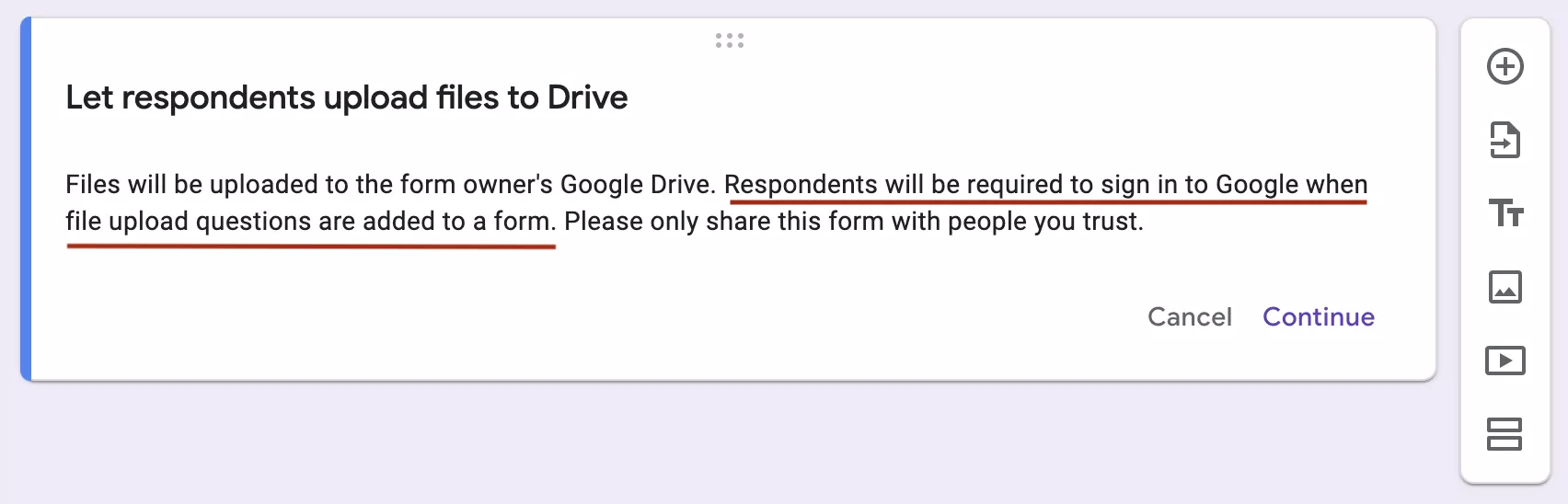
This is the single biggest friction point for client-facing intake forms. When you add a file upload question, Google Forms forces every respondent to sign in with a Google account before uploading. There is no workaround within Google Forms itself.
For internal teams, this is fine — everyone has a Google Workspace account. But for external clients, it creates an immediate barrier. Not everyone has a Google account, and even those who do often refuse to sign in to upload a document. Many clients email the file instead, which defeats the purpose of having a structured intake form. For more on this specific issue, see our guide on file uploads in Google Forms.
Limited conditional logic
Google Forms supports section-level branching — you can route respondents to different pages based on a multiple choice answer. But you cannot show or hide individual questions based on previous answers. You can't build a dynamic intake form where follow-up questions appear only when relevant.
For example, if a client selects "Business" as their entity type, you'd want to show fields for EIN and state of incorporation — but hide those for individual clients. Google Forms can't do this without creating separate sections for every scenario, which gets unwieldy fast.
No custom branding
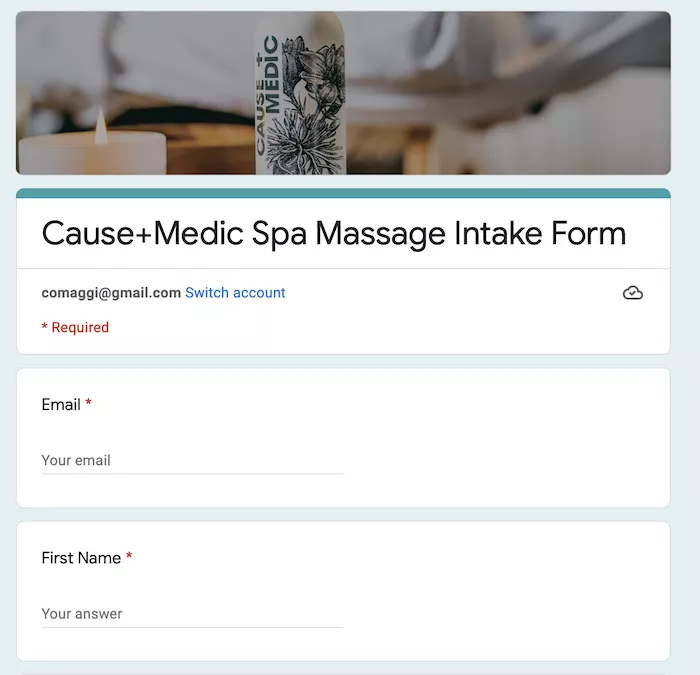
You can change the header image, theme color, and font style, but every form still looks unmistakably like a Google Form. You cannot add your company logo to the form body, use a custom domain (forms appear at docs.google.com), or remove the "Google Forms" branding at the bottom.
For internal use, this doesn't matter. For client-facing intake, it does. A form that could have come from anyone doesn't build trust — especially when you're asking clients for sensitive information like financial records, identification, or medical history.
No automated reminders
When you send an intake form, there's no built-in way to follow up with people who haven't completed it. You have to manually track who has and hasn't responded, then send reminder emails one by one. For a single client, that's manageable. When you're onboarding five or ten clients at the same time, it eats hours every week.
No file organization
Files uploaded through Google Forms land in a single folder in Google Drive with auto-generated file names. Collecting intake documents from ten clients? You'll sort, rename, and organize every file by hand. There's no way to auto-create client folders or route files to specific locations based on form responses.
Forms can appear in Google Search
Google Forms with public URLs can get indexed by Google, even if you never intended your intake form to be discoverable. Search for intake form site:docs.google.com/forms and you'll find hundreds of examples — many containing fields for sensitive personal data. If you're in a regulated industry, this alone could be a compliance risk.
If you need your Google Form to be accessible but not indexed, see our guide on making a Google Form public without it appearing in search results.
Better Alternatives for Professional Intake Forms
Google Forms is a solid pick for internal surveys or quick feedback collection. But professional client intake — where you're onboarding paying clients, collecting sensitive documents, and representing your brand — demands more.
Here's what a dedicated intake tool offers that Google Forms can't:
- File uploads without sign-in — Clients click a link and upload. No Google account required.
- Custom branding — Your logo, colors, and domain so the form looks like part of your business.
- Automated reminders — Scheduled follow-up emails to clients who haven't submitted, so you stop chasing people manually.
- Conditional logic at the question level — Show or hide individual questions based on previous answers, not just entire sections.
- Automatic file organization — Uploaded files sorted into client-specific folders in your cloud storage, labeled and ready to use.
- Multi-page forms — Break complex intake into logical steps without the constraints of Google Forms sections.
File Request Pro for client intake
File Request Pro is built for this exact use case — collecting files and information from clients without the friction of Google Forms. It connects directly to Google Drive, Dropbox, OneDrive, and SharePoint, so your workflow stays the same. The difference is what your clients experience: a branded, sign-in-free upload page instead of a generic Google Form.
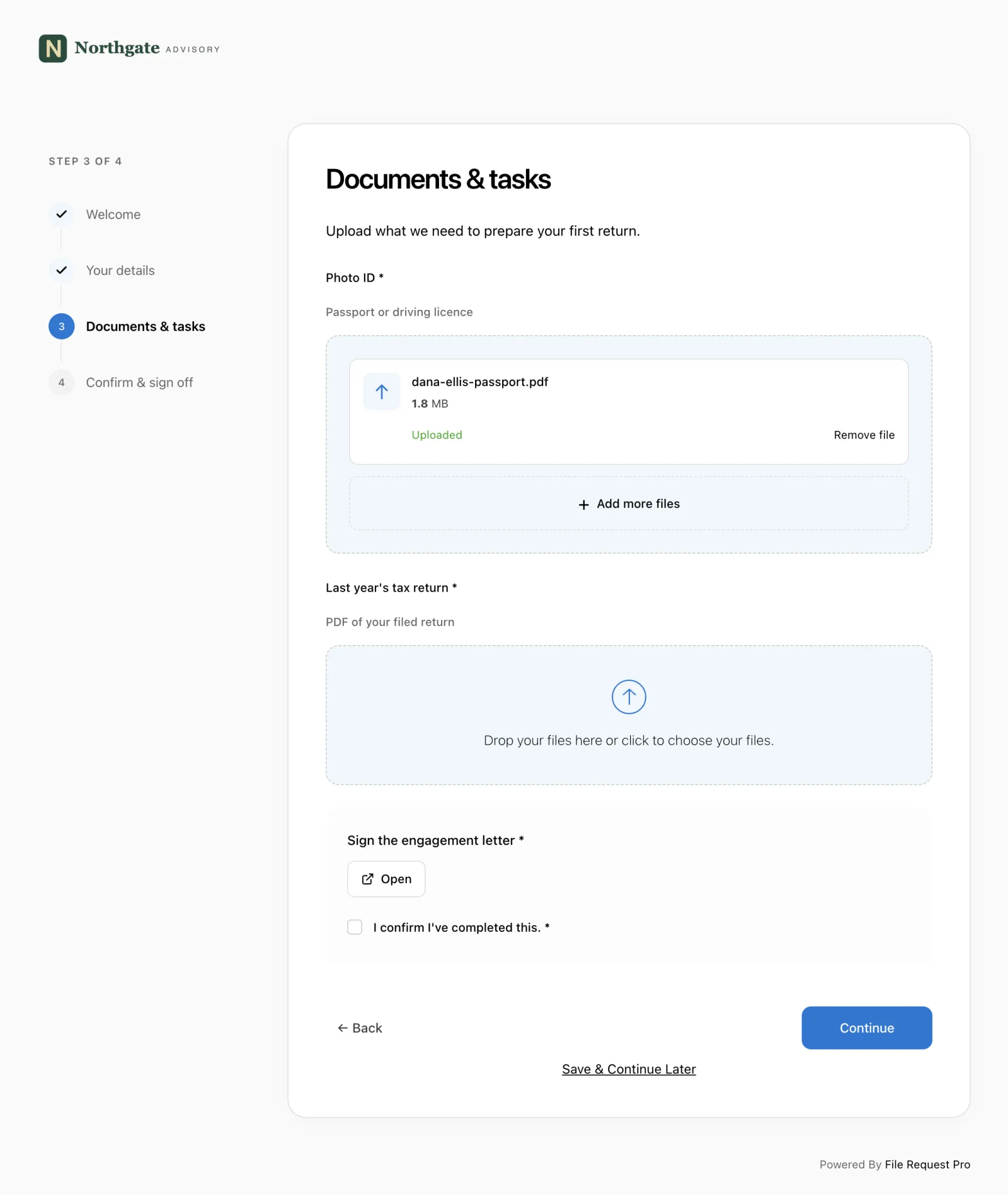
Here's how it works:
- Connect your cloud storage — Link your Google Drive account (shared or individual) in one click. Files your clients upload go straight to Drive, organized automatically. Learn more about letting anyone upload to your Google Drive.
- Build a branded intake form — Add file upload fields, text questions, dropdowns, checkboxes, and date fields. Apply your logo, brand colors, and even use a custom domain like intake.yourfirm.com.
- Add conditional logic — Show or hide questions and entire pages based on client responses, so each person only sees what's relevant to them.
- Set up automated reminders — Schedule a sequence of follow-up emails with deadlines, so you stop chasing clients for missing documents.
- Share and collect — Send a branded link or embed the form on your website. Clients upload without creating an account or signing in.
- Everything lands in your Drive — Files and text responses are organized into folders in Google Drive automatically, labeled by client name or any custom field you choose.
For an intake workflow that combines questions with external uploads, see how to use forms with file upload fields.
Google Forms Intake Form FAQ
Can I use Google Forms for client intake?
Yes. Google Forms handles basic intake — collecting names, contact details, project descriptions, and preferences — well enough. It's free, quick to set up, and responses feed directly into Google Sheets. The limitations surface when you need file uploads from clients without Google accounts, custom branding, automated reminders, or question-level conditional logic.
Is Google Forms HIPAA compliant for patient intake?
Not on its own. Google Workspace Enterprise plans can be configured with a Business Associate Agreement (BAA), but the free version of Google Forms does not meet HIPAA requirements. If you're collecting protected health information, check with your compliance team before using any form builder.
Can clients upload files to a Google Form without signing in?
No. Google Forms requires respondents to sign in with a Google account before uploading files. There's no setting to disable this. If your clients don't have Google accounts — or refuse to sign in — they can't upload. For file collection without sign-in, use a tool like File Request Pro, which handles file uploads without login.
How do I make my Google Form intake form look professional?
You can customize the header image, theme color, background color, and font. But you cannot add a company logo to the form body, use a custom domain, or remove "Google Forms" branding. For a fully branded intake experience, you'll need a dedicated form tool that supports white-label customization.
Can I send reminders for incomplete Google Forms?
No. Google Forms has no built-in reminder feature. You'd need to manually track who hasn't responded (by comparing form responses against your client list) and send follow-up emails one at a time. Some third-party add-ons offer basic automation, but they're limited compared to purpose-built intake tools with automated reminder sequences.
Is there a Google Forms intake form template?
Google's template gallery doesn't include a dedicated intake form template. You'll need to build one from a blank form using the question types and field recommendations in this guide. You can also search Google's public template gallery for community-created forms, though quality and relevance vary widely.
How do I collect data from Google Forms into a spreadsheet?
Open your form, click the Responses tab, and click the green Google Sheets icon. This creates a linked spreadsheet where each submission becomes a new row. The sheet updates automatically with every new response. For more on working with Google Forms data, see our guide on collecting data with Google Forms.
What's the difference between Google Forms and a dedicated intake tool?
Google Forms is a general-purpose form builder. It handles surveys, polls, and basic data collection well. A dedicated intake tool like File Request Pro is purpose-built for client onboarding — it adds file collection without sign-in, automated reminders, branded forms, question-level conditional logic, and automatic file organization in your cloud storage. If your intake process is mostly text fields, Google Forms works. If it involves documents, branding, or follow-ups, use a dedicated tool.
